
Troubleshooting Low Voltage Landscape Lighting: A Professional Diagnostic Checklist

A silent, dark landscape is more than a minor inconvenience; it’s a compromise of your property’s security and a sudden dimming of the architectural beauty you’ve carefully curated. You invested in a premium outdoor environment, so when the lights fail to trigger at dusk, the frustration is immediate. Mastering the art of troubleshooting low voltage landscape lighting doesn’t require an engineering degree, but it does demand a methodical eye for detail. Whether it’s a single flickering fixture or a total system blackout, the solution often lies in understanding the delicate balance between electrical integrity and environmental stressors.
It’s understandable to feel overwhelmed by technical concepts like voltage drop or the hidden complexities of a GFCI reset. You want your safe, illuminated nightscape back without the guesswork. This guide provides a professional diagnostic checklist to help you identify the root cause of any failure. We’ll move from simple power checks to advanced wire fault detection, giving you a clear path to resolution and a plan for long-term preventative maintenance. By following this systematic approach, you can restore the brilliance of your home while protecting your investment for years to come.
Key Takeaways
- Start your diagnostic journey at the power source by checking for moisture-induced GFCI trips. This simple reset often restores the entire system without further intervention.
- Learn how to isolate control devices like timers and photocells to determine if the issue lies within the system’s brain or its electrical heart.
- Master the techniques for troubleshooting low voltage landscape lighting when dealing with severed main lines or underground wire breaks caused by common landscaping activities.
- Distinguish between socket corrosion and LED diode failure to resolve individual fixture flickers or the dimming effect seen at the end of long runs.
- Recognize when a complex fault in pool or fountain lighting requires professional engineering expertise to ensure long-term system integrity and safety.
The Immediate Triage: A Quick-Start Checklist for Total System Outages
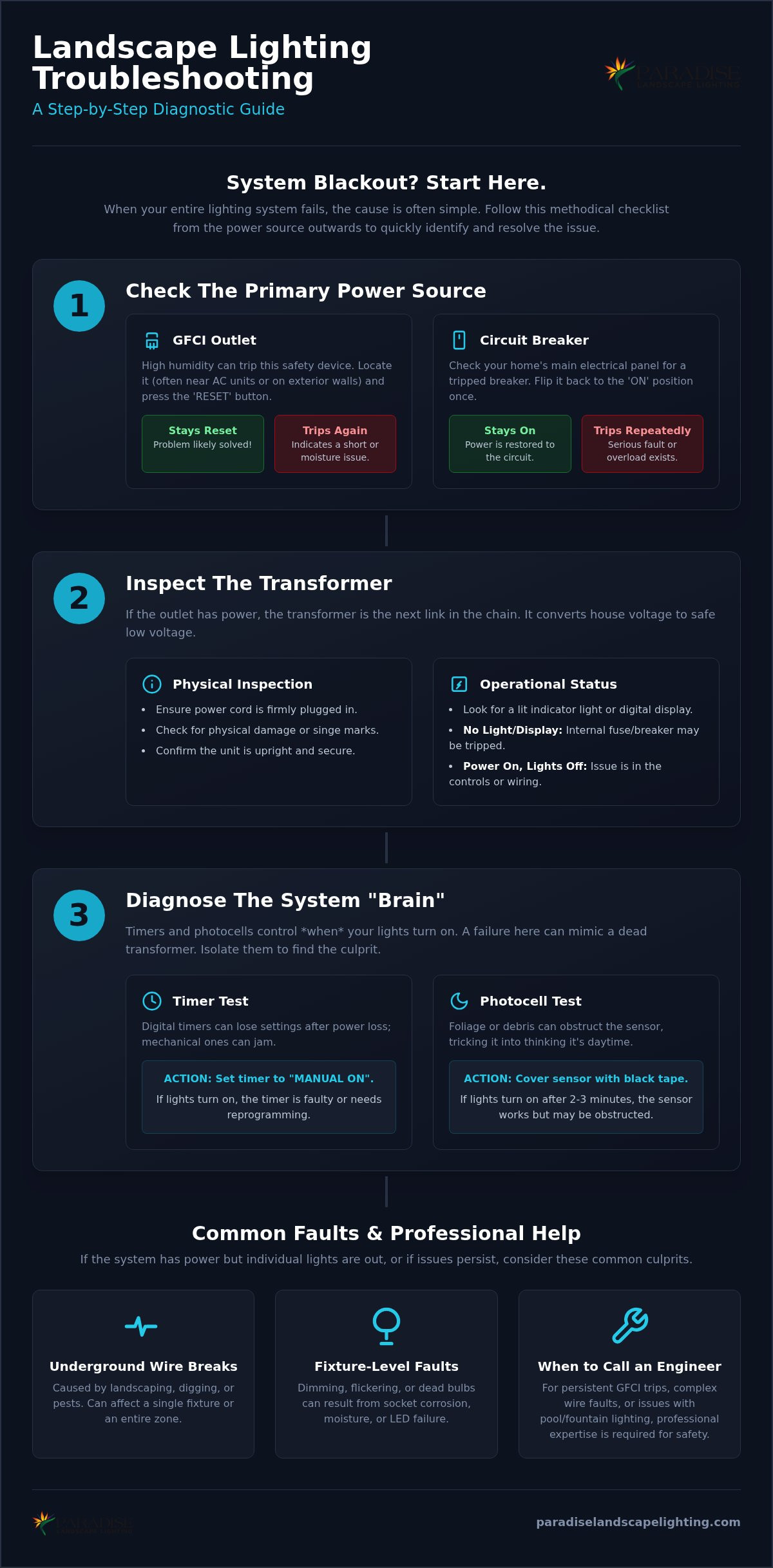
When a complete blackout occurs across your property, don’t panic. High-performance Landscape lighting systems are engineered for durability, but they rely on a stable power chain that can be interrupted by the simplest environmental factors. Effective troubleshooting low voltage landscape lighting begins with a methodical process of elimination. You must start at the primary power source and work outward toward the individual fixtures. This logical progression saves time and prevents the headache of unnecessary digging or fixture disassembly before you’ve confirmed the basics.
The GFCI and Circuit Breaker Audit
South Florida’s unique microclimates present specific challenges for outdoor electrical components. High humidity and heavy seasonal rains often lead to moisture-induced trips in Ground Fault Circuit Interrupter (GFCI) outlets. These safety devices are typically located near pool pumps, AC units, or on exterior walls from Miami to Palm Beach. Locate these outlets and check the reset button. If the button clicks back into place and stays, you’ve likely resolved the issue. If it immediately trips again, it’s a clear signal of a persistent short circuit or significant moisture ingress that requires a professional’s eye.
It’s also vital to differentiate between a local outlet failure and a broader electrical issue. Step inside and check your home’s main electrical panel. A tripped breaker feeding the outdoor circuit will render even the most sophisticated transformer useless. If the breaker has flipped to the “off” or “neutral” position, reset it once. Constant tripping at the main panel suggests the circuit is overloaded or there’s a serious fault in the high-voltage supply line.
Transformer Power Verification
Once you’ve confirmed the outlet is live, shift your focus to the transformer itself. This unit acts as the heart of your system, converting 120V house current into a safe low-voltage output. Start with a physical inspection. Ensure the power cord is firmly seated in the outlet and hasn’t been loosened by garden activity or local wildlife. Check the base of the unit for any signs of singeing or physical damage to the power cord.
Most professional-grade transformers feature an internal display or an indicator light to show operational status. If the screen is blank or the light is dark despite having power at the outlet, the unit’s internal fuse or secondary circuit breaker might have triggered. This often happens after a local power surge. If the transformer displays power but the landscape remains dark, the issue likely resides in the control devices or the underground wiring, which we’ll examine in the following sections of our troubleshooting low voltage landscape lighting checklist.
Diagnosing the Brain: Transformer and Timer Troubleshooting
If your primary power source is verified, the next phase of troubleshooting low voltage landscape lighting involves isolating the system’s control logic. The transformer acts as the heart, but the timer and photocell serve as the brain, dictating exactly when the transformation of your property begins. A failure here often mimics a dead transformer, yet it’s frequently a simple communication error between these components. By bypassing the control devices, you can determine if the transformer itself is functional or if a peripheral sensor has failed.
Mechanical timers are known for their tactile reliability, but they’re prone to physical jams or losing their “on” pins. Digital timers offer more sophisticated scheduling, yet they frequently lose their internal clock after the power fluctuations common in South Florida. If your lights refuse to trigger, try setting the timer to a “permanent on” or “manual” mode. If the system illuminates, your timer is the culprit. For photocells, use the “black tape” method: cover the sensor completely with dark electrical tape to simulate night. Wait two to three minutes; if the lights engage, the sensor is working correctly.
Photocell and Sensor Interference
South Florida’s lush, rapid-growth foliage often creates unexpected obstacles for light sensors. A palm frond or a thickening hedge can easily shade a photocell, tricking the system into activating during a bright Miami afternoon. Conversely, if a sensor is positioned too close to a new LED fixture, it may experience “chatter.” This happens when the sensor detects its own light, turns the system off, and then turns it back on once it’s dark again, creating a frustrating flickering effect. In coastal areas like Fort Lauderdale, salt spray and fine debris can cloud the sensor’s lens. A gentle cleaning with a damp microfiber cloth is often all that’s needed to restore its clarity and precision.
Testing the Secondary Output
When manual overrides fail, it’s time for a more technical assessment using a multimeter. Set your device to measure AC voltage and place the probes on the transformer’s terminal block. You should ideally see a reading between 12V and 15V. If the transformer emits a low hum but the multimeter shows zero output, the internal secondary protection has likely failed. A secondary tap is the connection point for low voltage distribution lines. Testing these taps individually helps you identify if a specific circuit has a short that is causing the transformer to protect itself by shutting down. If your readings are inconsistent or the internal components appear scorched, you may benefit from a professional system audit to ensure your engineering-grade equipment remains at peak performance.
Underground Integrity: Finding Wire Breaks and Connection Faults
Identifying a partial system failure is the hallmark of a severed main line. When one section of your garden remains beautifully illuminated while another sits in total darkness, the electrical path has likely been compromised underground. In the lush environments of South Florida, mulch installation and routine lawn edging are the primary enemies of buried cables. A single misplaced shovel strike or a deep-cutting edger can easily slice through low voltage wiring, creating a break that disrupts the entire downstream run. Effective troubleshooting low voltage landscape lighting requires a strategic approach to find these hidden faults without turning your manicured lawn into a construction site.
Environmental Stressors on South Florida Wiring
The unique geography of our region places extraordinary stress on underground components. In mature neighborhoods like Coral Gables, aggressive root systems from banyans and oaks can slowly crush or pull buried cables as they expand. This physical pressure often leads to intermittent failures that are difficult to pin down. Additionally, our high humidity and proximity to the ocean mean that salt air is constantly working to penetrate substandard connections. Poorly sealed wire nuts allow moisture to seep in, accelerating copper oxidation and turning a once-solid connection into a brittle, non-conductive mess. This is why comprehensive landscape lighting system maintenance must always include a detailed inspection of junction boxes and splices to ensure they remain watertight and corrosion-free.
Locating and Repairing the Fault
To find a break without excavating the entire yard, professionals use the sectionalizing technique. Start by identifying the last functional fixture on the line and the first dark one; the fault almost certainly lies between these two points. During this process, you may encounter “ghost voltage,” where a multimeter shows a reading, but the wire is too damaged to carry a full electrical load. This happens when a cable is partially severed or heavily oxidized but not fully broken. It’s a deceptive state that can lead to flickering or dimming rather than a total blackout.
When you locate the break, a permanent fix requires more than just electrical tape. We recommend using waterproof heat-shrink connectors that create a hermetic seal against the Florida elements. If you discover multiple failed splices or significant wire rot along a single run, it’s often more cost-effective and reliable to replace the entire length of cable. Patching a failing line repeatedly only invites future outages. For homeowners in Broward County dealing with recurring underground faults, professional low voltage landscape lighting repair in Fort Lauderdale can address root causes like salt air corrosion and landscaper damage before they escalate into full system failures. By maintaining the engineering integrity of your underground lines, you ensure the long-term reliability of your outdoor investment.
Fixture-Level Diagnostics: Solving Dimming, Flickering, and Moisture
When the majority of your system performs flawlessly but a single area lacks brilliance, the investigation moves from the “veins” of the system to the fixtures themselves. This stage of troubleshooting low voltage landscape lighting is where the artistry of design meets the precision of engineering. A dark fixture isn’t always a sign of a failed light; it’s often a symptom of environmental interference at the point of illumination. You must determine if the failure is internal to the LED or an external connection issue caused by the unforgiving South Florida elements.
Isolating a single dark fixture starts with an inspection of the socket. In our tropical environment, moisture can easily bypass aging seals, leading to green copper oxidation that blocks the electrical flow. If the socket is clean but the light remains out, the LED diode or its internal driver has likely failed. Flickering, on the other hand, usually points to loose bi-pin connections or an incompatible dimming controller that’s struggling to communicate with the LED’s circuitry. These small technical hurdles can often be cleared with a thorough cleaning and a firm re-seating of the lamp.
LED Performance and Voltage Drop
The “dimming effect” at the end of a long wire run is a classic engineering challenge known as voltage drop. While traditional lights were highly sensitive to this, modern LEDs generally require a steady window between 10V and 15V to operate at peak efficiency. If you measure the voltage at the fixture and find it’s dipping below 10V, the light will appear weak or fail to engage entirely. Many homeowners find that upgrading halogen landscape lights to LED instantly resolves these issues because LEDs draw significantly less current, allowing more electrical “pressure” to reach the end of the line. However, even the best LEDs can struggle during high-heat Florida summers, where internal drivers may fail if the fixture’s heat sink is clogged with garden debris.
Moisture and Seal Integrity
Fixtures integrated into water feature lighting design Miami properties face the most extreme conditions. Condensation inside a lens isn’t just an aesthetic problem; it’s a precursor to total failure. Water disrupts the clarity of the beam and can eventually short the internal components. We recommend a seasonal audit of all gaskets and seals. Cleaning the glass and re-seating the gaskets ensures a watertight fit, while a small application of dielectric grease to the socket pins provides an invisible barrier against the humidity. If your fixtures are showing signs of moisture ingress or inconsistent performance, contact our team for a professional maintenance audit to protect your nighttime investment.
Professional Maintenance: When Troubleshooting Requires an Engineer
While the initial steps of troubleshooting low voltage landscape lighting can resolve many common issues, high-end bespoke systems often reach a level of complexity where DIY efforts fall short. Specialized diagnostic equipment, such as underground cable fault locators and calibrated multimeters, are essential for pinpointing deep-seated faults without disturbing your property’s aesthetic. For owners of expansive estates in communities like Weston or Southwest Ranches, the electrical architecture is often so intricate that a simple repair can inadvertently throw the entire system out of balance. A professional audit serves as a bridge between mere repair and the long-term preservation of your outdoor investment.
The Engineering Advantage in Troubleshooting
A landscape lighting engineer approaches a failure not just as a broken component, but as a symptom of a larger load imbalance. While a handyman might simply replace a bulb or patch a wire, an engineered solution involves precise load calculations to ensure that every fixture receives the exact voltage required for longevity and color consistency. This is particularly crucial when your garden matures or you add new architectural features. As foliage grows and shadows shift, your system may need re-balancing to maintain its original design intent. This meticulous attention to detail ensures that your lighting remains a reliable art form rather than a recurring technical frustration. For estate owners seeking a system built from the ground up with this level of precision, exploring outdoor lighting design Boca Raton specialists who prioritize bespoke artistry over generic installations can make all the difference in long-term performance.
Comprehensive Maintenance Checklists
Transitioning from reactive troubleshooting to a proactive maintenance schedule is the hallmark of sophisticated property management. We recommend biannual inspections that go far beyond a visual sweep. This includes a methodical review of the system’s integrity against the South Florida climate. A professional maintenance visit typically covers:
- Trimming rapid-growth foliage to clear light paths and prevent sensor interference.
- Deep cleaning lenses to remove salt residue and mineral deposits from irrigation.
- Re-aiming fixtures to account for plant growth and seasonal shifts in the landscape.
- Testing the transformer’s total amperage load to prevent future circuit overloads.
- Updating smart-timer firmware to ensure seamless integration with home automation systems.
Reactive repairs are stressful and often occur at the most inconvenient times. By investing in a structured diagnostic plan, you identify potential failures before they result in a dark landscape. This proactive stance protects your nighttime security and preserves the visual impact of your home’s exterior. If you’ve reached the limit of your diagnostic checklist or simply want the peace of mind that comes with expert oversight, Contact Paradise Landscape Lighting for a professional system diagnostic and maintenance plan tailored to your property’s unique engineering needs.
Restoring the Brilliance of Your Nightscape
Mastering the art of troubleshooting low voltage landscape lighting is a journey from simple power resets to understanding the engineering integrity of your property. You’ve learned how to audit your power source, isolate control devices, and identify the hidden wire breaks caused by our aggressive tropical environment. While these diagnostic steps empower you to handle minor outages, complex electrical faults or system imbalances often require a more technical touch to prevent long-term damage.
When the solution requires more than a quick fix, our team brings over a decade of experience in South Florida nightscapes to your doorstep. We utilize an on-staff lighting engineer and specialized fault-location technology to resolve even the most elusive failures in pool and fountain lighting. Don’t let a dark landscape compromise your security or the beauty of your home. You can Book a Professional System Diagnostic with Paradise Landscape Lighting today to ensure your system remains as resilient as it is radiant. Your property deserves the precision of an engineered solution that stands the test of time.
Frequently Asked Questions
Why is only half of my landscape lighting system working?
This localized blackout usually indicates a severed main line or a failed connection point between the functional and dark sections. In our region, this often occurs after aggressive lawn edging or mulch installation. You should check the junction between the last working light and the first dark one. It could also be a tripped secondary circuit breaker on the transformer if your system was designed with multiple zones.
How do I find a buried wire break without a professional locator?
You can utilize the sectionalizing method by testing the voltage at various points along the run. Start at the midpoint of the dark section and check for power. If there’s no power, the break is between that point and the transformer. If power is present, the break is further down the line. This process of elimination helps you narrow the search area without extensive digging.
Can I replace my old halogen bulbs with LEDs to fix flickering?
Swapping bulbs won’t always fix flickering if the underlying issue is a loose connection or an incompatible transformer. Flickering often stems from voltage fluctuations or poor contact in the socket. When troubleshooting low voltage landscape lighting, ensure your transformer is LED-compatible and that all sockets are treated with dielectric grease. This prevents the oxidation that causes intermittent power loss in our humid climate.
What causes a landscape lighting transformer to keep tripping the GFCI?
Moisture ingress is the most common culprit for recurring GFCI trips in South Florida. Water inside an outlet, a leaky transformer housing, or a short circuit in a buried wire can trigger this safety feature. If the trip occurs immediately upon reset, there’s likely a direct short. If it happens during rain, you should inspect the seals on your outdoor outlets and transformer enclosure for gaps.
Is it safe to troubleshoot my low voltage lighting in wet grass?
It’s generally safe because low voltage systems operate at 12V to 15V, which doesn’t carry the same shock risk as high-voltage household current. However, you should never handle the 120V primary side of the transformer or the GFCI outlet while standing in water. Always keep the transformer’s main power cord dry and avoid opening the unit’s internal housing during a rainstorm to protect the electronics.
How often should I have my outdoor lighting system professionally maintained?
We recommend a comprehensive professional maintenance audit at least twice a year to combat South Florida’s rapid plant growth and salt air. These biannual visits allow an engineer to re-balance voltage loads, clean lenses clouded by irrigation minerals, and re-aim fixtures. Regular checkups prevent minor issues from turning into expensive failures, ensuring your nightscape remains both secure and aesthetically perfect throughout the seasons.
Why do my LED landscape lights look dimmer than when they were installed?
Dimming in LED systems is often caused by voltage drop or a buildup of debris on the fixture’s lens. Over time, mineral deposits from hard water can create a film that reduces light output. If your system has been expanded, the transformer may be reaching its capacity. Effective troubleshooting low voltage landscape lighting involves cleaning the glass and verifying that the voltage at the fixture remains above 10V.
What should I do if my fountain lights are filling with water?
You must disconnect the power immediately to prevent the internal electronics from shorting out. Fountain and pool deck lights rely on specialized gaskets and seals that can degrade over time due to chlorine or heat. Once the power is off, remove the fixture, dry it completely, and replace the seals. If the housing itself is cracked, a full fixture replacement is necessary to maintain the engineering integrity of your fountain.
Return to News