
Illuminating Paradise: The Ultimate Guide to Landscape Lighting for Pools and Fountains in 2026
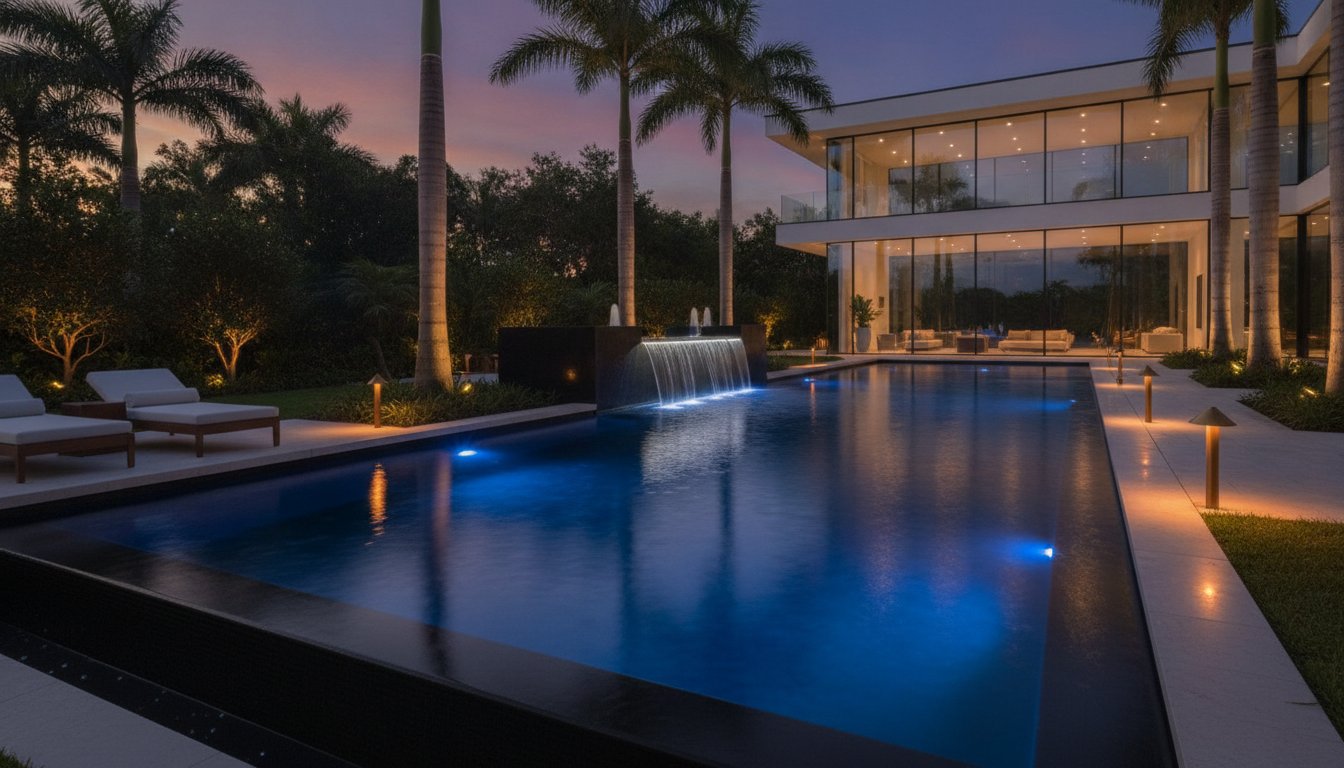
Luxury water lighting is an engineering challenge solved through artistic refraction, not just adding more bulbs. You have likely felt the frustration of a beautiful pool area being ruined by harsh, glaring spotlights or the constant battle against salt air corrosion that eats away at standard fixtures. It is exhausting to maintain a system that feels more like a utility than an upgrade. We understand that your outdoor space should be a sanctuary, not a source of maintenance headaches.
This guide shows you how professional water feature lighting design Miami transforms your backyard into a mesmerizing nighttime masterpiece while ensuring safety and peak energy efficiency. You’ll discover how to achieve that resort-style “wow” factor using low-voltage LED systems that withstand the unique South Florida climate. We will explore the latest 2026 standards, including sea turtle-friendly amber LEDs and the enduring elegance of living finishes like brass and copper that patina beautifully over time. From meeting the Florida Building Code’s illumination requirements to integrating smart, app-controlled automation, you’re about to learn how to build a sophisticated nightscape that lasts.
Key Takeaways
- Master the strategic use of light to enhance motion and depth, creating a high-end aesthetic that adds tangible value to your estate.
- Understand how to manipulate light refraction in moving water to create ‘the invisible source’ effect, where you see the glow but never the fixture.
- Learn the engineering standards behind safe, sustainable systems, including the necessity of low-voltage circuits and high-grade submersible components.
- Define your project’s scope by identifying your primary goals for water feature lighting design Miami, whether you’re highlighting a small garden fountain or an expansive infinity-edge pool.
- Discover how the synergy between an in-house lighting designer and an engineer produces a bespoke system that balances artistry with technical precision.
Why Specialized Landscape Lighting for Pools and Fountains is a Luxury Necessity
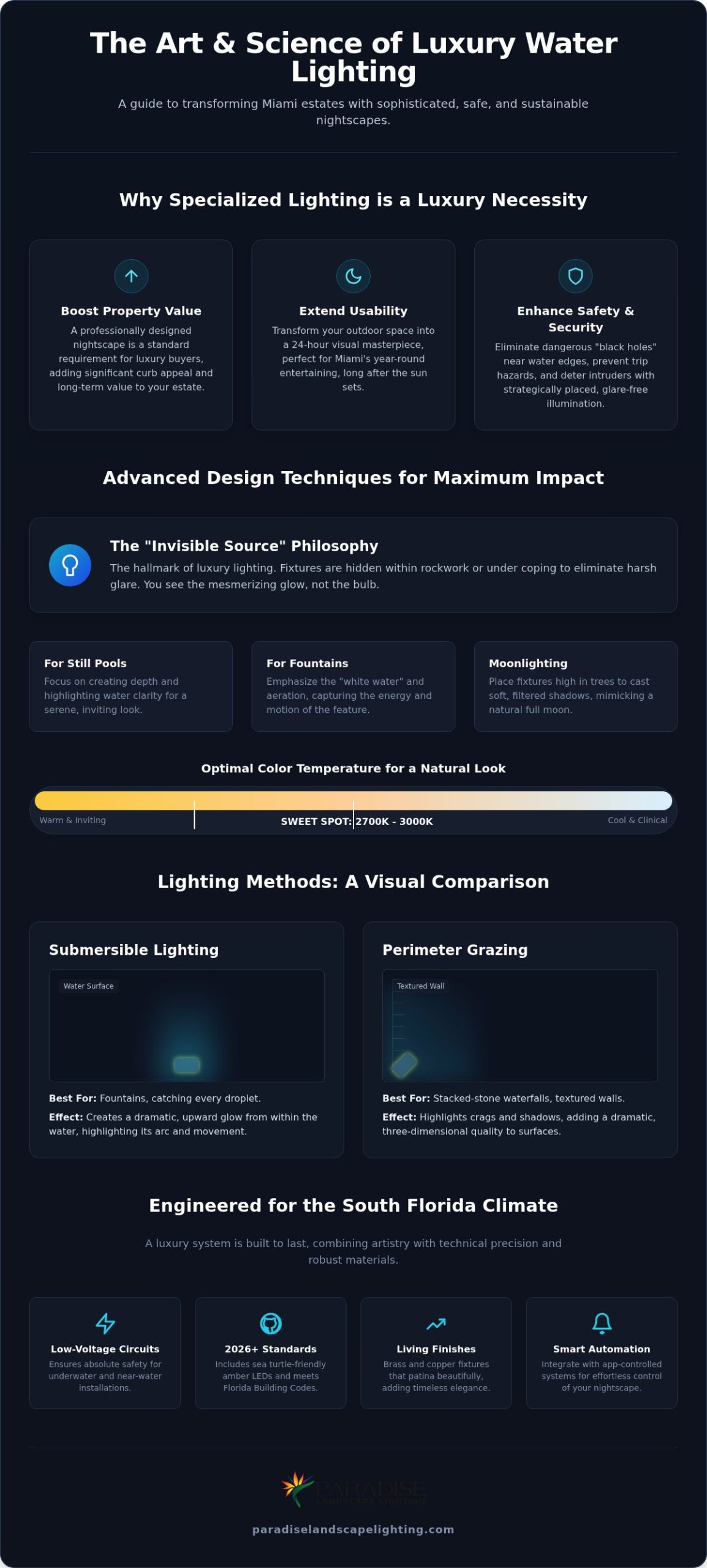
True water feature lighting is far more than the simple installation of underwater bulbs; it is the strategic application of light to accentuate motion, depth, and reflection. When executed correctly, it transforms a dark backyard into a sophisticated sanctuary. To appreciate the complexity of these projects, it helps to consider What is a Water Feature? beyond its basic definition. It is a focal point that requires specialized water feature lighting design Miami experts to navigate the interplay between light and liquid. This approach creates a resort-style aesthetic that has become a hallmark of high-end South Florida living, significantly increasing the desirability of a residence.
Extending the usability of your outdoor space into the evening hours is perhaps the most immediate benefit. In Miami, where the climate encourages year-round outdoor entertaining, a professionally lit pool or fountain ensures the party doesn’t have to move indoors once the sun sets. It turns a daytime amenity into a 24-hour visual masterpiece that defines the character of the home.
Enhancing Safety and Security Around Water Features
Safety remains a paramount concern for any property owner with a pool or fountain. Dark spots near the water’s edge often hide trip hazards or slippery surfaces, creating significant liability risks. Professional water feature lighting design Miami addresses these “black holes” by utilizing subtle path lighting and recessed deck lights. These fixtures provide enough illumination to prevent slips without creating the blinding glare associated with cheaper, high-voltage floodlights. For waterfront estates, a well-lit perimeter also serves as a powerful deterrent, providing clear visibility that enhances the overall security of the home.
The ROI of Professional Pool Area Lighting Design
The financial logic behind professional lighting is clear. Luxury buyers in the Miami market view a professionally designed nightscape as a standard requirement rather than an optional upgrade. Custom lighting provides an immediate boost to curb appeal, making the property stand out during evening showings. While DIY solar kits often fail within months due to salt air and humidity, a bespoke LED system offers long-term reliability. These engineered systems use salt-air resistant hardware and low-voltage technology to ensure the investment lasts for decades. The result is a high-performance installation that preserves the property’s value while minimizing maintenance costs, a combination that savvy homeowners and investors prioritize above all else.
Advanced Design Techniques: How to Light Water for Maximum Visual Impact
The hallmark of luxury water feature lighting design Miami is the “invisible source” philosophy. We believe you should see the glow, not the bulb. By hiding fixtures within rockwork or under coping, we eliminate the harsh glare that often plagues amateur installations. This creates a seamless transition between the water and the surrounding landscape, allowing the natural beauty of the feature to take center stage. It’s a method that prioritizes the experience of the space over the equipment itself. This same principle applies to enclosed pool environments, where pool cage lighting Palm Beach specialists use the invisible source approach to maintain architectural beauty while delivering a resort-style starry night effect.
Light behaves differently depending on the state of the water. For still pools, we focus on depth and clarity. For fountains, we emphasize the white water and aeration. Choosing the right color temperature is critical; typically, a warm 2700K to 3000K range keeps water looking natural and inviting rather than clinical. For expansive estates, we often employ “Moonlighting” by placing fixtures high in the canopy of nearby palms. This casts soft, filtered shadows across the pool deck, mimicking the natural glow of a full moon and providing a gentle wash of light over the entire area.
Submersible Lighting vs. Perimeter Grazing
Submersible lighting is the gold standard for fountains. It provides a dramatic upward effect that follows the arc of the water, catching every droplet. In contrast, perimeter grazing involves placing lights close to a textured surface, such as a stacked-stone waterfall. This technique highlights the crags and shadows of the stone, adding a three-dimensional quality to the feature. While underwater lights provide a deep internal glow, surface-aimed fixtures create the “sparkle” that catches the eye. Adhering to strict Pool Lighting Safety Codes ensures these high-impact designs remain safe for swimmers while maintaining peak performance.
The Role of Motion, Shadow, and Refraction
Moving water acts as a natural lens. When light hits a ripple, it creates “dancing” patterns on adjacent walls or ceilings, often referred to as caustic light. For those with still infinity-edge pools, we aim for the “Mirror Effect.” By lighting the landscape behind the water rather than the water itself, the pool becomes a perfect reflective surface. Refraction is the change in direction and velocity of light as it passes from air into water, causing the beam to bend and illuminate the volume of the pool rather than just the surface. Achieving these complex visual layers requires a deep understanding of both optics and fluid dynamics. If you are ready to elevate your property, exploring bespoke water feature lighting design Miami solutions is the first step toward a true nighttime transformation.
The Engineering Behind Safe and Sustainable Water Feature Illumination
The visual artistry of water feature lighting design Miami homeowners desire rests entirely on a foundation of rigorous electrical engineering. While the design provides the aesthetic appeal, the engineering ensures the system remains safe, functional, and efficient in South Florida’s demanding environment. We prioritize low-voltage (12V/15V) systems for all aquatic installations. These systems are inherently safer in wet environments compared to high-voltage alternatives, significantly reducing the risk of electrical shock. Beyond safety, professional engineering prevents “voltage drop,” a common issue in large Miami estates where lights further from the transformer appear dimmer. By calculating wire gauges and transformer loads with precision, we ensure every fixture shines with consistent intensity across the entire property.
Submersible fixtures require a strict IP68 rating. This means they are completely dust-tight and engineered for continuous immersion in water. These fixtures must withstand the physical pressure of deep pool placements and the chemical reality of treated water. To understand how these technical choices influence the final visual result, you can explore Advanced Lighting Design Techniques used by industry leaders. This technical standard is what separates a temporary “glow” from a permanent nighttime masterpiece.
Low Voltage LED vs. Outdated Halogen Systems
The transition from halogen to LED represents a significant leap in both sustainability and performance. LEDs use up to 80% less power than traditional halogen bulbs, providing substantial energy savings for expansive nightscapes. Heat output is another critical factor often overlooked. Halogen bulbs run extremely hot, which can damage delicate pool liners or cause rapid mineral scaling on the fixture lens. LEDs remain cool to the touch, preserving the integrity of your water feature’s surfaces. The maintenance cycle is also transformed. While halogen bulbs require frequent replacement, high-quality LEDs are designed to last for years, which eliminates the frustration of constant bulb changes in hard-to-reach underwater locations. If your existing system relies on outdated halogen technology, an LED landscape lighting retrofit Broward County homeowners trust demonstrates how dramatically a modern upgrade can transform energy efficiency and visual quality across an entire property.
Salt Air and Chemical Resistance in South Florida
Miami’s coastal environment is notoriously corrosive. Salt air and pool chemicals like chlorine or salt-water systems quickly destroy inferior materials. This is why we insist on using brass and copper hardware for every water feature lighting design Miami project. Unlike aluminum, which pits and corrodes when exposed to salt spray, brass and copper develop a natural, protective patina that actually enhances their durability over time. A comprehensive approach to your property’s nightscape should also consider how residential architectural lighting Miami specialists apply the same salt-air resistant materials and engineering principles to your home’s facade, ensuring a cohesive and durable design from the water’s edge to the roofline. To keep your system looking pristine, we recommend a simple maintenance routine:
- Periodically wipe down lenses to prevent calcium and mineral buildup from hard water.
- Clear away organic debris around submersible fixtures to ensure proper heat dissipation.
- Inspect seals during seasonal check-ups to maintain the IP68 waterproof integrity.
This proactive engineering approach ensures your investment remains a source of beauty rather than a maintenance burden.
Planning Your Nightscape: A Buying Guide for Miami Homeowners
Successful planning begins with a clear understanding of your primary objectives. Before selecting a single fixture, you should decide if your goal is subtle ambiance, essential safety, or high-drama focal point aesthetics. In the context of water feature lighting design Miami, these goals often overlap, but prioritizing one helps guide the engineering and hardware choices. A serene garden fountain requires a different intensity than a sprawling infinity-edge pool designed for large-scale entertaining. Identifying these needs early ensures the final result aligns perfectly with your lifestyle.
Assessing the scale of your project is the next critical step. Small garden fountains might only require a few well-placed spotlights, but expansive water features demand a more complex engineering approach. Budgeting for a professional system involves more than just the cost of the bulbs. It includes the design expertise to hide those fixtures, the engineering to prevent voltage drop, and the investment in high-quality, salt-air resistant hardware. A well-planned budget prioritizes long-term performance over low-cost, temporary solutions that often fail in the humid Florida climate. It’s about building a system that doesn’t just look good on opening night but remains reliable for years. For pool enclosures specifically, a professional pool cage lighting Palm Beach installation requires the same commitment to engineered, bespoke solutions that prevent exposed wiring degradation in the humid, salty environment.
Choosing the Right Fixtures for Fountains and Waterfalls
The type of water movement dictates the fixture choice. For waterfalls, bullet-mount spotlights are the preferred tool for “grazing” stone textures and catching the white water as it breaks. Central fountain plumes often benefit from donut lights. These specialized fixtures sit at the base of the plume and encircle the water stream, illuminating it from the inside out for a glowing, vertical effect. In deeper basins where mounting to the floor isn’t ideal, weighted submersible lights provide a stable, non-invasive way to add depth and volume to the water without permanent structural changes. For a comprehensive look at how these techniques come together in practice, our underwater lighting for fountains installation guide walks through every step from fixture selection to final placement.
Color-Changing LEDs and Smart Controls
Modern water feature lighting design Miami often includes the versatility of RGBW color-changing LEDs. While a static, warm white (2700K) remains the standard for a classic, sophisticated look, color-capable systems allow you to adapt the mood instantly. You can set specific “scenes” for different occasions, such as a soft “Intimate Dinner” glow or a vibrant “Pool Party” palette. These systems integrate seamlessly with existing smart home platforms, allowing you to manage schedules and dimming levels directly from a smartphone app. This level of control ensures your outdoor space is always ready for the moment. If you’re ready to see how these technologies can enhance your estate, contact our design team to begin your bespoke project.
Transforming Your Miami Estate with Paradise Landscape Lighting
Paradise Landscape Lighting approaches every property as a canvas where artistry and technical precision converge. We reject the concept of cookie-cutter lighting kits, opting instead for a bespoke philosophy that prioritizes your specific architectural vision. Our reach extends across South Florida, offering Bespoke Outdoor LED Lighting Design in Fort Lauderdale and continuing down the coast to the most prestigious neighborhoods of Miami Beach. By integrating high-performance technology with an eye for detail, we provide a water feature lighting design Miami homeowners can rely on for both beauty and longevity. It’s about creating a system that reflects your personal style while standing up to the harsh coastal elements.
Our commitment to excellence doesn’t end with the installation. We understand that the salt air and tropical climate of South Florida require a proactive approach to system health. By focusing on high-grade materials and engineered low-voltage solutions, we ensure that your investment remains a source of pride rather than a maintenance burden. When you understand the nuances of water feature lighting design Miami, you ensure your estate remains a beacon of luxury long after the sun has set.
Our Bespoke Design and Engineering Process
Our methodology is built on the partnership between our in-house lighting designers and engineers. We begin with a comprehensive nighttime consultation, a step that allows us to map the unique shadows and reflections of your water features in real time. This vision mapping ensures that the final installation matches your expectations perfectly. On the technical side, our engineers perform meticulous calculations to ensure zero voltage drop across your estate. We utilize the same “hidden fixture” installation techniques that define our work in Boca Raton luxury estates. This ensures that the hardware remains invisible, leaving only the mesmerizing glow of the water to be seen.
Retrofitting and Upgrading Existing Systems
Many estates already have lighting systems that have fallen into disrepair. Salt air and humidity often cause older, high-voltage halogen systems to flicker or fail entirely. We specialize in auditing these existing installations to determine if the underlying infrastructure is safe for an upgrade. Our team can transform an outdated, inefficient system into a modern LED masterpiece that uses a fraction of the energy while providing superior light quality. This process involves more than just swapping bulbs; it is a complete technical overhaul that ensures safety and efficiency for the long term. We focus on restoring the “wow” factor to your pool or fountain while drastically reducing your future maintenance requirements.
Elevate Your Estate with a Masterful Nightscape
The transformation of your outdoor space into a resort-style sanctuary relies on the careful balance of light refraction and technical durability. We’ve discussed how the “invisible source” philosophy and precise engineering eliminate harsh glare while ensuring your property meets modern safety standards. In our unique coastal environment, utilizing salt-air resistant hardware and energy-efficient LED technology is essential for a system that lasts. These technical choices preserve the beauty of your investment against the relentless South Florida humidity.
Our in-house lighting engineers bring this specialized expertise to every water feature lighting design Miami project we undertake. Whether you own a modern estate in Miami Beach or a historic home in Coral Gables, we provide the bespoke solutions required for high-performance results. We take pride in managing the intricate details of voltage loads and fixture placement so you don’t have to worry about the technicalities. It is this commitment to craftsmanship that defines a true luxury nightscape.
It’s time to reclaim your evenings and see your property in a new light. Request a Bespoke Lighting Design Consultation to begin your journey toward a mesmerizing nighttime masterpiece. We look forward to bringing your vision to life with professional integrity and creative flair.
Frequently Asked Questions
Is it safe to install electric lights inside a swimming pool or fountain?
Yes, it is completely safe when using low-voltage LED systems and proper grounding. The Florida Building Code and NEC Article 680 mandate the use of transformers to step down power to a maximum of 15 volts for underwater luminaires. This low voltage, combined with mandatory Ground-Fault Circuit Interrupter (GFCI) protection, ensures that even if a seal fails, there is no risk of high-voltage shock to swimmers.
What is the best color temperature for lighting a pool at night?
A warm white color temperature between 2700K and 3000K is ideal for creating a natural, inviting glow. This range enhances the clarity of the water without making it look clinical or artificially blue. For those seeking more versatility in their water feature lighting design Miami, we often install RGBW fixtures. These allow you to switch from sophisticated warm white to vibrant colors for social gatherings via a smartphone app.
How do I prevent my fountain lights from getting covered in algae or calcium?
Preventing buildup starts with choosing LED fixtures that run cool to the touch. Traditional halogen bulbs generate high heat that bakes minerals onto the lens, whereas LEDs significantly reduce this scaling effect. We recommend a seasonal maintenance routine where you wipe the lenses with a soft cloth and a mild acidic solution to remove calcium. Keeping your water chemistry balanced also plays a vital role in protecting your hardware.
Can I control my pool and fountain lighting from my phone?
You can absolutely manage your entire nightscape through integrated smart home apps. Modern transformers now feature Wi-Fi or Bluetooth connectivity, allowing you to dim lights, change colors, and set automated schedules from your phone. This technology makes it simple to transition between security and entertainment modes with a single tap. It’s a standard feature in high-end water feature lighting design Miami projects today.
Do I need to empty my pool to install new underwater lighting?
In most cases, you don’t need to drain your pool to upgrade or install new lighting. Many modern underwater LEDs are designed to fit into existing niches or can be installed as weighted, submersible units for fountains. If we are performing a retrofit of an older system, our technicians can usually handle the installation while the pool remains full. Only new construction or major structural modifications typically require a dry pool.
How long do LED water feature lights typically last in Florida’s climate?
High-quality LED fixtures are engineered to last between 30,000 and 50,000 hours. In the intense South Florida climate, the actual lifespan depends heavily on the quality of the housing and heat dissipation. While the salt air and humidity are aggressive, professional-grade brass and copper fixtures protect the internal electronics for years. This longevity is a massive improvement over old halogen bulbs that required annual replacements.
Will salt-water pool systems damage my lighting fixtures?
Salt-water systems are highly corrosive to inferior metals like aluminum or thin stainless steel. To ensure your lighting survives, you must use fixtures made from heavy-gauge cast brass or copper. These materials are naturally resistant to the chemical reactions caused by salt-water pool systems. They develop a protective patina over time, ensuring the structural integrity and aesthetic of the light remain intact despite the constant chemical exposure.
What is the difference between IP67 and IP68 lighting ratings?
The primary difference is the duration and depth of water exposure the fixture can handle. An IP67 rating means a light is protected against temporary immersion in water up to one meter deep. However, for pool and fountain applications, you must use IP68-rated fixtures. These are specifically engineered for continuous immersion under pressure, ensuring the internal seals remain watertight even when submerged at the bottom of a deep pool for years.
Return to News