
Mastering Underwater Fountain Lighting: Installation Guide
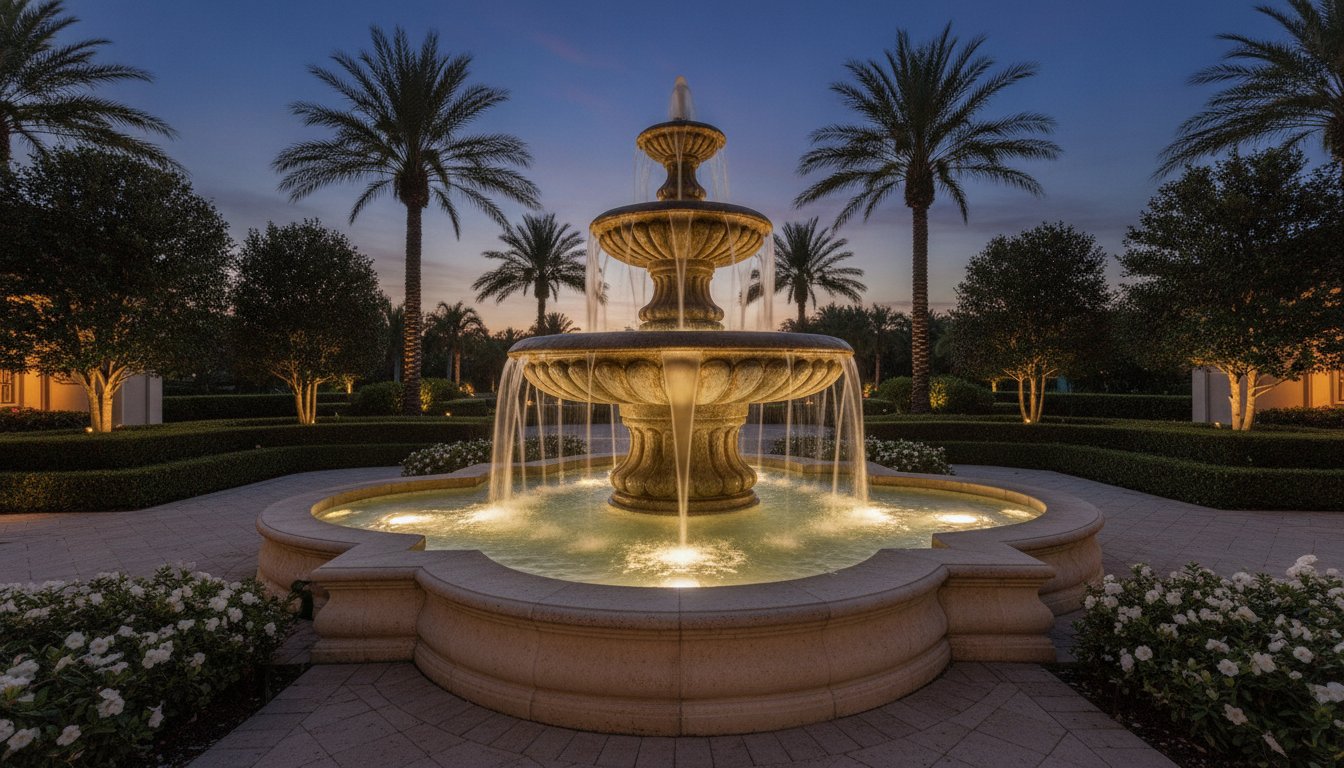
A fountain shouldn’t disappear when the sun goes down; it should transform into the most captivating focal point of your estate. While many view a water feature as a daytime luxury, the strategic use of underwater lighting for fountains turns a simple stone structure into a luminous nighttime masterpiece. You likely recognize that mixing electricity with water is a high-stakes endeavor. It’s natural to feel concerned about fixtures failing due to South Florida’s corrosive environment or the frustration of a light that creates a harsh glare rather than a soft, inviting glow.
We understand these challenges because we approach every installation as both visionary artists and meticulous technicians. This guide promises to bridge the gap between technical safety and high-end design, showing you how to achieve a resort-style atmosphere that lasts for years. We will explore the latest NEC 2026 safety standards, the importance of IP68-rated LED systems, and the precise engineering required to ensure your investment remains both beautiful and secure. You’ll gain a clear understanding of how to select and place fixtures that emphasize movement and depth without compromising on professional-grade reliability.
Key Takeaways
- Elevate your estate’s ambiance by transforming standard water features into dramatic nighttime focal points through the intentional application of light and movement.
- Understand why IP68-rated fixtures and low-voltage systems are the non-negotiable engineering standards for safe, professional-grade underwater lighting for fountains.
- Identify the most effective fixture configurations for your basin, including the use of specialized ring lights to accentuate vertical jets and architectural niche mounts.
- Master the professional installation sequence to ensure a leak-proof basin entry and long-term circuit integrity for a reliable, resort-style finish.
- Discover proactive maintenance strategies to protect your investment from South Florida’s environmental stressors, such as calcium scaling and chemical corrosion.
The Art of Submersible Brilliance: Why Fountain Lighting Matters
A fountain serves as a majestic anchor for any estate during the daylight hours, but without thoughtful illumination, it becomes a dark void once night falls. Transforming this daytime focal point into a nighttime centerpiece requires a deep understanding of how light interacts with fluid motion. There’s a profound psychological impact when we witness the interplay of moving water and light; it evokes a sense of tranquility and security that static elements simply cannot replicate. By implementing professional underwater lighting for fountains, you aren’t just adding visibility. You’re creating an immersive experience that increases property value and enhances the safety of garden pathways and basins.
The sound of a fountain is naturally therapeutic, but the visual element of glowing water adds a layer of sophistication that calms the mind. It provides a sense of order and intentionality to the property. When a guest walks through your garden, the illuminated fountain acts as a beacon, guiding them through the space with elegance. It’s about more than just seeing the water; it’s about feeling the energy of the landscape. This transformation is what separates a standard yard from a curated estate.
Creating the ‘Luminous Flow’ Effect
Light behaves differently depending on the water’s surface. A vertical jet requires a concentrated beam to travel up the stream, while a bubbling basin benefits from a soft, internal glow that radiates from the depths. This luminous flow effect relies on the precise placement of fixtures to emphasize the texture of hand-carved stone or intricate tile work. When we apply advanced landscape lighting techniques, we focus on the invisible source philosophy. This ensures the eye sees the beauty of the light, not the hardware of the fixture. By hiding the source, the water appears to glow from within, creating a magical, ethereal quality that captivates anyone nearby.
The Luxury Standard in South Florida Estates
In the prestigious neighborhoods of Miami and Fort Lauderdale, homeowners view their outdoor spaces as extensions of their living rooms. Achieving a true resort-style feel at home demands more than just a few spotlights. It requires integrating fountain lights with broader bespoke outdoor lighting designs that unify the entire landscape. Professional underwater lighting for fountains is the final touch that bridges the gap between a standard garden and a world-class sanctuary.
- Architectural Cohesion: Ensuring the fountain’s glow complements the home’s facade and existing garden highlights.
- Safety and Depth: Illuminating the water’s edge to prevent accidents while adding visual layers to the property.
- Atmospheric Precision: Using specific color temperatures to match the estate’s aesthetic, from cool modern whites to warm, traditional ambers.
We approach every project as a blend of the visionary artist and the meticulous technician. This ensures your water feature isn’t just lit, but engineered for long-term performance and visual impact. To complete the full nightscape picture, pairing your fountain lighting with tree uplighting Miami specialists can dramatically elevate the surrounding tropical canopy and create a cohesive, resort-style environment across your entire estate.
Engineering for Depths: Underwater LED Requirements
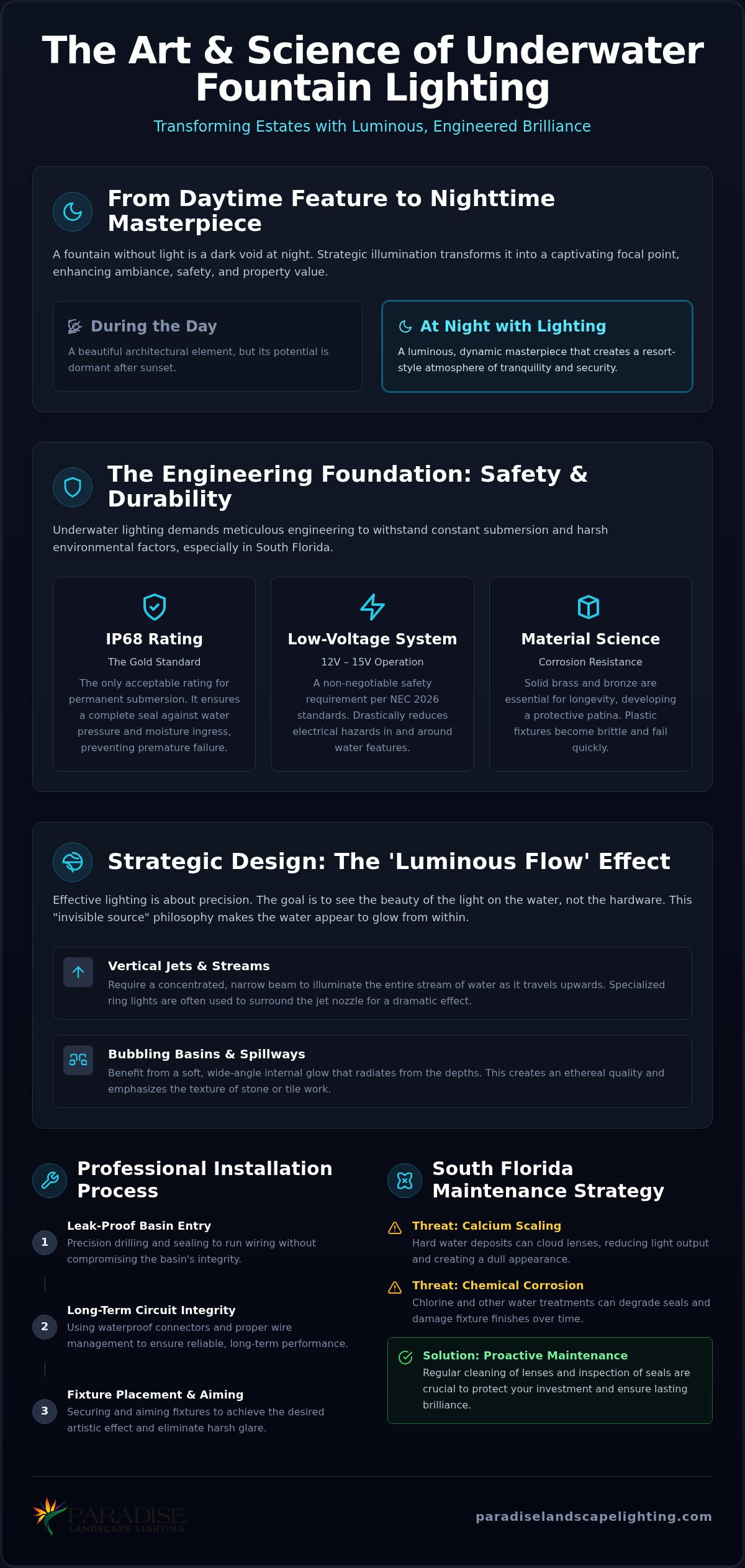
Engineering underwater lighting for fountains isn’t just about aesthetics; it’s a matter of technical survival in South Florida’s demanding climate. The combination of high humidity, salt air, and constant submersion requires a level of precision that standard outdoor fixtures can’t provide. To ensure longevity and safety, we adhere to the IP68 rating, which is the absolute gold standard for equipment designed for permanent submersion beyond one meter. While IP67 fixtures might survive a temporary splash, only IP68-rated components can withstand the relentless pressure and moisture of a fountain basin without failing.
Safety remains our primary directive. Low-voltage systems, typically operating between 12V and 15V, are non-negotiable for water-based installations. This standard aligns with the Florida Building Code and NEC 2026 requirements, significantly reducing the risk of electrical hazards. Beyond safety, material science plays a vital role in performance. In our local environment, plastic fixtures often become brittle or warp, while solid brass and bronze fixtures develop a protective patina that resists corrosion. These dense metals also aid in thermal management, effectively dissipating heat into the surrounding water to prevent the LED chips from premature degradation.
Voltage Drop and Waterproof Connections
Achieving consistent brilliance across a large estate requires careful mathematical planning. When running cable to remote garden features, voltage drop can lead to dim or flickering lights if the wire gauge isn’t sized correctly. We utilize heat-shrink solder connectors rather than standard wire nuts to create a truly hermetic seal that prevents water wicking into the copper strands. A landscape lighting engineer plays a critical role in calculating precise electrical loads to ensure consistent brightness across every fixture in the system. If you’re planning a complex installation, our team at Paradise Landscape Lighting can help align these technical requirements with your artistic vision.
LED Color Temperature for Water Features
The visual character of your fountain is heavily influenced by color temperature. Warm white (2700K) is a classic choice that emphasizes the natural beauty of stone and provides a welcoming, high-end glow. Conversely, cool white (5000K) can make water appear crisper and more modern, though it may feel clinical if not balanced correctly. Many of our clients now opt for RGBW systems, which allow for customizable atmospheres during events while maintaining a high-quality dedicated white chip for daily use. According to Illuminating Engineering Society standards, water clarity is a decisive factor in light penetration; even slight turbidity can scatter light and alter color rendering. Understanding these nuances is essential for creating successful underwater lighting for fountains that remains vibrant through every season.
Strategic Design: Choosing the Right Fixtures for Your Fountain
Selecting the appropriate hardware for a water feature is where technical engineering meets theatrical artistry. The goal is rarely to see the fixture itself; instead, we prioritize an “Invisible Source” philosophy. This approach ensures that the light appears to originate from the water’s movement rather than a piece of metal sitting in a basin. Achieving this requires a nuanced understanding of fixture types and their specific applications within the fountain’s architecture. While freestanding weighted submersible fixtures offer flexibility for retrofitting or deep basins, niche-mounted lights provide a seamless, integrated look that is often planned during the initial construction phase.
Specific water patterns demand specialized solutions. For instance, ring lights are the professional secret for illuminating vertical jets. By encircling the nozzle, the light travels up the entire column of water, turning a simple spray into a shimmering pillar of light. If your feature includes waterfalls or spillways, bullet lights are often used for directional grazing. These fixtures are positioned to skim the surface of the falling water, highlighting the white-water turbulence and the texture of the stone behind it. Choosing the right underwater lighting for fountains involves matching these specific tools to the unique mechanics of your water feature.
Matching Fixtures to Fountain Style
Every architectural style requires a different lighting strategy. Classical tiered fountains benefit from soft, multi-level illumination that highlights each basin’s overflow. In contrast, modern infinity edges or sleek rills often require linear LED strips or recessed niches to maintain their clean, minimalist profiles. For naturalistic features like bubbling boulders or basalt columns, we often hide small, high-output fixtures within the crevices of the stone to create a mysterious, organic glow. It’s also vital to ensure your fountain’s aesthetic integrates seamlessly with your pool area lighting design, creating a unified resort-style atmosphere across the entire estate.
Beam Angles and Light Dispersion
Precision in light dispersion is what separates a DIY project from a professional installation. We use narrow spot beams, often between 10 and 15 degrees, for tall and powerful water jets to ensure the light reaches the peak of the arc. Wide flood beams are better suited for gentle ripples and broad basins where a soft wash of light is desired. Proper positioning is essential to avoid “hot spots,” which occur when light reflects harshly off the water’s surface or creates a blinding glare for viewers. By carefully calculating the angle of incidence, we ensure the light stays within the water, enhancing the underwater lighting for fountains while keeping the surrounding landscape comfortable and inviting.
Step-by-Step: The Professional Fountain Lighting Installation Process
Professional installation of underwater lighting for fountains requires a methodical sequence to ensure the system survives the hydraulic environment. We begin every project with a pre-installation bench test. Testing every fixture and transformer above water allows us to verify circuit integrity before any component is submerged. This proactive step prevents the frustration and labor of draining a basin to troubleshoot a minor wiring defect. Once verified, we transition to the most critical phase: managing the conduit and basin entry points.
Ensuring a leak-proof entry is a matter of engineering precision. We utilize specialized conduit seals and water-stop fittings that prevent the fountain’s water from escaping through the electrical runs. Fixtures must then be anchored securely to the floor or walls of the basin. Whether using weighted bases or mechanical fasteners, the lights must withstand constant water pressure and the subtle, relentless vibrations generated by the fountain’s pump. If a fixture shifts even an inch, the intended visual effect is lost.
Sealing the System
A primary cause of failure in submersible systems is “wicking.” This phenomenon occurs when water travels inside the wire jacket through capillary action, eventually reaching the internal electronics of the LED. To combat this, we use professional-grade underwater potting compounds for all wire junctions and tighten gland nuts to strict engineering specifications. This creates a hermetic barrier that protects the system’s longevity. We don’t rely on standard electrical tape; we use materials designed for permanent submersion.
Integration and Control
Modern estates demand sophisticated management. We connect fountain zones to smart home automation systems, allowing for effortless control via smartphone. By setting astronomical timers, your underwater lighting for fountains will activate precisely at dusk, adjusting automatically as the days shorten or lengthen. For a truly cohesive aesthetic, we often synchronize these features with your pool cage lighting in Palm Beach. If you are ready to secure your investment with a professional installation, contact Paradise Landscape Lighting today to discuss your project.
The final step in our process is the “night aim.” Water refracts light differently than air, so we perform final adjustments after dark with the fountain running. This allows us to perfect the visual arc and ensure the light captures the water’s movement without causing glare for viewers on the patio or pool deck. It’s the difference between a fountain that is simply lit and one that is truly mastered.
Maintenance and Longevity in South Florida’s Environment
High-quality LED systems are remarkably efficient, but they aren’t indestructible. In South Florida, the combination of intense heat and specific water chemistry creates a unique set of challenges for underwater lighting for fountains. Calcium deposits and hard water scaling can quickly accumulate on submersible lenses, diffusing the light and ruining the intended visual effect. Regular cleaning is essential to maintain that crisp, resort-style glow that defines a luxury estate. Without this attention, even the most expensive fixtures will eventually lose their brilliance.
Chemical balance is another critical factor in system longevity. Whether your fountain uses chlorine, bromine, or natural minerals, these sanitizers are inherently aggressive toward hardware. Over time, they can degrade fixture finishes and compromise the integrity of rubber seals if they aren’t monitored. We recommend a professional maintenance plan that includes seasonal checks of both the lighting and the pump system. Ensuring these two systems work in harmony prevents electrical interference and guarantees that the water flow doesn’t obscure the light’s path. It’s a holistic approach that protects your investment from the inside out.
Combating Corrosion in Miami and Fort Lauderdale
Proximity to the Atlantic means salt air is a constant presence. Inferior metals like aluminum or thin-gauge steel will pit and fail within a few short seasons. This is why we prioritize marine-grade brass and bronze components for estates in Miami and Fort Lauderdale. These materials don’t just resist rust; they develop a protective patina that thrives in the humidity. A proactive seal replacement schedule is a vital part of our service. By replacing gaskets before they become brittle, we prevent internal moisture from ever reaching the sensitive LED drivers. This technical foresight is what keeps our underwater lighting for fountains operational in the harshest coastal conditions. For homeowners looking to extend this same corrosion-resistant engineering philosophy above the waterline, exploring tree uplighting Miami solutions designed for coastal environments ensures your palms and tropical canopy receive the same durable, resort-quality treatment.
The Paradise Advantage: Expert Design and Engineering
Our team balances aesthetic flair with technical durability. We understand that a luminous water feature is a significant investment in your property’s value and your personal lifestyle. A professionally engineered installation provides the peace of mind that your system will perform reliably for years to come. We don’t just install lights; we design enduring nighttime experiences. If you’re ready to elevate your outdoor space, you can request a consultation for your custom landscape lighting in Boca Raton. Our approach ensures that every fixture is positioned for maximum impact and engineered for the long haul.
Elevate Your Estate with Luminous Water Features
Mastering the interplay of light and water requires a delicate balance of technical engineering and artistic vision. By prioritizing IP68-rated fixtures and low-voltage safety standards, you ensure your fountain remains a secure and reliable asset for years to come. We’ve explored how strategic placement and the “Invisible Source” philosophy can transform a standard basin into a dramatic focal point. In South Florida’s unique climate, choosing marine-grade materials is the only way to protect your investment from salt air and hard water scaling. Professional underwater lighting for fountains isn’t just about visibility; it’s about creating a sophisticated atmosphere that enhances the value of your property.
Our team brings specialized underwater engineering expertise to every project, creating custom designs for South Florida’s most prestigious estates. We focus on energy-efficient, low-voltage LED solutions that provide high performance without high overhead. If you’re ready to see your water features in a new light, it’s time to partner with a trusted advisor. Schedule a Design Consultation with our Lighting Engineers to begin your transformation. Your estate deserves a nighttime masterpiece that reflects your commitment to quality and style.
Frequently Asked Questions
Is underwater lighting for fountains safe for residential use?
Underwater lighting for fountains is exceptionally safe for residential estates when using low-voltage LED systems. These 12V to 15V systems are designed to eliminate high-voltage risks in aquatic environments. Professional installation ensures compliance with NEC 2026 standards and local Florida codes. By utilizing ground-fault circuit interrupters and waterproof connections, we create a secure environment where children and pets can enjoy the landscape without hazard.
What is the best IP rating for fountain lights?
IP68 is the absolute gold standard for any fixture intended for permanent submersion. While IP67 fixtures can handle temporary splashes, they aren’t engineered to withstand the constant pressure of a fountain basin. An IP68 rating signifies that the housing is hermetically sealed against water intrusion at depths beyond one meter. This ensures your investment remains operational despite the relentless moisture and pressure found in professional-grade water features.
Can I use color-changing LEDs in my fountain?
You can certainly integrate color-changing LEDs to create dynamic atmospheres for special events or seasonal displays. Our Color LED Lighting systems utilize RGBW technology, providing millions of color options alongside a dedicated, high-quality white chip for daily use. These systems are easily controlled via smartphone apps or home automation hubs. This allows you to transition from a classic warm white to a festive palette with a single tap.
How do I hide the wires for my underwater fountain lights?
Hiding wires requires a combination of architectural foresight and strategic placement. During construction, we often utilize dedicated conduits and recessed niches to keep electrical runs completely out of sight. For existing fountains, we follow our “Invisible Source” philosophy by tucking wires behind stone features or using weighted fixtures that blend with the basin floor. This approach ensures the focus remains on the luminous water rather than the technical hardware powering it.
How much maintenance do underwater lights require?
Submerged fixtures require periodic maintenance to combat the effects of hard water scaling and algae growth. In South Florida, we recommend cleaning the lenses every few months to prevent calcium deposits from dimming the output. Professional maintenance plans are the most effective way to manage this. These plans include checking the integrity of seals and ensuring that pump vibrations haven’t shifted the fixtures’ alignment over time.
What happens if a light bulb needs to be changed in a submerged fixture?
Modern high-end LED fixtures rarely require traditional bulb changes because the light source is integrated for maximum longevity. If a component does fail, our modular designs allow for the replacement of the LED engine or the entire fixture without needing to drain the basin. We typically leave extra cable coiled in the niche or basin. This allows us to bring the fixture to the surface for service without cutting wires.
Can fountain lighting be integrated with my pool’s lighting system?
Fountain lighting can and should be integrated with your pool’s lighting system to create a cohesive resort-style environment. By connecting both systems to a single automation controller, you can synchronize colors, timing, and dimming levels across your entire estate. This unified approach ensures that your underwater lighting for fountains complements your pool deck and architectural highlights. It results in a seamless transition between different water features on your property.
Return to News