
Low Voltage Outdoor Lighting in South Florida: The Ultimate 2026 Guide
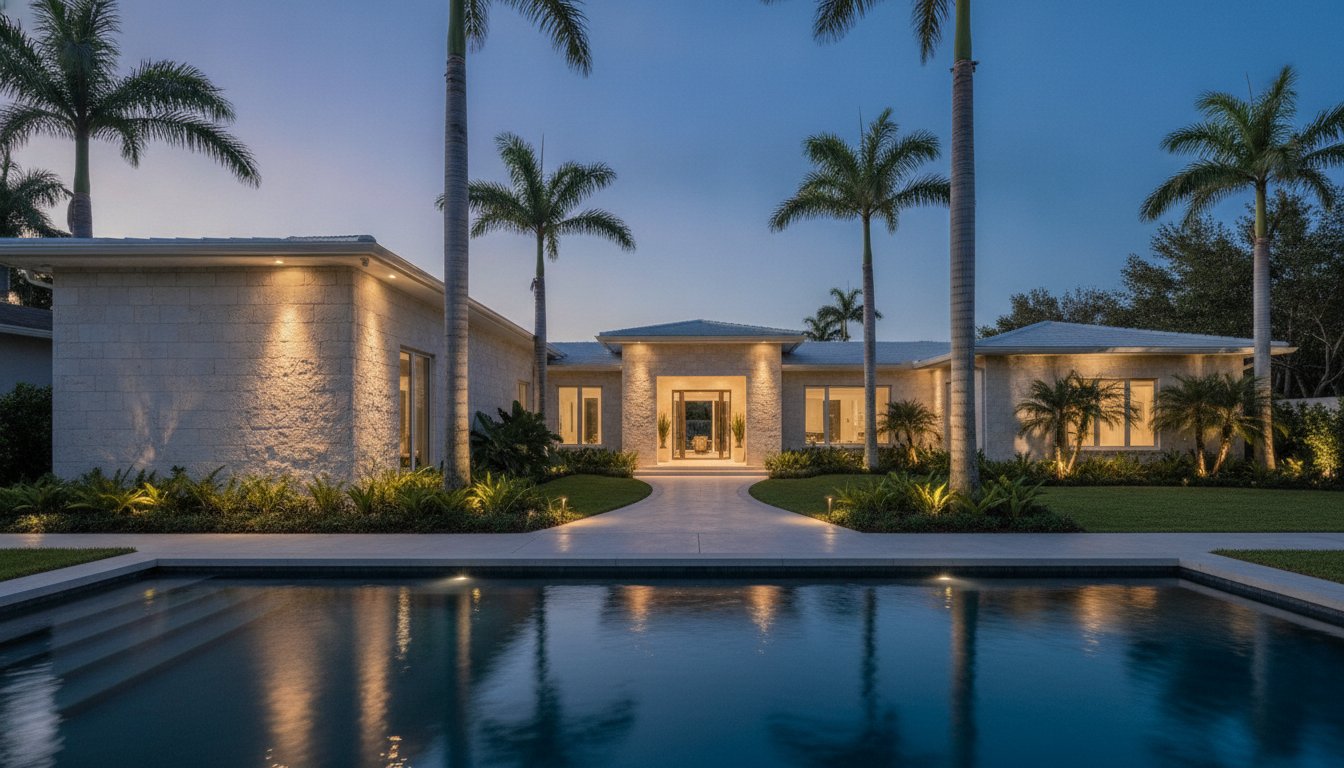
In the corrosive salt air of South Florida, a standard outdoor lighting system isn’t just an investment; it’s a ticking clock. Most homeowners realize too late that the humid, coastal climate ruthlessly targets low-quality fixtures and poor wiring. This is why professional landscape lighting maintenance Fort Lauderdale isn’t merely a luxury, but a vital part of protecting your estate’s nighttime curb appeal. If you’ve ever dealt with flickering bulbs, glary floodlights, or skyrocketing energy bills from an outdated halogen system, you know that true elegance requires more than just a few stakes in the ground.
It’s frustrating to invest in a beautiful landscape only to have it disappear into shadows or be washed out by harsh, “cheap” security lights. You deserve a property that feels like a five-star resort, where the light is felt rather than seen. Discover how bespoke low voltage LED engineering transforms South Florida landscapes into safe, energy-efficient, and breathtaking nighttime retreats. This guide explores the “invisible source” design philosophy, coastal-grade materials, and the technical precision needed to create a durable, high-performance lighting masterpiece for 2026.
Key Takeaways
- Understand why low-voltage (12V) LED engineering is the gold standard for creating safe, energy-efficient, and luxurious South Florida estates.
- Learn how to select coastal-grade materials like solid brass and copper to ensure your system survives the corrosive effects of salt air and high humidity.
- Discover the “Invisible Source” design technique, which focuses on the beauty of the light’s effect rather than the glare of the fixture itself.
- Identify why proactive landscape lighting maintenance Fort Lauderdale is critical for preserving the longevity and performance of your outdoor lighting.
- Explore the transition from high-consumption halogen systems to modern LED retrofits that offer superior durability and lower energy bills.
Low Voltage Outdoor Lighting: Essential for South Florida
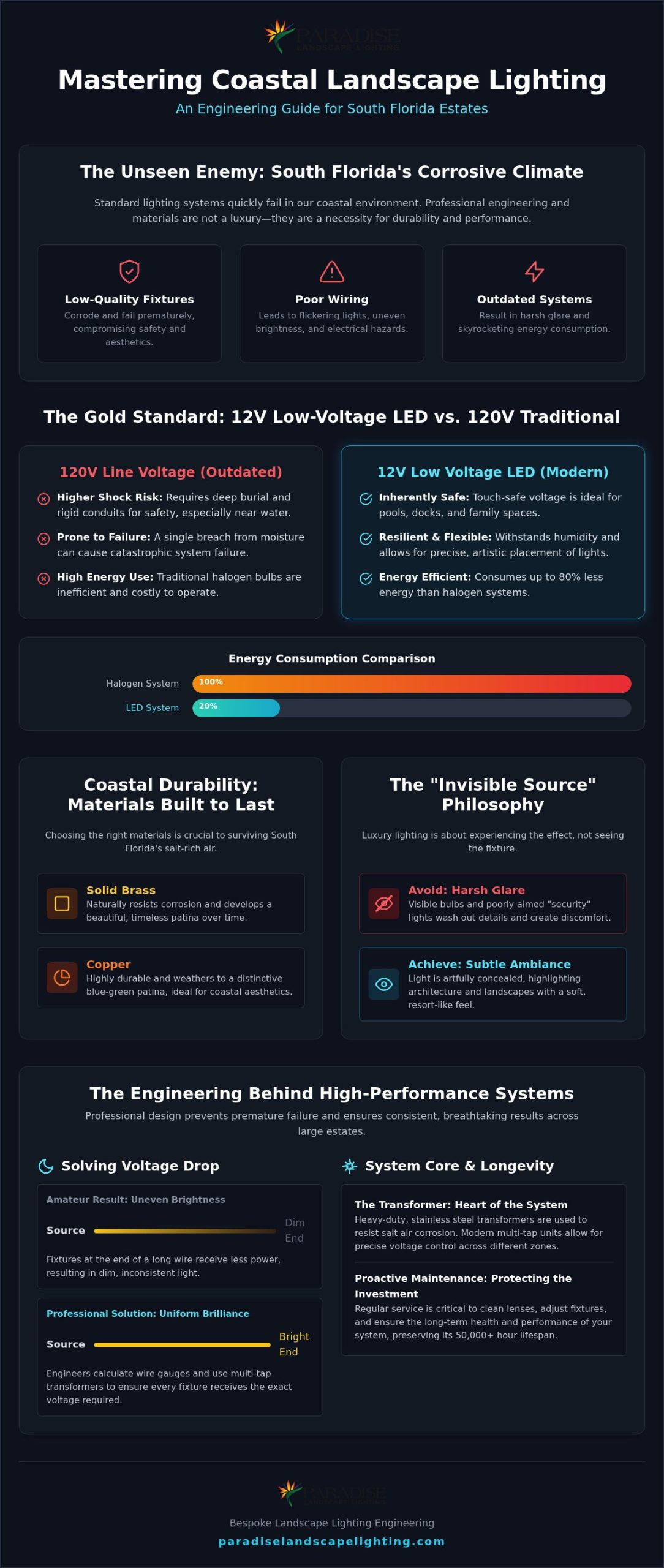
Understanding the electrical foundation of your estate is the first step toward a luxury outdoor experience. In South Florida, the choice between line voltage (120V) and low voltage (12V) isn’t just about brightness; it’s about engineering for a volatile environment. Traditional 120V systems require rigid conduits and deep burial to meet safety standards. Conversely, a 12V system uses a dedicated transformer to convert standard household power into a safe, manageable current. This flexibility allows for a more artistic application of light, ensuring your architectural features are highlighted with precision rather than flooded with overwhelming glare.
For many homeowners, the shift toward low voltage is driven by the need for consistent landscape lighting maintenance Fort Lauderdale. High-voltage systems are prone to catastrophic failure when moisture breaches a seal. In our coastal climate, where humidity and salt spray are constant, the robust nature of low-voltage LED technology provides a more resilient alternative. It’s the industry standard for estates that demand both high performance and long-term reliability. By utilizing a lower voltage, we can achieve a sophisticated look that is easier to adjust as your landscape grows and matures.
The Safety Advantage Near South Florida Water Features
Water and electricity are a dangerous combination. On a property featuring a pool, fountain, or dock, a 12V system provides an essential layer of protection. Because the voltage is so low, it’s essentially touch-safe. This eliminates lethal shock risks if a cable is accidentally severed or exposed to water. It’s often the only compliant choice for intricate pool deck lighting, offering peace of mind for families with children and pets in their outdoor spaces.
Energy Efficiency: Low Voltage vs. Traditional Halogen
Modern LED systems consume roughly 80% less energy than halogen predecessors. This allows you to illuminate an entire estate for a fraction of the cost. While traditional bulbs fail quickly, high-quality LED fixtures are engineered to perform for 50,000 hours or more. Regular landscape lighting maintenance Fort Lauderdale ensures these energy-efficient components stay clean and functional, reducing the carbon footprint of luxury estates without sacrificing the visual impact of your architecture.
The Engineering Behind High-Performance LED Systems
Luxury lighting design is an art, but its longevity is pure science. A dedicated lighting engineer bridges the gap between a visionary concept and a functional, durable reality. They don’t just choose fixtures; they calculate the precise electrical load and distribution required to sustain a high-performance system in the harsh South Florida climate. This technical foundation ensures that your home’s nighttime aesthetic remains consistent and reliable for years to come. Without this level of precision, even the most expensive fixtures can fail prematurely due to electrical strain or poor circuit design.
Solving the Challenge of Voltage Drop
Voltage drop is the loss of electrical potential as current moves through a circuit. On large South Florida estates, this is a common hurdle that separates professional installations from amateur ones. When a wire run is too long or the wire gauge is too thin, the fixtures at the end of the line receive less power. This results in uneven brightness and shifting color temperatures, making your landscape look inconsistent. Engineers solve this by meticulously calculating wire gauges and strategically planning run lengths. By balancing the load, they ensure every LED receives the exact voltage required to shine with uniform brilliance across your entire property.
Transformers and Control Systems for 2026
The transformer is the heart of your outdoor lighting system. For estates in coastal environments, we prioritize heavy-duty, stainless steel units that are specifically built to resist the corrosive salt air. Modern systems in 2026 often utilize multi-tap transformers. These allow the engineer to send different voltage levels to different zones, compensating for long distances without overtaxing the bulbs closer to the power source. Integrating these units with smart home technology provides a seamless experience, allowing for app-controlled scheduling and real-time monitoring of your system’s health.
Professional engineering prevents the premature failure often seen in “handyman” installations. When a system is designed with the correct electrical margins, it operates cooler and more efficiently. However, even the best-engineered systems require periodic landscape lighting maintenance Fort Lauderdale to check for wire exposure or shifting soil. This proactive approach protects your investment and ensures the engineering remains sound as your landscape matures, making professional care a cornerstone of luxury estate management. By combining technical expertise with a commitment to quality, you can enjoy a breathtaking outdoor retreat that stands the test of time.
Coastal Durability: Surviving the South Florida Environment
South Florida presents a unique set of challenges that can quickly degrade standard outdoor lighting. The combination of salt-laden air, relentless humidity, and intense UV radiation creates a “triple threat” for any exterior hardware. While a fixture might look pristine in a showroom, its true test begins the moment it’s installed near the Atlantic coast. Engineering for this environment requires a deep understanding of material science and local conditions. Without specialized hardware, systems often succumb to corrosion and electrical failure within just a few seasons.
Protecting your investment starts with choosing components designed specifically for these stressors. Regular landscape lighting maintenance Fort Lauderdale is essential because even the highest-quality materials need cleaning to prevent salt crusting and mineral buildup. This proactive care ensures that the seals remain watertight and the finishes continue to look refined. In our region, durability isn’t a luxury; it’s the foundation of a functional estate.
Material Science: Brass vs. Aluminum
Many off-the-shelf fixtures are made of powder-coated aluminum. In the salt air of Miami Beach or Fort Lauderdale, this material is prone to “pitting,” where the salt eats through the coating and causes the metal to flake and peel. Once the integrity of the fixture is compromised, moisture enters the internal electronics, leading to total system failure. We prioritize solid brass and copper for luxury installations. These materials don’t rust; instead, they develop a natural patina over time that actually serves as a protective layer against the elements. This aging process adds a sense of timeless elegance to the property while ensuring the hardware remains structurally sound for decades.
- Solid Brass: Exceptionally heavy and resistant to the corrosive effects of salt spray.
- Natural Copper: Offers superior heat dissipation for LEDs and a beautiful, evolving aesthetic.
- Sealed Engineering: High-performance fixtures utilize silicone O-rings to keep moisture and South Florida’s invasive insects out of the socket.
Navigating South Florida’s Unique Soil Conditions
The ground beneath your feet in South Florida is often as challenging as the air above it. Much of our region sits on a bed of limestone and coral rock, which makes traditional cable burial difficult. Amateur installers often leave wires too close to the surface, where they’re easily damaged by lawn equipment or local wildlife. Professional installation involves specialized trenching techniques and, in some cases, protective conduits to shield low-voltage lines from the jagged edges of coral rock. This level of care prevents the “mystery shorts” that plague poorly installed systems and ensures that your walkway and fence lighting remains stable even in sandy or rocky terrain.
Stability is also a factor during our intense storm seasons. Properly mounted fixtures, anchored deep into the substrate or secured to architectural features, are far more likely to survive hurricane-force winds. When combined with consistent landscape lighting maintenance Fort Lauderdale, these engineered solutions provide the resilience needed to keep your estate illuminated through the toughest tropical weather.
The “Invisible Source” Design Philosophy
True luxury in outdoor lighting is defined by what you don’t see. When a guest walks onto your property, their eyes should be drawn to the majestic sweep of a Banyan tree or the intricate texture of a coral stone wall, not the blinding glare of a naked bulb. This “Invisible Source” philosophy is the hallmark of a high-end estate. It moves away from the harsh, functional look of traditional floodlights and toward an immersive environment that feels like a five-star resort. By concealing the hardware, we ensure the focus remains on the beauty of your home rather than the equipment providing the glow.
Achieving this level of sophistication requires a meticulous eye during the initial design phase. You can explore these specific placement methods in our How to Hide Landscape Lighting: The Designer’s Guide. Using South Florida’s dense tropical foliage as a natural shield for fixtures ensures that the light seems to emanate from the environment itself. This approach eliminates “hot spots” and creates a soft, balanced ambiance that enhances safety without sacrificing elegance.
Highlighting Tropical Landscapes and Palms
South Florida’s unique flora offers incredible opportunities for artistic lighting. Royal Palms and Banyan trees require specific uplighting techniques that emphasize their height and structural complexity without creating glare for people on the ground. We use shadowed silhouettes and moonlighting to create depth in garden beds, making the space feel larger and more layered. High-performance low voltage LED technology is perfect for accentuating the vibrant textures of Florida palms. To keep these effects precise, consistent landscape lighting maintenance Fort Lauderdale is necessary. As your tropical garden grows, fixtures often need slight adjustments to ensure they remain hidden while still providing the intended illumination.
Architectural Facade Lighting for Curb Appeal
Your home’s facade is a canvas for light. Applying light to stone, stucco, and wood enhances architectural details that often disappear after sunset. There is a significant difference between “washing” a wall with a broad light and “grazing” it for maximum impact. Grazing is a technique where lights are placed close to a wall to highlight surface irregularities. This is particularly effective for the textured stone and stucco common in luxury Fort Lauderdale estates. Homeowners with Mediterranean-style properties, such as those seeking architectural lighting Coral Gables specialists trust, will find that grazing techniques are especially powerful for honoring historic facades. By carefully positioning these “invisible sources” at the base of architectural features, we create a sense of drama and curb appeal that traditional lighting simply cannot match.
Ready to transform your estate into a breathtaking nighttime retreat? Schedule a design consultation to see how our engineering-first approach can bring the “Invisible Source” philosophy to your property.
Maintenance and Retrofitting: Protecting Your Investment
Investing in a high-end lighting system is only the first chapter of your estate’s aesthetic journey. In the volatile environment of South Florida, “set it and forget it” simply doesn’t exist. The same salt air and humidity that demand coastal-grade materials also necessitate a proactive approach to care. Professional landscape lighting maintenance Fort Lauderdale ensures that your system continues to operate at peak efficiency while preserving the delicate “invisible source” balance established during the initial design. Without regular attention, even the most robust brass fixtures can be overtaken by rapid tropical growth or obscured by mineral deposits from irrigation systems.
System creep is a common issue for many Florida homeowners. As your palms mature and your garden beds expand, the original lighting plan can become misaligned. Fixtures that once highlighted a specific architectural detail might now be buried under foliage or pointing in the wrong direction. Regular maintenance prevents this degradation, allowing a technician to adjust placements and check for cable exposure caused by soil erosion. This meticulous care extends the life of your engineering and keeps your nighttime retreat looking as flawless as the day it was installed.
Halogen to LED Retrofitting: Why Upgrade Now?
If your property still relies on an older halogen system, you’re likely dealing with high energy bills and frequent bulb failures. Halogen bulbs generate significant heat, which can stress fixture seals and attract unwanted insects. Retrofitting to modern LED technology is a seamless process that often utilizes your existing low-voltage wiring. The benefits go far beyond energy savings. Modern LEDs offer a high Color Rendering Index (CRI), which means the vibrant greens of your palms and the deep hues of your stonework appear more natural and saturated under the light. It’s an immediate upgrade in both performance and visual quality.
The Paradise Maintenance Checklist
A truly professional maintenance visit is more than just a quick bulb check. It’s a comprehensive technical audit of your entire system. At Paradise Landscape Lighting, we treat maintenance as an extension of our engineering process. Our checklist is designed to combat the specific environmental stressors found in Fort Lauderdale and the surrounding coastal areas.
- Lens Restoration: We clean every lens to remove salt crusting and mineral buildup, restoring the intended brightness and clarity of the beam.
- Electrical Integrity: Our technicians inspect all connections and check the transformer’s output to ensure no “mystery shorts” are developing.
- Landscape Alignment: We re-aim and adjust fixtures to account for the growth of your tropical flora, ensuring the light remains focused on the effect, not the hardware.
- Cable Protection: We verify that all low-voltage lines remain safely buried and protected from lawn equipment or erosion.
Don’t let the South Florida elements dim your property’s brilliance. You can ensure your system stays flawless with bespoke low voltage landscape lighting maintenance tailored to your estate’s unique needs. By partnering with a local expert like Paradise Landscape Lighting, you’re choosing a team that understands the intersection of engineering and artistry. We provide the specialized knowledge required to handle complex coastal projects, ensuring your investment remains a source of pride and security for years to come.
Elevate Your Estate’s Nighttime Legacy
Your South Florida home is a sanctuary. Its beauty shouldn’t fade when the sun goes down. Achieving a resort-style atmosphere requires a deliberate blend of technical precision and artistic vision. By prioritizing an engineering-led design process and utilizing solid brass and copper fixtures, you ensure your system survives the coastal elements while maintaining its elegant patina. The hallmark of a truly luxury estate is the “Invisible Source” aesthetic, where the focus remains on your property’s best features rather than the hardware itself.
Preserving this breathtaking look over time requires more than just occasional bulb changes. Consistent landscape lighting maintenance Fort Lauderdale is the key to protecting your investment against rapid tropical growth and corrosive salt air. Whether you’re starting with a fresh installation or retrofitting an outdated halogen system, the right expertise makes all the difference in achieving long-term reliability and performance. It’s about ensuring your outdoor spaces are as functional and secure as they are beautiful.
Are you ready to see your landscape in a new light? Request a Bespoke Design Consultation with Paradise Landscape Lighting today. Let’s work together to transform your property into a safe, energy-efficient, and stunning nighttime retreat that stands the test of time.
Common Questions About South Florida Landscape Lighting
Is low voltage outdoor lighting bright enough for a large South Florida estate?
Yes, low voltage LED systems provide more than enough illumination for even the largest properties. Modern LED engineering allows us to control lumens and beam angles with extreme precision, ensuring your architectural features and tropical palms are perfectly highlighted. It’s not about the raw power of the current, but the quality of the optics. A well-designed 12V system creates a much more sophisticated, layered look than high-voltage floodlights ever could.
How much does it cost to run a low voltage LED system monthly?
Low voltage LED systems are incredibly efficient, consuming roughly 80% less electricity than traditional halogen setups. Because the wattage is so low, you can illuminate an entire estate for a fraction of the cost of running standard household appliances. This efficiency allows you to keep your property beautiful and secure all night without worrying about high energy bills. Modern LED technology ensures that your luxury retreat remains cost-effective and environmentally responsible.
Can I install low voltage lighting myself or do I need a professional?
Professional installation is highly recommended to ensure the system survives South Florida’s harsh climate. While DIY kits exist, they often lack the engineering required to prevent voltage drop and premature failure in salt air. A professional lighting engineer calculates precise electrical loads and uses coastal-grade materials that a standard hardware store doesn’t carry. Expert placement also ensures an “invisible source” aesthetic, avoiding the glary look typical of amateur projects.
Will salt air corrode my outdoor lighting fixtures in Fort Lauderdale?
Salt air is highly corrosive to aluminum fixtures, but it won’t damage solid brass or copper. In coastal areas like Fort Lauderdale, aluminum finishes tend to pit and peel within a few seasons. We exclusively use heavy-duty brass and copper because they develop a protective patina instead of rusting. Choosing the right materials from the start is the best way to ensure your system remains a permanent part of your estate’s landscape.
How often does a landscape lighting system in Florida need maintenance?
We recommend professional landscape lighting maintenance Fort Lauderdale at least twice a year to combat rapid tropical growth and salt buildup. During these visits, technicians clean lenses, re-aim fixtures as plants grow, and check for any cable exposure caused by soil erosion. This proactive schedule keeps your system looking flawless and prevents minor issues from becoming expensive repairs. Consistent care is essential for maintaining the high-performance standards expected of a luxury estate.
What happens to my low voltage lighting during a hurricane or heavy storm?
Engineered low voltage systems are remarkably resilient during tropical storms. Because the fixtures are anchored deep into the substrate and use heavy-duty materials, they’re built to withstand high winds. If a cable is accidentally exposed or severed by a fallen branch, the 12V current is touch-safe, which eliminates the risk of high-voltage shock. After any major storm, a quick maintenance check ensures everything is still aligned and functioning correctly.
Can I control my low voltage outdoor lighting from my smartphone?
Yes, modern systems in 2026 integrate seamlessly with smart home technology for full app-based control. You can adjust schedules, dim specific zones, or even change colors from your smartphone or tablet. This level of control allows you to customize the ambiance of your pool deck or garden for different occasions. Smart transformers also provide real-time data on your system’s health, making it easier to identify when professional attention is needed.
What is the difference between warm white and cool white LED for my garden?
Warm white (2700K to 3000K) is the standard for luxury estates because it creates a welcoming, resort-style feel. It enhances the natural colors of wood, stone, and tropical foliage. Cool white (4000K and above) can often look harsh or clinical, though it’s sometimes used for specific security applications. For most South Florida landscapes, we recommend warm white tones to achieve a sophisticated and cohesive nighttime environment that feels both high-end and inviting.
Return to News