
How to Hide Landscape Lighting: The Designer’s Guide
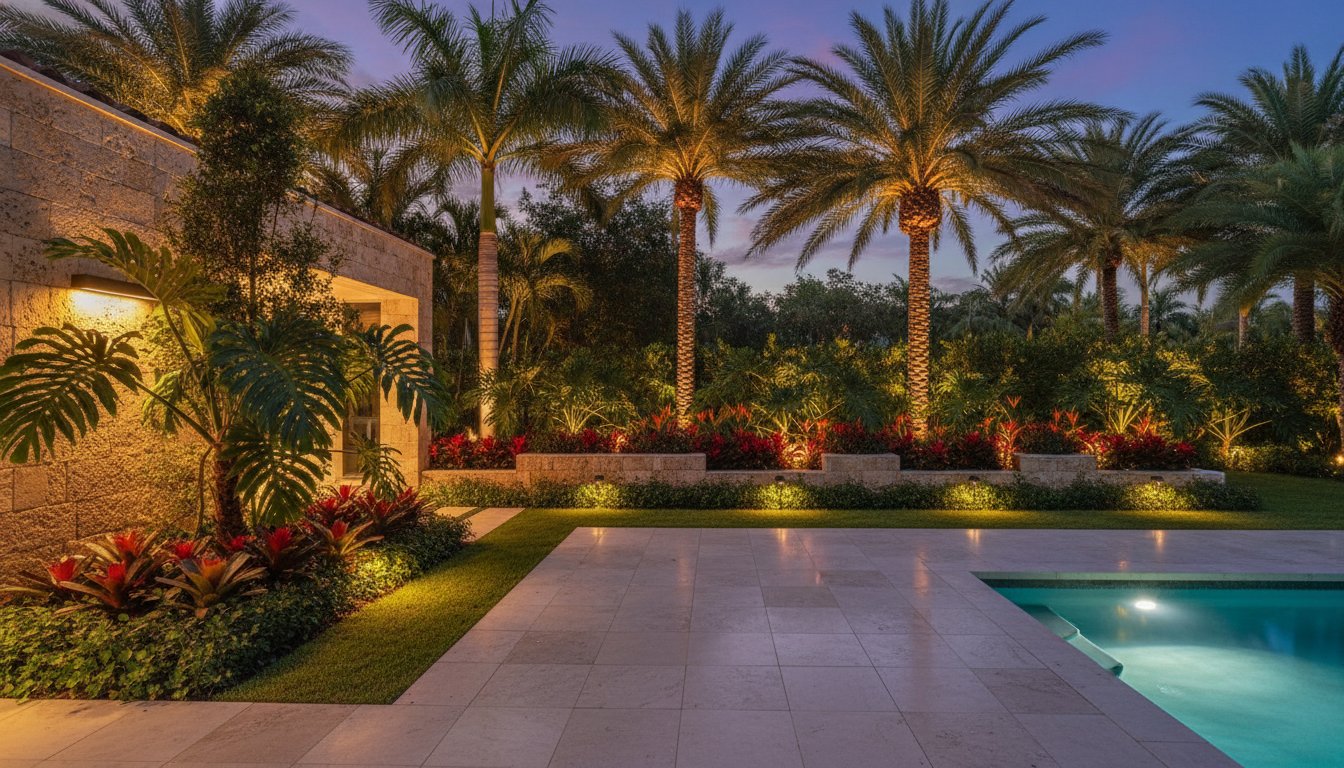
The most sophisticated outdoor lighting isn’t actually something you see; it’s something you experience. True luxury in a nightscape is defined by the glow on a limestone wall or the soft silhouette of a palm tree, never by the hardware that creates it. You’ve likely spent a great deal of time and resources perfecting your garden’s aesthetic, only to find that exposed wires or bulky canisters are ruining the view during the day. It’s a common frustration for homeowners who want the ambiance of a resort without the cluttered look of a construction site.
Mastering how to hide landscape lighting fixtures is the essential step in elevating your property from ordinary to extraordinary. Whether you’re dealing with the challenges of tucking lights into a sleek pool deck or burying cable safely beneath South Florida’s unique terrain, there’s a professional technique to ensure your system remains invisible. In this guide, we’ll share the designer secrets for concealing equipment and protecting your investment. You’ll learn how to integrate lighting into your hardscape and foliage so that when the sun goes down, only the artistry remains.
Key Takeaways
- Prioritize the visual effect over the hardware. Use low-lying ground covers and strategic foliage to mask equipment and maintain garden aesthetics during the day.
- Integrate light sources seamlessly into hardscapes. Techniques like core-drilling and recessed placement allow for high-performance lighting in stone walkways and pool decks.
- Master the professional standards for how to hide landscape lighting fixtures. Proper trenching and the use of PVC conduits ensure your wiring remains both invisible and safe.
- Invest in bespoke engineering. A professional approach prevents technical issues like voltage drop and ensures your hidden system performs reliably for years to come.
The Philosophy of Invisible Landscape Lighting
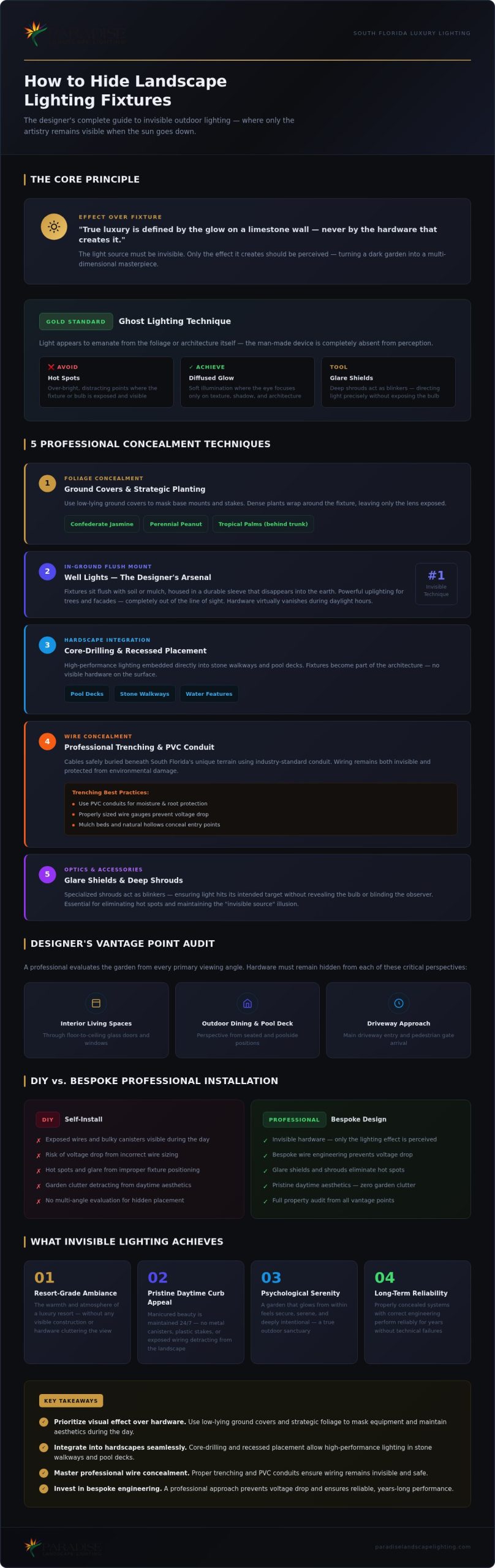
High-end design is a game of whispers, not shouts. In the context of a luxury South Florida estate, the most impactful lighting is often the kind you cannot see. This “Effect over Fixture” principle dictates that the beauty of a property should be enhanced by illumination, but never cluttered by the hardware that produces it. While functional path lighting serves a vital safety purpose, artistic accent lighting aims for something deeper. It creates a narrative through shadows and highlights, turning a dark garden into a multi-dimensional masterpiece. Professional designers achieve this by mastering how to hide landscape lighting fixtures using specialized tools like glare shields and deep shrouds. These components act as blinkers, ensuring the light hits its intended target without blinding the observer or revealing the bulb.
Source vs. Effect: Understanding the Goal
The gold standard of luxury illumination is known as “ghost lighting.” This technique creates a luminous environment where the light seems to emanate from the foliage or architecture itself, rather than a man-made device. To achieve this, you must eliminate “hot spots.” These are the distracting, over-bright points of light that occur when a fixture is improperly positioned or exposed. A successful design requires evaluating the garden from every primary viewing angle. Whether you’re looking through a floor-to-ceiling window in the living room or lounging on the patio, the source of the glow should remain a mystery. When the hardware is invisible, the eye focuses entirely on the texture of a stone wall or the delicate leaves of a Japanese Fern Tree.
To ensure a seamless effect, a landscape lighting designer will audit your property from several key vantage points:
- The view from interior living spaces through glass doors.
- The perspective from outdoor dining areas and pool decks.
- The approach from the main driveway or pedestrian gate.
The Aesthetic Impact of Hidden Hardware
Daytime aesthetics are just as critical as nighttime performance. A garden filled with visible metal canisters and plastic stakes quickly begins to feel like “garden clutter,” which detracts from the manicured beauty of a Miami or Boca Raton landscape. By minimizing the physical footprint of the system, you maintain the property’s pristine curb appeal. There is a profound psychological benefit to a garden that glows from within. It feels secure, serene, and deeply intentional. Ultimately, the “invisible source” concept is a hallmark of luxury design where the hardware is secondary to the atmosphere it creates. This approach ensures that your outdoor space remains a sanctuary of nature and architecture, undisturbed by the technical requirements of the lighting system. It’s a blend of meticulous engineering and visionary artistry that separates a basic installation from a bespoke nightscape. Knowing how to hide landscape lighting fixtures is not just a technical skill; it’s the foundation of creating a truly immersive environment.
This commitment to a clean, intentional aesthetic often extends to the smallest details of your home’s exterior. For those looking to complement their hidden lighting with high-quality, handcrafted entryway accents, Lolli’s Loops provides artisanal pieces that align with a sophisticated, resort-style finish.
For those seeking a comprehensive design strategy that extends beyond illumination, Beverly Hills Luxury Interiors provides expert architecture and landscape design services that prioritize this same level of seamless, high-end integration.
Practical Techniques for Concealing Fixtures in Foliage
Your garden is more than a backdrop; it’s a tactical tool for masking the technical components of your lighting system. Understanding how to hide landscape lighting fixtures within your garden beds requires a balance of horticulture and engineering. By using the natural layers of your landscape, you can ensure that the only thing your guests notice is the warm glow on your architectural features. Low-lying ground covers like Confederate jasmine or perennial peanut are excellent for masking base mounts and stakes. These plants provide a dense, green carpet that wraps around the fixture, leaving only the lens exposed to do its work. For vertical interest, strategic placement behind the thick trunks of tropical palms or within architectural planters allows you to project light upward without the canister being visible from the patio or walkway.
Well lights are perhaps the most effective tool in the designer’s arsenal for achieving an invisible look. These fixtures sit flush with the soil or mulch, housed in a durable sleeve that disappears into the earth. They provide powerful uplighting for trees and facades while remaining completely out of the line of sight. When you combine these with natural hollows or mulch beds, the hardware virtually vanishes during the day. This level of integration is a hallmark of professional LED lighting installation, where the goal is a seamless transition between the built environment and nature.
Leveraging South Florida Flora
In the unique climates of Miami, Fort Lauderdale, and Boca Raton, plants grow with incredible speed. Utilizing broad-leafed species like Bromeliads or Bird of Paradise provides excellent natural shielding for larger accent lights. However, you must account for this rapid tropical growth. A fixture that is perfectly positioned today might be swallowed by greenery in six months, choking the light output and creating a fire hazard. Maintenance access is vital. You should never bury a fixture so deeply that a technician can’t reach it for a lens cleaning or adjustment. A professional designer will space fixtures according to the mature size of the plant, not just its current state. Understanding the demands of landscape lighting maintenance in Fort Lauderdale is essential to keeping a hidden system performing at its peak as your tropical garden matures.
Using Artificial and Natural Camouflage
Sometimes the landscape doesn’t provide enough natural cover. In these instances, high-quality camouflage is necessary. Faux-rock covers are a sophisticated way to hide larger components like transformers or junction boxes, blending them into your decorative stone or boulder arrangements. Matching the fixture finish to the environment is equally important. Bronze or “dark chocolate” finishes disappear into mulch and shadows, while verde green options blend into lush lawns. Integrating fixtures directly into existing landscape boulders or decorative stone features ensures that the hardware feels like a permanent, intentional part of the terrain rather than an afterthought. This meticulous attention to detail ensures your nightscape remains a sanctuary of light, free from the distraction of visible hardware.
Hiding Lights in Hardscapes, Pools, and Water Features
Hardscapes present a unique challenge because there’s no soil to naturally mask the hardware. Integrating lighting into stone, concrete, or tile requires a surgical approach that begins during the design phase. One of the most effective methods for illuminating stone walkways is core-drilling. By precision-drilling into the material, we install recessed “star” lighting that sits perfectly flush with the surface. This creates a high-end, celestial effect where the light source is invisible during the day and provides a safe, glare-free path at night. Learning how to hide landscape lighting fixtures in these rigid environments is what separates a standard installation from a bespoke architectural masterpiece. Homeowners in historic neighborhoods who want to honor their home’s character while achieving this level of precision can explore how architectural lighting Coral Gables specialists integrate hidden fixtures into Mediterranean-style facades without compromising their historical integrity.
Linear LED strips offer another layer of sophistication. When tucked under stair treads or the overhanging lip of pool coping, these strips provide a continuous wash of light that highlights the texture of the stone while hiding the tape itself. This technique is especially critical for low voltage landscape lighting Boca Raton projects, where architectural facades and pool decks are central to the estate’s luxury appeal. By embedding the light into the structure, you create a permanent, integrated glow that feels like a part of the home’s DNA.
The Art of Undercap Lighting
Concealing fixtures beneath wall caps and seating ledges is a masterclass in engineering. These “undercap” lights are designed to be slim enough to fit into the shadows of a stone overhang. A professional installation must account for more than just aesthetics. Proper engineering is required to ensure heat dissipation and moisture protection within these recessed areas. Without adequate ventilation and high-quality seals, trapped heat can shorten the lifespan of the LED. South Florida’s humidity can also lead to internal corrosion if the fixture isn’t properly rated. A designer ensures that the hardware remains hidden while maintaining the technical integrity of the entire system.
Water Feature Stealth
Illuminating fountains and ponds requires a deep understanding of light refraction and material durability. To highlight the movement of water without seeing the lamp, submersible fixtures should be tucked behind waterfalls or placed strategically under large lily pads. Directional aiming is crucial here. If the light is angled poorly, it reflects off the water’s surface, creating a distracting glare rather than a luminous glow. In South Florida, the salt air and high mineral content of the water are particularly harsh on equipment. We prioritize high-grade, corrosion-resistant materials to ensure that your hidden water lights remain functional. Mastering how to hide landscape lighting fixtures in aquatic environments ensures that the focus remains on the soothing movement of the water, not the equipment beneath it.
Masterclass in Wire Concealment and Cable Burial
The true test of a professional system is what remains hidden beneath the surface. While understanding how to hide landscape lighting fixtures focuses on the visible hardware, the integrity of your nightscape depends on the “invisible” network of cables powering the art. Professional trenching is about more than just digging a hole; it’s about adhering to safety standards and local codes to ensure longevity. In high-traffic areas or under driveways, we utilize PVC conduit to protect cables from the weight of vehicles and the persistent movement of the earth. This prevents the wire from being crushed or severed over time. Crossing sidewalks or pavers requires a surgical touch, often involving boring techniques that allow us to pass wires through without lifting a single stone or disrupting the surface.
Once the installation is complete, a meticulous designer provides a map of the system. This ensures that future gardening projects or home renovations don’t accidentally compromise the buried lines. Proper labeling and mapping are the final steps in a professional-grade installation, turning a complex electrical project into a manageable asset for the homeowner.
Trenching Techniques for Different Soil Types
South Florida’s geology presents unique challenges for cable burial. When dealing with the rugged limestone and coral rock common in Miami-Dade and Broward counties, a standard shovel often isn’t enough. We use power trenchers to cut through these hard layers, ensuring cables reach a consistent, safe depth. In more delicate areas near mature root systems, flat-blade spades allow for a manual approach that protects your flora. For properties with extensive concrete, we often “tuck” wires into existing expansion joints, sealing them with professional-grade color-matched caulk to keep the run completely hidden from view.
Cable Management at the Transformer
The transformer is the brain of your system, and its placement should be as intentional as the lights themselves. We often utilize pedestal mounts or decorative enclosures to conceal these units within your landscaping. Inside the enclosure, neat wiring habits are essential to prevent a “spaghetti” look that complicates future maintenance. 12V low-voltage systems are significantly safer for buried residential applications because they eliminate the risk of dangerous electrical shocks if a cable is accidentally nicked by a garden tool. If you want to ensure your system is as durable as it is beautiful, consider a professional LED lighting installation that prioritizes these engineering details. Mastering how to hide landscape lighting fixtures and their support systems is an investment in both the safety and the long-term value of your estate.
Why Bespoke Engineering Outshines DIY Concealment
While DIY tutorials often suggest that anyone can stick a light in the ground, they rarely account for the complex physics of light. A seasoned landscape lighting designer understands how to predict light throw, ensuring that a hidden fixture illuminates the target without creating spill or glare. This is the difference between a garden that looks lit and a garden that looks enchanted. Beyond the aesthetics, engineering plays a critical role in system longevity. When you’re managing long, hidden wire runs, you must account for voltage drop. If the electrical load isn’t balanced correctly, the fixtures at the end of the line will appear dim or flicker, undermining the entire effect. Professional systems utilize heavy-gauge wire and calculated hub-runs to ensure consistent performance across the entire property.
Understanding how to hide landscape lighting fixtures is only half the battle; the other half is ensuring those fixtures are high-quality enough to withstand the environment. We prioritize professional-grade, solid brass fixtures that don’t just endure the elements; they improve with age. These materials develop a natural patina that blends seamlessly into the mulch and shadows of a South Florida garden. Most importantly, a professional design ensures that “invisible” doesn’t mean “unreachable.” We engineer our systems so that while the hardware is tucked away from view, it remains accessible for routine maintenance like lens cleaning or beam adjustments.
Precision Placement and Aiming
There’s a vast difference between placing a light and engineering a nightscape. We utilize specialized optics to narrow beams, allowing us to pinpoint a specific architectural detail from a distance without contributing to light pollution. This precision is what allows us to keep the light source tucked away in the foliage while the effect remains bold and clear. As your landscape matures, these fixtures often require seasonal adjustments. A professional setup includes the flexibility to move or re-aim lights slightly to accommodate the growth of your palms and shrubbery, ensuring the design remains perfect year after year.
Durability in the Florida Climate
Big-box store plastic fixtures are the enemy of a high-end nightscape. In the intense heat and humidity of Miami and Fort Lauderdale, these materials quickly become brittle, crack, and fail, eventually becoming visible eyesores in your garden beds. We utilize fixtures with watertight seals and high-performance heat sinks to protect the internal LED components. This level of durability is essential for systems integrated into hardscapes or buried in damp soil. If you want a system that performs as beautifully as it looks, you need a blend of artistic vision and technical precision. Ready for a professional touch? Contact Paradise Landscape Lighting for a custom design consultation.
Elevate Your Estate with Invisible Artistry
Creating a truly luxurious nightscape is a delicate balance of technical skill and creative vision. By prioritizing the luminous effect over the physical hardware, you transform your property into a sanctuary that feels both secure and ethereal. We’ve explored the essential methods for how to hide landscape lighting fixtures within your garden beds, hardscapes, and water features. These techniques don’t just improve your home’s aesthetics; they ensure your system remains a durable, high-performance asset for years to come. Professional engineering is the key to preventing common pitfalls like voltage drop and exposed wiring in our unique South Florida climate.
Our award-winning design and engineering team specializes in crafting bespoke solutions for South Florida luxury estates. With our expertise in energy-efficient, low-voltage LED technology, we bridge the gap between complex engineering and pure artistry. Don’t let visible hardware detract from the beauty of your home. Request a Bespoke Lighting Design Consultation today and let us help you reveal the hidden potential of your landscape. Your garden deserves a professional touch that lets the light shine through while the fixtures remain a mystery.
Frequently Asked Questions
Can I hide landscape lighting wires without digging a deep trench?
You can utilize shallow burial in garden beds, but deep trenching remains the professional standard for longevity. While some homeowners attempt to hide cables just beneath a layer of mulch, this leaves the system vulnerable to lawn mowers and garden tools. We recommend a minimum depth of six inches to protect your investment from UV exposure and accidental damage during routine landscaping.
Will hiding my fixtures behind plants block too much light?
Strategic placement ensures that foliage acts as a shield for the hardware rather than a barrier for the illumination. By positioning fixtures behind the trunks of palms or using well lights that sit flush with the ground, you can achieve a clear light throw. It’s essential to account for the mature size of your plants to prevent the beam from being swallowed by greenery over time.
What is the best way to hide a landscape lighting transformer?
The most effective way to conceal a transformer is by using a decorative pedestal or a custom enclosure that blends into your home’s architecture. Tucking the unit behind large shrubs or a decorative garden wall keeps the “brain” of your system out of sight while maintaining easy access for maintenance. Always ensure the enclosure provides adequate ventilation to prevent the hardware from overheating in the South Florida sun.
How do I hide wires when installing lights on a concrete patio or pool deck?
When working with existing concrete, we often utilize expansion joints to mask the cable runs. We carefully tuck the low-voltage cable into these pre-existing gaps and seal them with a color-matched, professional-grade sealant. This creates a completely flush finish that is invisible to the naked eye. For new builds, we coordinate with contractors to install sleeves beneath the stone before it is poured.
Are there specific light fixtures designed to be invisible?
Yes, certain hardware is specifically engineered to disappear into its environment. Well lights and recessed star lights are the primary examples of how to hide landscape lighting fixtures while maintaining high performance. These units sit flush with the surface of the soil or hardscape, providing powerful illumination without any visible canisters or stakes to clutter your garden’s daytime aesthetic.
How deep should landscape lighting wires be buried in South Florida?
In the unique soil conditions of Miami and Fort Lauderdale, wires should ideally be buried six inches deep. While the presence of coral rock and limestone can make manual digging difficult, power trenchers allow us to reach the necessary depth for maximum protection. This depth is sufficient to keep the cables safe from common gardening activities and aeration equipment that could otherwise sever the line.
Can I use mulch to hide my lighting cables?
Mulch should only be used as a secondary layer of concealment, never as the primary protection for your wiring. While it is tempting to simply lay wire on the surface and cover it with mulch, this is a temporary fix that leads to long-term maintenance headaches. Wires should always be buried in the soil first; the mulch then provides a finished look that masks the entry point of the fixture.
What happens if I accidentally cut a buried lighting wire while gardening?
Cutting a low-voltage wire is a common occurrence, but it isn’t a dangerous emergency. Because the system operates on 12V power, there is no risk of a high-voltage shock. However, the connection requires a professional splice with a watertight heat-shrink connector. This prevents moisture from wicking into the cable and causing internal corrosion, which could eventually lead to a total system failure if left unaddressed.
Return to News