
Why Are My Landscape Lights Flickering? What to Check

A flickering landscape-lighting system doesn’t always have a bad bulb. If you’re wondering why your landscape lights are flickering, common causes include an overloaded transformer, voltage drop along a long cable run, a loose or corroded connection, moisture, or a damaged bulb. The pattern matters: one flickering light may point to a different fault than several lights flashing or dimming together.
It’s frustrating when outdoor lighting that should make a garden, walkway, or pool area feel polished instead becomes unreliable. The good news is that a few careful observations can help narrow down what’s happening before you decide on the next step.
This guide explains what to inspect, how transformer load and cable runs can affect brightness, and when damaged wiring or recurring power problems call for an electrician. Start with warning signs that need professional attention, then work through practical checks for fixtures, connections, and controls.
Key Takeaways
- Use the pattern of flickering to narrow down whether the issue is isolated to one fixture or affecting the whole lighting system.
- Loose, corroded, or damp connections can interrupt power; damaged or exposed wiring is a reason to stop and seek professional help.
- Long cable runs and undersized wire can contribute to voltage drop, so compare readings at different points in the system.
- Check the GFCI outlet, breaker, transformer, timer, and switch to identify whether the interruption begins at the power source or farther along the circuit.
- Keep fixtures and connections clear of dirt and debris, and consider transformer capacity when multiple lights flicker or dim together.
1. When Should You Call an Electrician for Outdoor Lighting Problems?
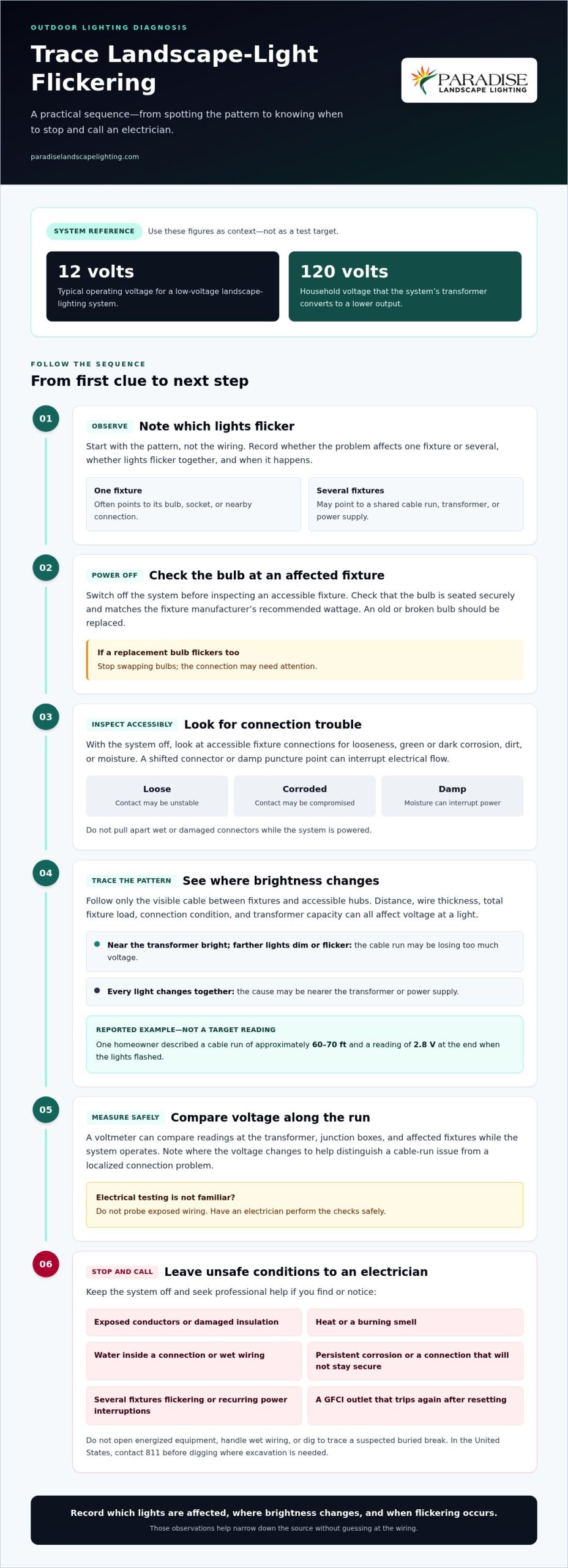
If you’re asking why your landscape lights are flickering, start by observing the pattern, not by handling the wiring. Note whether one fixture or several flicker, then switch off the system before inspecting accessible fixtures and connections. Look for a loose bulb, visible corrosion, moisture, or damaged insulation. Don’t open energized equipment or handle wet wiring.
Outdoor troubleshooting can expose you to electric shock, especially around wet connections, damaged insulation, or the transformer’s household-voltage side. If you see exposed conductors, feel heat, smell burning, or find water inside a connection, leave the system off and call an electrician.
A single flickering fixture often points to its bulb, socket, or nearby connection. With the power off, check that the bulb is seated securely and matches the fixture manufacturer’s recommended wattage. An incompatible bulb can disrupt operation, while an old or broken bulb can flicker and should be replaced. If a replacement bulb flickers too, stop swapping bulbs and inspect the connection instead.
Look at accessible fixture connections for looseness, green or dark corrosion, dirt, and moisture. Low-voltage landscape wires commonly connect to fixtures through two small prongs that pierce the insulation. A shifted connector, corroded contact, or damp puncture point can interrupt electrical flow. Don’t pull apart a wet or damaged connector while the system is powered. If corrosion returns, insulation is split, or the connection won’t stay secure, have an electrician assess it.
Follow the visible cable between fixtures and any accessible hub or junction point. Crushed, cut, or exposed wire can cause intermittent power, while a loose hub connection may affect several lights downstream. Don’t dig to trace a suspected buried break. In the United States, contact 811 before digging where a suspected landscape-lighting wire cut requires excavation.
Call an electrician if several fixtures flicker, the problem returns after basic bulb checks, or power interruptions keep happening. Get help for wet or damaged wiring, persistent corrosion, or a GFCI outlet that trips again after resetting. These symptoms may indicate a fault beyond a simple bulb replacement. Keep the system switched off until the unsafe condition is addressed, and describe which lights flicker and when.
Loose connections, corroded contacts, and incompatible bulbs can make low-voltage lights flicker. Loose wiring is a common cause of outdoor lighting problems, so recurring flickering shouldn’t be treated as a bulb issue alone. Replace outdoor bulbs that are old or broken.
Faulty connections, moisture, or malfunctioning controls can make low-voltage lights operate intermittently. Moisture intrusion and overloaded circuits can also cause outdoor lights to flicker. If the problem continues after replacing a damaged bulb or affects several lights, leave diagnosis of connections, controls, and circuit load to an electrician rather than altering wiring. Note which lights are affected and when the flickering occurs.
2. Voltage drop from long wire runs or thin wire gauge
A low-voltage landscape lighting system typically operates at 12 volts. Its transformer converts household voltage of 120 volts to a lower output for outdoor fixtures. As electricity travels through cable, some voltage is lost along the way. Long runs and thin wire can increase that loss, leaving distant lights dimmer or unstable. The effect may become more noticeable when several fixtures share the same cable run.
Distance is only one factor. Wire thickness, total fixture load, connection condition, and transformer capacity all affect voltage at each light. Thicker cable can help minimize voltage loss, particularly on longer runs. A loose or dirty contact can also add resistance, so a dim fixture doesn’t automatically mean the cable gauge is wrong. Compare symptoms across the system before drawing a conclusion.
Notice where the change begins. If fixtures near the transformer stay bright but those farther along dim or flicker, the cable run may be losing too much voltage. If every light changes together, the cause may sit nearer the transformer or power supply. One reported homeowner example involved a cable run of approximately 60–70 ft and a reading of 2.8 V at the end when the lights flashed. That reading illustrates why location matters; it isn’t a target voltage for other systems.
A voltmeter can help trace voltage at the transformer, junction boxes, and fixtures along the wire run. Compare readings at the transformer and at the affected fixture while the system operates, noting where the voltage changes. Measurements can help distinguish a cable-run issue from a localized connection problem. If you’re unfamiliar with electrical testing, don’t probe exposed wiring; have an electrician perform the checks safely.
When reviewing the layout, map the cable path and mark each fixture’s position. Record which lights dim, whether they flicker together, and how brightness changes closer to the transformer. These observations can help identify whether distance, wire thickness, load, or contacts need attention. Don’t add higher-wattage bulbs to compensate for dim output, as they can increase system load instead of correcting voltage loss.
If the pattern points to cable length or fixture placement, a carefully planned lighting layout can account for both as part of the system design. The goal is consistent illumination along the run, not simply brighter output at the transformer. A measured voltage check gives a clearer starting point for deciding what needs adjustment.
3. Checking the GFCI outlet, circuit breaker, transformer, timer, and power switch
Trace the power path from the GFCI outlet to the fixtures. Note whether the whole system flickers or only part of it; widespread changes may suggest a shared power or control issue. Check the outlet, breaker, transformer display, timer setting, and switch position without opening electrical equipment. This sequence can help identify where the interruption begins.
Check the GFCI outlet first. If its reset button has popped, reset it once with dry hands and observe the lights. If the GFCI trips again immediately, there may be a short circuit in the landscape lighting system. Don’t keep resetting it. Leave the system off and arrange an electrician’s assessment, especially if moisture or damaged wiring is visible near the outlet.
Next, inspect the circuit breaker. If it has tripped, turn the landscape-lighting switch off before resetting the breaker once. Observe whether it trips again when power returns. Repeated trips point to an electrical fault or heavy circuit load, not just a timer setting. Don’t remove the breaker panel cover or touch wiring inside it.
The transformer is the next checkpoint. Confirm its power switch is on, then check its display or indicator light for an error or interruption. A typical low-voltage system uses a transformer to convert household voltage of 120 volts to a lower output. Landscape lights should receive 12 volts near the transformer when it’s on. A transformer’s output should read between 12 and 15 volts when tested with a multimeter set to AC voltage. Testing energized wiring can be hazardous, so leave that measurement to someone trained to perform it safely.
Then check the timer and any separate power switch. Confirm the timer shows the intended time and its programmed on period hasn’t ended. If the lights flicker at the same time each evening, a schedule or control issue may be involved. If they flicker at different times, note whether the transformer display changes too. This comparison can help distinguish a control interruption from an output problem.
Power surges, a faulty transformer, and heavy circuit loads can all create voltage problems. For example, if the GFCI stays set but transformer output fluctuates, the fault may be beyond the outlet. If resetting a control changes nothing, don’t adjust wiring or open the transformer. Record which device changes, when flickering starts, and whether the fixtures stay bright. Those details give an electrician a useful starting point without exposing you to live components.
4. Cleaning fixtures and protecting exposed wires
Dirt on a fixture can affect light output and electrical contact. Dust, debris, and hard-water spots around sockets or connectors may interrupt contact and contribute to flickering. Clean landscape lighting fixtures once or twice a year, checking each light, not just those that look dim. Before handling a fixture, switch off the system and let its components cool.
Work carefully on the outside of each fixture. Wipe the lens and housing with a soft cloth, then clear loose dirt from the surrounding area. Inspect the socket opening and accessible connector for debris, corrosion, or moisture. Don’t force tools into a socket or pull apart a connection that looks wet or damaged. If flickering continues after cleaning, dirt may not be the cause.
Follow the visible cable around the fixture and along accessible runs. Look for cracked insulation, exposed wire, a loose connector, or cable pressed against a sharp edge. Moisture at a connection can disrupt electrical flow, while damaged insulation leaves wiring vulnerable to further weather exposure. Stop handling wiring that appears wet or damaged, and keep the system switched off.
Weatherproof covers can help reduce weather-related damage to outdoor lighting components. Check that covers are in place and haven’t cracked, shifted, or filled with debris. Silicone sealant can seal visible gaps or cracks and help prevent water from entering outdoor fixtures and cables. Apply it only to a visible gap or crack, not over a connector that needs inspection or servicing.
Use the flicker pattern to guide your inspection. If one fixture works again after you clean its lens and accessible contacts, debris may have affected the connection. If several lights keep flickering after cleaning, inspect the visible wiring path for moisture or damage. Don’t treat sealant as a fix for a cut wire, corroded contact, or loose connection; those faults need proper correction.
Make a maintenance pass once or twice a year, noting which fixtures need cleaning and where covers or insulation show wear. Record the affected light and any visible moisture, dirt, or cable damage. These notes can help distinguish a recurring outdoor lighting issue from a one-time buildup of debris. If you find exposed wiring or persistent moisture, leave that section untouched and have the electrical fault addressed.
5. Overloaded transformers and flickering lights
An overloaded transformer can make several outdoor fixtures flicker or appear very dim. The key comparison is the combined wattage of the connected lights against the transformer’s rated capacity. Outdoor landscape lighting transformers should be used at no more than 80% of their capacity. Add the wattage shown on every bulb or fixture label, then compare that total with the transformer’s rating. A load above that guideline can leave less operating headroom and contribute to unstable output.
For example, one reported lighting setup had a 37 W load. That figure alone doesn’t establish whether its transformer was overloaded; the transformer’s rated capacity matters too. A bulb with higher wattage than the transformer can handle adds load and may cause flickering. Check each bulb label and fixture recommendation, then total the actual load. Don’t estimate by counting fixtures, since their wattages can differ.
Flicker patterns can offer another clue. If several lights dim or flash together, a shared transformer or voltage issue deserves attention. A single fixture flickering points more toward its local bulb or connection. One homeowner described lights flashing once every 5 seconds. That timing is a useful observation, not a diagnostic rule. Note whether all fixtures flash together and whether brightness changes as additional lights switch on.
A transformer can become faulty through age or damage. If its output is unstable, changing bulbs alone may not resolve the problem. An electrician can safely compare the connected load with the transformer rating and test its output. If the transformer is overloaded, old, or damaged, replacing it or adding another transformer may provide capacity for the system. The right fix depends on the measured load and existing layout.
Before arranging that assessment, write down the wattage of each fixture, the transformer rating, and which lights flicker together. Include the timing, such as a repeated flash every 5 seconds, if that describes the pattern. Don’t install a larger transformer or add equipment based only on a wattage guess; wiring, connections, and system configuration also affect performance. A measured load gives a clearer basis for the next step.
The practical takeaway is to treat simultaneous flickering as a reason to assess total load, not just replace bulbs. Keep the transformer’s 80% capacity limit in view, and have faulty or undersized equipment evaluated before expanding the lighting system. That helps preserve consistent illumination across the outdoor space and prevents added fixtures from worsening an existing overload.
Paradise Landscape Lighting: Landscape Lighting Design
Paradise Landscape Lighting can help when flickering points to a broader layout or installation concern rather than a simple bulb issue. Its Landscape Lighting Design considers how fixtures, cable routes, and transformer capacity work together across an outdoor space. This helps shape a cohesive plan for gardens, pools, fountains, and architectural features.
For a project that needs a refreshed system, Paradise Landscape Lighting also offers LED Lighting Installation. Sculpture and Artwork Lighting or Pool Deck Lighting can be included in a tailored outdoor lighting plan, with attention to visual effect and reliable operation.
Contact Paradise Landscape Lighting to discuss a landscape lighting design for your space.
Bring Your Outdoor Lighting Back Into Focus
If you’re still asking, “why are my landscape lights flickering?”, use the issue as an opportunity to make your outdoor lighting more dependable and intentional. A clear record of what you noticed can guide your next decision, whether that means addressing an electrical fault or reconsidering how the space is illuminated. Safety comes first; design improvements make sense once any wiring issue is resolved.
For homeowners ready to rethink the overall effect, Paradise Landscape Lighting can create a plan around the property’s features and how you use them. Landscape Lighting Design establishes a cohesive approach, while LED Lighting Installation or Sculpture and Artwork Lighting can support specific project goals.
Share your outdoor lighting goals with Paradise Landscape Lighting and take the next step toward a more considered landscape.
Frequently Asked Questions
When Should You Call an Electrician for Outdoor Lighting Problems?
Call an electrician if flickering comes with exposed wiring, a burning smell, unusual heat, or repeated power interruptions. Stop troubleshooting if a GFCI outlet trips again after resetting or water is visible inside an electrical component. For example, if several fixtures go dark and the breaker trips when you switch on the system, leave it off and describe that sequence to the electrician.
What are the most common causes of flickering landscape lights?
Common causes include a failing bulb, an unstable connection, moisture, voltage drop, or a transformer struggling with its load. The pattern helps narrow down the possibilities: one fixture behaving differently from the rest suggests a local fault, while several lights changing together points toward a shared part of the system. Note whether flickering begins after rain, at startup, or when other lights turn on.
How can I tell whether a landscape light flicker is caused by a loose connection or a bad bulb?
Turn off the system, then replace the suspect bulb with a compatible bulb that you know works in another fixture. If the flicker follows the original bulb to the second fixture, the bulb is likely faulty. If the same fixture still flickers with the replacement, its socket or connection may be involved. Don’t handle wet, corroded, or exposed wiring; have the fault assessed safely.
Can a failing landscape lighting transformer cause lights to flicker?
Yes. A failing transformer can produce unstable output, affecting several connected fixtures at once. Look for a pattern where several lights flicker or dim together rather than one isolated fixture. A transformer can also be overloaded, so both its condition and the connected lighting load matter. An electrician can test its output and determine whether the transformer or another system component needs attention.
When should I call a licensed electrician to fix flickering landscape lights?
Call an electrician if the problem continues after replacing a compatible bulb, affects several fixtures, or involves damaged wiring, moisture inside components, or a breaker that trips repeatedly. Don’t open a transformer or probe energized wiring to find the fault. Share which fixtures flicker, which controls you switched, and whether the system’s protection device tripped. These observations help focus the electrical assessment without further handling.
Return to News