
Uplighting a House Facade in Miami Beach: A 2026 Homeowner’s Guide
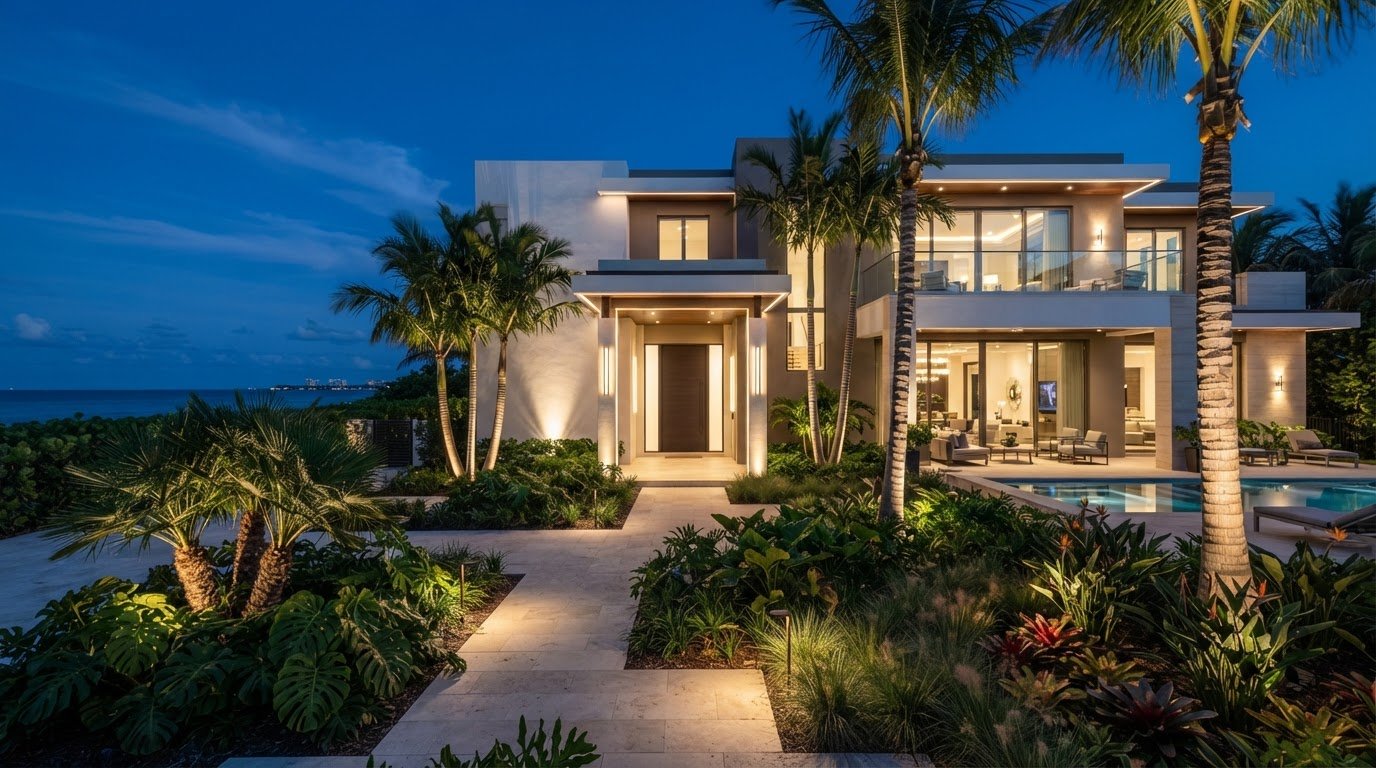
More uplights won’t necessarily make a Miami Beach home look more impressive at night. The result depends on what you emphasize and how the light works with the home’s materials, proportions, and sightlines. That’s the principle behind thoughtful uplighting house facade Miami Beach homeowners can enjoy without harsh glare or visual clutter.
If you’re deciding whether to highlight a column, textured wall, entryway, or roofline, it helps to start with the effect you want rather than a fixture count. Coastal conditions, nearby windows, and the home’s architecture all inform placement. A refined plan doesn’t treat every surface equally; it creates depth while keeping the facade comfortable to look at.
This guide explains how uplighting interacts with common facade features, how to compare beam direction, color, and placement, and what to prepare before a project begins. It also shows how design and engineering connect the visual concept with technical execution, so each choice contributes to a cohesive nighttime appearance.
Key Takeaways
- Plan uplighting house facade Miami Beach around the architectural features you want to emphasize, not the number of fixtures.
- Use facade texture, depth, and fixture distance to decide whether light should graze a surface or cover a broader wall.
- Compare narrow-beam accents and wider coverage by weighing the facade condition and the visual effect each creates.
- Before installation, note your home’s materials, existing landscape elements, key sightlines, and typical nighttime viewing positions.
- A tailored project connects architectural priorities with design, engineering, installation, and ongoing maintenance.
Why Uplight a House Facade in Miami Beach?
Facade uplighting uses fixtures positioned at ground level or near the base of a structure to direct light upward across selected architectural surfaces. After sunset, carefully aimed light can reveal a column’s profile, bring out texture in a masonry wall, or give an entryway more presence. The goal isn’t to make every wall equally bright. It’s to create a composed view in which a few details stand out while the rest of the facade retains its natural depth.
That restraint matters in Miami Beach, where homes range from crisp modern forms to Mediterranean-inspired residences with arches, deep recesses, and layered rooflines. Coastal exposure makes fixture placement and long-term suitability important design considerations. Nearby homes and windows matter, too: light should serve the architecture without becoming a distraction beyond the property. Thoughtful uplighting house facade Miami Beach begins with the specific building and its surroundings, not a preset arrangement of lights.
Architectural lighting is most effective when it responds to the form and purpose of a space. The principles of architectural lighting design offer useful context for how illumination can shape a built environment. For a home facade, consider what deserves attention, what should remain in shadow, and how the exterior appears from the street, the entry, and neighboring viewpoints.
Which facade details benefit most from uplighting?
Start with features that give the home character: columns, an entry surround, a textured wall, a distinctive roofline, or a recessed section that creates natural shadow. Materials and proportions affect the result. A rough surface can reveal depth when light skims across it, while a broad, smooth wall may look flat under too much uniform illumination. Tall features may also call for a different approach than low, wide ones.
Choose a few focal points rather than lighting every surface. This gives the facade a clear visual hierarchy. An entry and a pair of columns, for instance, may create a stronger composition than a bright outline around the entire house.
What should Miami Beach homeowners want the finished scene to feel like?
A considered scene balances illuminated areas with darker ones. Contrast helps the eye distinguish architectural features and keeps the exterior from feeling washed out. The intended mood might be welcoming and understated, or more dramatic around a particular feature, but the light should still feel connected to the home’s character.
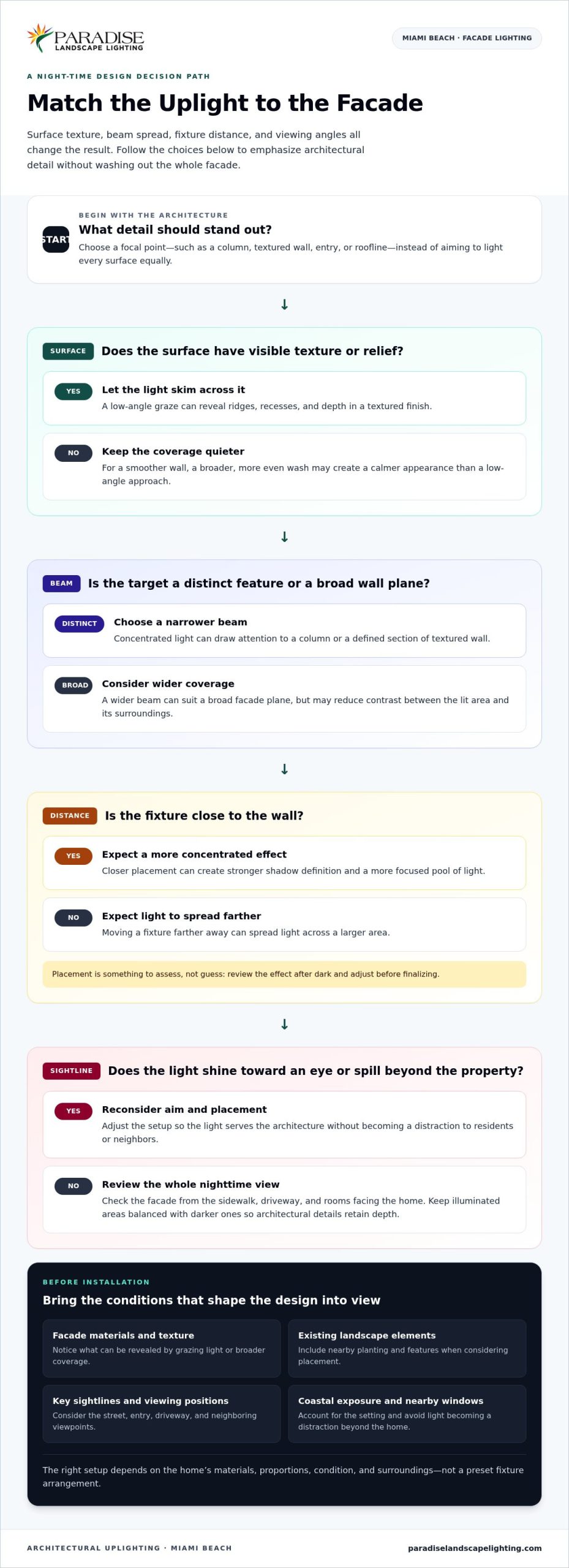
Check the view from the sidewalk, driveway, and rooms facing the facade. If a fixture shines directly toward the eye or light spills onto a neighboring property, it can compete with the architecture. Judge the effect from the places residents and neighbors actually see the home.
How Uplighting Reveals Miami Beach Facade Materials and Form
Light doesn’t simply make a facade visible. Its direction, spread, and distance from the wall affect which details stand out and how much depth the surface appears to have. A textured finish may show pronounced ridges and recesses when light travels across it from a low angle. On a smoother wall, the same approach can create uneven streaks, while a broader, more even wash may give the surface a quieter appearance.
Shadows are part of the design. They reveal relief around trim, masonry joints, and recessed openings, helping a facade feel dimensional after dark. Too much brightness, however, can soften those shadows and make even a detailed surface look flat. The right balance depends on the material, its condition, and the surrounding architecture, so a setup that works on one home may not suit another.
How do beam spread and fixture placement change the effect?
A narrower beam concentrates light on a smaller area, which can draw attention to a column or a distinct section of textured wall. A wider beam covers more of the facade and can suit a broad wall plane, though it may reduce contrast between the lit area and its surroundings.
Distance changes the look, too. Closer placement can produce stronger shadow definition and a more concentrated effect; moving a fixture farther away can spread light across a larger area. Treat placement as something to assess, not guess. Review the effect at night and adjust the position before finalizing it, since daytime views won’t show how shadows and bright spots interact.
How can lighting complement different Miami Beach home styles?
A Mediterranean Revival facade might have deep-set windows, arches, and pronounced trim. Rather than outlining every feature, a lighting concept could use those existing layers to create contrast around an entry or across a textured wall. On a contemporary home, clean wall planes and simple geometry may call for controlled coverage that respects the facade’s uncluttered lines.
These are starting points, not templates. Match the emphasis to the home’s materials and form, and take particular care with historically significant features. The National Park Service’s historic preservation lighting guidelines can offer useful context when considering how exterior changes relate to a building’s character.
For a broader view of how exterior illumination can shape a home’s nighttime presence, explore residential architectural lighting in Miami. Paradise Landscape Lighting creates custom architectural lighting designs that translate a home’s distinctive surfaces and proportions into a cohesive concept.
Comparing Facade Uplighting Choices: Beam, Placement, and Visual Impact
There’s no single beam or fixture position that suits every exterior. For uplighting house facade Miami Beach, compare choices by the feature you want to reveal and the views the light will affect. A column seen from the street may call for different treatment than a broad wall facing nearby windows. Use the comparisons below as a starting point, then judge the effect at night from the places people will actually see it.
| Design choice | Suitable facade condition | Visual trade-off |
|---|---|---|
| Narrow-beam accent | A distinct column, entry detail, or other contained feature | Creates a focused point of interest, but can look isolated if it doesn’t relate to nearby features. |
| Wider wall coverage | A broad, relatively open wall plane | Creates more even illumination, but may reduce the contrast that gives details definition. |
| Closer fixture placement | A textured surface where shadow and relief are part of the intended effect | Can make surface variation more pronounced, but may create uneven patches if poorly aimed. |
| Farther fixture placement | A taller or broader area that needs more overall coverage | Spreads light across more of the facade, though fine texture may appear less distinct. |
Should you choose a focused accent or a broader wall wash?
A focused beam can give a single architectural feature a clear presence, especially when it has enough visual weight to hold attention on its own. Wider coverage may suit a large, simple wall that would otherwise feel disconnected from the rest of the composition. Consider the home’s geometry: separate accents can compete when details are closely spaced, while one dominant feature may benefit from focused treatment.
Viewing distance matters, too. From across the street, a small highlight may disappear into the overall facade; from a nearby path, the same detail may feel prominent. Compare the options from both positions before deciding how much of the wall to illuminate.
How should glare, fixture visibility, and light spill factor into the choice?
Concealing a fixture can keep attention on the architecture, while an exposed fixture may become part of the view. In either case, placement and aiming should direct the beam toward its intended surface. Shielding can help control stray light, but review the result from street-facing angles and inside rooms where neighbors may see the source or its reflection.
Include neighboring windows in the review, not as an afterthought. The International Dark-Sky Association’s responsible outdoor lighting practices provide helpful context for limiting unnecessary light beyond the feature being illuminated.
A practical comparison is part of a well-coordinated design. Paradise Landscape Lighting brings architectural priorities and technical planning together in custom low-voltage LED projects. Explore facade lighting design to develop the effect you want to create.
Plan a Miami Beach Facade Uplighting Project Before Installation
A clear brief turns the idea of a more striking facade into practical design decisions. Before planning uplighting house facade Miami Beach, gather details about the home and how it’s seen at night. Note facade materials, existing landscape elements, nearby windows and walkways, and where residents, visitors, and neighbors typically view the property. These observations give a lighting designer useful context for shaping a concept around the actual setting.
Work through these steps before installation:
- Identify focal features. List the columns, entry, roofline, wall textures, or recesses you’d like to emphasize. Also note areas you’d prefer to keep understated.
- Observe sightlines. View the facade from the street, driveway, walkways, and rooms facing the exterior. Include neighboring windows and property edges in your notes.
- Set priorities. Decide what matters most, such as a more legible entry, clearer definition of a distinctive wall, or a balanced view of several features. A priority list helps guide design choices if every goal can’t be addressed equally.
- Plan a night review. Set aside time to evaluate the proposed positions and effect after dark, when glare, shadows, and spill light are visible in context.
What should homeowners document before the design conversation?
Make a simple record of the facade’s materials and features, along with existing trees, planting beds, paths, and other exterior lighting. Note current issues plainly: perhaps a bright source is visible from the street, the entry feels too dark, or light falls unevenly across a wall. Include photos or written notes from typical viewing positions, plus any details you want to remain subtle.
Miami Beach’s coastal setting also makes it sensible to discuss fixture materials and ongoing care during project planning. Salt air and exposure are relevant considerations, but suitability depends on the specific equipment and location. A tailored design can account for these conditions without relying on a one-size-fits-all assumption about durability. Where shoreline or wildlife protections may apply, review current Miami Beach requirements before installation rather than assuming general outdoor-lighting guidance covers every property.
How can a homeowner assess a proposed lighting concept?
A useful concept explains why each fixture is included, where its light will travel, and which facade surface it’s intended to reveal. It should also account for sightlines and include a plan to review placement and appearance after dark. These details help you assess whether the proposal serves the home’s priorities, rather than simply adding points of light. Related bespoke outdoor LED lighting design offers further planning context.
Paradise Landscape Lighting connects design, engineering, installation, and maintenance for custom low-voltage LED systems. Plan your facade lighting project with Paradise Landscape Lighting to bring your priorities into a considered design.
Design and Install House Facade Uplighting with Paradise Landscape Lighting
A successful facade project brings visual intent and technical planning together from the start. Paradise Landscape Lighting designs, engineers, installs, and maintains custom low-voltage LED systems for residential outdoor spaces, including homes in Miami Beach. Rather than beginning with a standard fixture count, the team shapes a plan around the home’s architecture, the homeowner’s priorities, and the way the exterior should feel after dark.
What happens from design concept through installation?
The lighting designer translates the homeowner’s architectural priorities into a nighttime concept. That means connecting the desired emphasis, such as a distinctive entry or a sequence of facade features, with the home’s outdoor context. The lighting engineer plans the technical execution to support the concept. Design and engineering work together, so fixture placement and the appearance of the light are considered alongside system planning before installation begins.
The project path connects several complementary stages:
- Design: Establish a lighting concept responsive to the facade and the homeowner’s goals.
- Engineering: Plan the technical elements of the custom low-voltage LED system to carry the design into practice.
- Installation: Put the coordinated plan into place, with attention to fixture positioning and the intended visual effect.
- Maintenance: Support the longer-term performance of the residential outdoor lighting system.
Keeping these stages connected helps prevent the design from becoming a collection of isolated choices. The project is planned as a whole, from the initial architectural priorities through installation and continued care.
How can a custom plan balance architectural impact and restraint?
Every home has its own proportions, surfaces, and relationship to its surroundings. A tailored plan responds to those qualities instead of relying on a preset fixture count or applying the same pattern to every facade. Intentional aiming and placement direct attention where it belongs, while unlit areas preserve contrast. That balance can make the nighttime view feel composed rather than overly bright or busy.
For a Miami Beach home, the desired character might be quiet and welcoming, or more defined around a particular architectural feature. The design process connects that preference with technical execution, so each decision has a clear purpose. With uplighting house facade Miami Beach, a considered plan can bring the home’s character forward while keeping the overall effect measured.
Share what you value about your facade, what you’d like to emphasize, and how you want the home to feel at night. Discuss a tailored outdoor lighting project with Paradise Landscape Lighting and begin shaping a design around your home.
Shape the Nighttime Character of Your Home
Before your next design conversation, spend a few evenings noticing how your home looks from the street and from the places you use most. Which view would you like to make more welcoming? What should visitors notice as they approach? A clear sense of the experience you want can guide the design toward something personal, rather than simply brighter.
That vision is a valuable starting point for uplighting house facade Miami Beach. Share what you appreciate about your home and how you hope it will feel after dark. Paradise Landscape Lighting can translate those priorities into a tailored facade design for homes in Miami Beach and across South Florida, including Fort Lauderdale, Weston, Southwest Ranches, Wilton Manors, Palm Beach, Miami, Coral Gables, Plantation, West Palm Beach, and Coconut Grove.
Discuss a tailored Miami Beach facade lighting design with Paradise Landscape Lighting and take the next step toward an exterior that feels distinctly yours.
Frequently Asked Questions
What is uplighting on a house facade?
Uplighting directs light upward onto selected exterior features, such as an entry surround or a column, so they’re easier to see after dark. The effect depends on the relationship between the light, the surface, and the viewer. A rough wall, for example, may show more shadow from a low angle, while a smooth surface may call for broader coverage. A nighttime review helps reveal whether the feature reads clearly from the street.
Is uplighting a good choice for a Miami Beach home?
It can suit a Miami Beach home when the design responds to its architecture and surroundings. Consider how coastal exposure may affect fixture care, how close neighboring homes are, and whether the facade faces a sensitive area. Homeowners in Miami or Coral Gables may weigh similar factors, though local conditions and applicable requirements can differ. Keep the plan restrained, and review current rules where relevant.
Can facade uplighting create glare for neighbors?
Yes, glare can occur if a fixture shines toward a window, sidewalk, or neighboring property instead of the intended facade. During a night review, stand at the property edge and look back toward the fixtures, then check views from nearby rooms if possible. A light that looks subtle from the driveway may feel intrusive from another angle. Adjusting its direction or shielding can help reduce distraction and keep illumination focused.
Does Miami Beach have rules for exterior facade lighting?
Applicable requirements can depend on the property’s location and the protections that apply there, so don’t rely on a general lighting summary. Before installation, review current City of Miami Beach guidance and any relevant county, state, shoreline, or wildlife-related requirements. This is especially prudent for homes near sensitive coastal areas. A project plan should reflect applicable requirements from the outset, rather than treating compliance as a final adjustment after the lighting layout is chosen.
How many uplights does a house facade need?
There’s no universal fixture count for a facade. Start by deciding which architectural features matter most, then consider the home’s scale, surface breaks, and the views from which those features need to read. One well-positioned accent may be enough to define a small entry detail, while a broad facade may need a different distribution. Choose placement based on the intended effect, not a preset number of lights.
Can uplighting work on textured stucco or stone?
Yes. Angled light can reveal changes in a stucco or stone surface, though the appearance varies with the material’s texture, color, and finish. A shallow angle may create stronger highlights and shadows; a more direct angle can make the surface appear more even. Assess a sample placement after dark before settling on the final position. The same setup may look quite different on another home or even another wall.
How do I maintain facade uplighting near the coast?
Plan for periodic inspection, since coastal exposure and site conditions can affect how an outdoor system looks and performs over time. Keep the area around fixtures clear, and watch for shifted aiming, diminished output, or visible wear. The right maintenance schedule depends on the installation, so avoid assuming a fixed interval. Paradise Landscape Lighting provides maintenance for outdoor lighting systems, including residential architectural lighting in Miami Beach and surrounding South Florida communities.
Return to News