
The Role of a Landscape Lighting Engineer: Merging Art and Technical Precision

Why does a stunning outdoor lighting design often lose its luster after just one season of Florida humidity? Many homeowners assume that a beautiful glow is simply the result of a good eye for design, but the reality is more complex. Without the technical oversight of a landscape lighting engineer, even the most artistic installations can fall victim to salt-air corrosion, voltage drops, or dangerous electrical failures near pools and fountains. True luxury isn’t just about how a system looks on the first night; it’s about how it performs five or ten years down the road.
We understand the frustration of watching an investment dim or flicker over time. You deserve a property that remains safe and vibrant without the headache of constant repairs. This article explores how professional engineering merges with artistic vision to create a system that is as technically sound as it is visually breathtaking. You’ll discover how specialized expertise ensures maximum energy efficiency, verified safety around water, and a lighting display that stands the test of time in our unique coastal environment.
Key Takeaways
- Understand the vital distinction between aesthetic design and the technical precision provided by a landscape lighting engineer to ensure your system’s longevity.
- Learn how expert voltage management and thermal engineering prevent common issues like flickering bulbs or premature LED failure in high-heat environments.
- Discover the specific material standards and IP ratings required to protect your outdoor lighting from South Florida’s salt-air corrosion and tropical downpours.
- Explore the collaborative process that combines site audits and technical mock-ups to guarantee safety around pools, fountains, and high-traffic walkways.
- Gain insight into why a bespoke engineering approach is the only way to maintain a breathtaking, energy-efficient glow for a decade or more.
What is a Landscape Lighting Engineer? Defining the Technical Edge
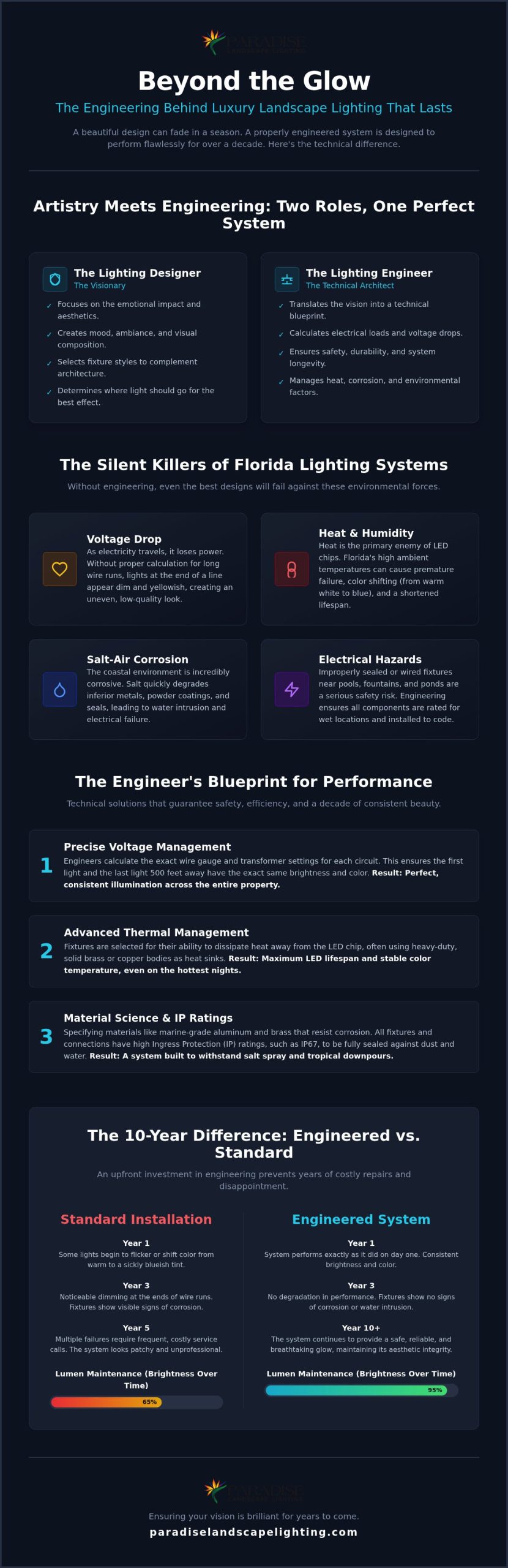
While many people use the terms lighting designer and lighting engineer interchangeably, they represent two distinct disciplines that must work in harmony. A lighting designer focuses on the emotional impact and visual composition of a space. In contrast, a landscape lighting engineer is the technical specialist responsible for calculating electrical loads, managing complex voltage distribution, and ensuring the structural integrity of every fixture. Without this technical foundation, a beautiful design is merely a temporary display. It’s the difference between a system that looks good for a month and one that remains flawless for a decade.
In coastal regions like Miami and Fort Lauderdale, the environment is particularly unforgiving. High water tables and intense soil salinity can quickly degrade inferior systems. A skilled engineer selects materials and designs circuit layouts that withstand these specific local pressures, moving beyond simple plug-and-play setups to create bespoke electrical infrastructures. This expertise is especially critical when transitioning from outdated, power-hungry halogen bulbs to modern, precision-based low-voltage LED technology, which requires much tighter tolerances to function correctly.
The Intersection of Art and Science
An engineer’s primary task is to translate a designer’s creative vision into a functioning electrical blueprint. This involves more than just running wires; it requires a deep understanding of Architectural lighting design and the physics of how light interacts with physical structures. When engineering is done correctly, it remains invisible. You don’t see the heavy-duty conduits or the sophisticated transformers; you only see the perfect, consistent glow across your architectural facades. A landscape lighting engineer acts as the technical backbone of any high-end outdoor project, ensuring that aesthetic brilliance is supported by flawless electrical execution.
Why a Standard Landscaper is Not an Engineer
Hiring a standard landscaper or a general electrical contractor for high-end illumination often leads to disappointing results. While they might understand basic wiring, they frequently lack the specialized knowledge required for low-voltage LED systems. Improperly balanced circuits can lead to flickering lights, premature LED burnout, or even fire hazards in dense foliage. Professional engineers focus on lumen maintenance, which is the ability of a light source to retain its brightness and color temperature over thousands of hours. They ensure that your walkway lights don’t shift from a warm white to a sickly blue after six months of use. This level of precision protects your investment and ensures the safety of high-traffic areas like pool decks and fountains.
The Physics of Light: Engineering for Optimal Performance
High-performance outdoor lighting isn’t a happy accident. It’s the result of rigorous mathematical calculations and a deep understanding of electrical physics. While a designer envisions the final look, a landscape lighting engineer ensures that vision is physically possible and sustainable over time. This involves managing the invisible forces that can degrade a system, specifically voltage drop and heat accumulation.
Mastering Voltage Drop Calculations
Voltage drop occurs when electricity travels through a wire; the further it goes, the more energy it loses. In expansive South Florida estates, such as those found in Weston or Southwest Ranches, long wire runs are unavoidable. If the electrical load isn’t perfectly balanced, the fixtures at the end of the line will appear dimmer or cast a yellowish hue compared to those closer to the transformer. An engineer prevents this by calculating the precise relationship between wire gauge, run length, and total wattage. By adhering to standards set by the Association of Outdoor Lighting Professionals, they ensure that the first light on the circuit and the last one 500 feet away emit the exact same lumen output.
Thermal Management and LED Longevity
Heat is the primary enemy of LED technology. While LEDs are far more efficient than old halogen bulbs, they still generate heat at the chip level. In the sweltering Florida climate, where ambient temperatures often remain high long after sunset, this heat must be dissipated efficiently. A landscape lighting engineer selects fixtures with superior thermal management properties, such as solid brass housings that act as natural heat sinks. Plastic or thin-walled aluminum fixtures often trap heat, leading to “color shift” or total chip failure within just a few years. Proper engineering extends the life of the system significantly, transforming a simple purchase into a long-term investment.
System Zoning and Load Integrity
Precision engineering also allows for sophisticated circuit zoning. This means you can have independent control over your architectural highlighting, walkway safety lights, and sculpture illumination. By performing meticulous load calculations, an engineer ensures the transformer operates at its optimal capacity, neither underpowered nor overloaded. This balance is critical for the longevity of the internal components. If you’re looking for a system built on these rigorous standards, our bespoke engineering services ensure your property remains perfectly illuminated for years to come.
Engineering for the Elements: Durability in South Florida
Florida’s climate is a crucible for outdoor hardware. While a system might look stunning on opening night, the salt air of Miami Beach and the relentless humidity of Fort Lauderdale will immediately begin to test its integrity. A professional landscape lighting engineer doesn’t just plan for the light; they plan for the environment. This means moving beyond standard retail fixtures and looking toward components engineered specifically for coastal stressors. It’s about ensuring that the investment you make today doesn’t vanish into a cloud of oxidation by next season.
Coastal Engineering Challenges
In South Florida, salt air is a constant, corrosive force that can eat through standard aluminum or powder-coated fixtures in months. For coastal estates, we exclusively recommend 316-grade stainless steel or solid brass. These materials develop a natural patina rather than flaking or pitting. Beyond the fixture itself, an engineer focuses on the “unseen” vulnerabilities, such as moisture wicking. This occurs when water is pulled into the wiring through capillary action, eventually rotting the internal components. By using heat-shrink connectors and gel-filled wire nuts, we create a hermetic seal that blocks humidity from entering the system. This meticulous attention to detail is a core principle taught by the International Landscape Lighting Institute, which emphasizes the fusion of technical durability with aesthetic intent.
Safety Standards for Pools and Fountains
Water and electricity are a dangerous combination, making technical precision a non-negotiable requirement for fountain and pool deck lighting. A landscape lighting engineer must adhere strictly to the National Electrical Code (NEC) to ensure every installation is safe for swimmers and guests. This involves the use of isolation transformers and specific grounding techniques that prevent stray voltage from entering the water. Engineering for these environments also requires a mastery of IP (Ingress Protection) ratings. We utilize fixtures with IP68 ratings for submerged applications, ensuring they remain bone-dry internally even during Broward County’s intense tropical downpours. By integrating fixtures directly into the stonework without compromising the waterproof seal, we achieve a seamless look that prioritizes human safety above all else. For those looking to build a new aquatic feature with these high standards, you can explore Custom Pool Design and Construction to see how professional engineering ensures a safe and beautiful result.
Wind and Impact Resistance
Florida’s hurricane season introduces another layer of complexity. High-end lighting must be anchored to withstand significant wind loads. This requires heavy-duty mounting stakes and, in some cases, concrete footings for larger architectural fixtures. We don’t just “place” a light; we secure it. This proactive engineering approach ensures that your investment remains intact and functional even after the storm passes, providing reliable illumination when you need it most for property security and navigation.
The Collaborative Design Process: Where Engineering Meets Artistry
A high-end lighting system begins long before the first shovel hits the dirt. It starts with a comprehensive site audit that goes far beyond a simple walkthrough. During this phase, a landscape lighting engineer maps the property’s topography and evaluates the existing electrical capacity. They identify exactly where the current infrastructure can support new loads and where dedicated circuits must be established to ensure system stability. This data collection allows for a technical mock-up, where we use light-spread calculations to predict shadow play and illumination levels with mathematical certainty before a single fixture is permanently installed.
The result of this collaboration is a detailed technical blueprint. This document serves as a master map of wire runs, transformer locations, and junction boxes. It’s an invaluable asset for homeowners, providing a clear guide for future landscaping or construction projects to ensure the lighting system remains undisturbed. By documenting every technical detail, we provide a level of accountability that standard contractors simply cannot match. To see this engineering-meets-artistry approach in action, explore our case study on outdoor LED lighting design for a Miami luxury estate, where bespoke engineering transformed a Coral Gables property into a nighttime masterpiece.
Precision Architectural Highlighting
This is where the “invisible” engineering truly shines. By calculating specific beam angles, we accentuate the textures of coral stone facades or the intricate lines of a custom sculpture without creating intrusive glare. We often hide fixtures within eaves or masonry to achieve a “light without the lamp” effect, focusing the observer’s eye on the architecture rather than the hardware. To see how we balance these technical requirements with high-end aesthetics, explore our Bespoke Landscape Lighting Design in Fort Lauderdale. Our goal is always to enhance the property’s natural beauty through rigorous technical application.
Smart System Integration
Modern luxury demands seamless connectivity. We engineer our systems to integrate perfectly with smart home platforms like Control4, Lutron, or dedicated mobile apps. This requires a sophisticated understanding of dimming protocols, specifically the difference between Pulse Width Modulation (PWM) and Constant Current. Selecting the wrong protocol can lead to subtle, irritating flickering that ruins the ambiance of a quiet evening. We also program astronomical timers that automatically adjust to the shifting Florida sunset, ensuring your home is always bathed in light at the perfect moment. A professional landscape lighting engineer always builds “headroom” into the system capacity, allowing for future garden growth or architectural additions, such as the louvered systems from Elite L.A. Patios, without requiring a total system overhaul.
If you’re ready to elevate your property with a system that balances visionary design with flawless technical execution, schedule your comprehensive engineering audit with our team today.
Why Engineering Excellence Defines Paradise Landscape Lighting
At Paradise Landscape Lighting, we believe that true luxury is found in the details that most people never see. While many competitors focus solely on the immediate visual impact, our team prioritizes the technical foundation that keeps those visuals consistent for years. A beautiful outdoor space is an investment, and we protect that investment by employing a dedicated landscape lighting engineer to oversee every phase of the project. From the initial electrical audit to the final precision aiming, we ensure that your system is as reliable as it is breathtaking.
We don’t rely on guesswork or remote photo-based designs. Instead, we perform on-site evaluations to understand the unique challenges of your property’s infrastructure. This hands-on approach allows us to select components that meet the “Paradise” standard, utilizing only high-grade materials engineered for the specific rigors of the coastal Florida environment. It’s a commitment to quality that ensures your property remains a beacon of elegance long after the installation is complete.
Our Bespoke Engineering Methodology
Our work in exclusive enclaves like Coral Gables and Palm Beach requires a high degree of technical rigor. These properties often feature complex architectural facades and expansive pool decks that demand precise electrical planning. We approach every project with a bespoke mindset, tailoring the wiring and voltage distribution to the specific needs of the landscape. For homeowners with existing systems, we offer energy-efficient LED retrofitting. This isn’t a simple bulb swap; it’s a comprehensive re-engineering of the circuit to ensure the new technology operates at peak efficiency without flickering or premature failure. Our Miami outdoor LED lighting design case study illustrates exactly how this methodology delivers resort-style results for luxury estates.
Maintenance as Preventive Engineering
We view maintenance not as a chore, but as a form of preventive engineering. As your landscape matures, trees grow and soil shifts, which can impact light placement and wire integrity. Our proactive service includes regular engineering check-ups where we perform voltage testing at both the transformer and individual fixtures. We clean lenses, re-aim lights to account for plant growth, and verify that all seals remain watertight. This methodical process prevents minor wear from turning into major system failures, keeping your outdoor sanctuary in pristine condition year-round.
You shouldn’t have to worry about the technical health of your illumination. Let our experts handle the science so you can enjoy the art. Schedule your professional landscape lighting engineering consultation today.
Secure the Future of Your Property’s Illumination
True luxury in outdoor lighting is found when breathtaking artistry is supported by invisible, flawless engineering. We’ve explored how a dedicated landscape lighting engineer manages the complex physics of voltage distribution and thermal dissipation to ensure your system remains as vibrant in five years as it is on the first night. From navigating the corrosive salt air of coastal Florida to implementing rigorous safety standards around water features, technical precision is what separates a temporary display from a permanent architectural asset.
Our team at Paradise Landscape Lighting specializes in creating these high-performance residential LED systems, offering a seamless journey from initial engineering audits to proactive, long-term maintenance. We don’t just install lights; we build durable electrical infrastructures designed specifically for the unique demands of South Florida luxury estates. By merging visionary design with meticulous technical oversight, we provide you with peace of mind and an outdoor sanctuary that stands the test of time.
Transform your nightscape with a professional lighting engineer from Paradise Landscape Lighting. We look forward to helping you realize the full potential of your property’s evening character.
Frequently Asked Questions
Do I really need an engineer for landscape lighting?
Yes, you need an engineer if you want a system that remains reliable and safe for more than a few seasons. While a standard installer can place fixtures, an engineer performs the critical electrical load calculations and thermal management plans that prevent premature system failure. This technical oversight is what protects your investment from the unique environmental stressors found in South Florida.
What is the difference between a lighting designer and a lighting engineer?
A lighting designer focuses on the aesthetic “what,” such as the mood, shadows, and visual composition of your property. In contrast, a landscape lighting engineer focuses on the technical “how,” including voltage drop calculations, circuit balancing, and structural durability. The engineer ensures that the designer’s artistic vision is backed by a sustainable and safe electrical infrastructure.
How does a lighting engineer prevent lights from flickering?
Flickering is almost always the result of improper voltage distribution or incompatible dimming technology. Engineers solve this by calculating the precise relationship between wire gauge and run length to ensure consistent power reaches every fixture. They also select the correct drivers and dimming protocols, such as Pulse Width Modulation, to maintain a steady current that eliminates the “strobe” effect often seen in lower-quality installations.
Can a landscape lighting engineer help with my pool and fountain lighting?
Engineering is a non-negotiable requirement for any lighting installed near water features. We use isolation transformers and specialized grounding techniques to ensure every pool deck or fountain installation complies with strict National Electrical Code (NEC) safety standards. This specialized expertise provides breathtaking underwater and perimeter illumination while ensuring there’s zero risk of stray voltage for swimmers or guests.
Is low-voltage lighting safer for my South Florida home?
Low-voltage LED systems are significantly safer for outdoor environments than traditional high-voltage lighting. Because they operate on 12V or 24V current, the risk of severe electrical shock is virtually eliminated if a cable is accidentally cut during landscaping or gardening. This is a vital safety feature in our humid climate, where moisture and high water tables can often interfere with outdoor electrical connections.
How long should a professionally engineered LED system last?
A system built to professional engineering standards should provide high-performance illumination for 10 to 15 years or more. This longevity depends on using high-grade materials like solid brass or 316-grade stainless steel that can withstand salt-air corrosion. When a landscape lighting engineer manages the heat dissipation of the LED chips, it prevents the internal components from burning out in the intense Florida heat.
Does a lighting engineer handle the permits for my project?
An engineer provides the technical blueprints, electrical specifications, and site maps required by local building departments to secure necessary permits. While the actual filing is often managed by the licensed installation contractor, having professionally engineered plans ensures the project meets all safety codes from the outset. This precision speeds up the approval process and guarantees that your system is fully compliant with municipal regulations.
Return to News