
Senior Walkway Lighting in Coral Gables: 2026 Guide

What if a brighter walkway light makes it harder, not easier, to see the path? For safe walkway lighting for seniors Coral Gables homeowners should focus on even visibility, not maximum brightness. Dim patches can hide steps, edges, and changes in paving, while poorly aimed lights may create glare and distracting shadows.
Comfortable lighting depends on where fixtures are placed and how their beams fall, not just how much light they produce. A thoughtful design can make path details easier to notice while preserving the calm, polished look of your property.
This guide explains which walkway hazards lighting can help reveal and how to plan consistent illumination for a Coral Gables home. You’ll learn why fixture direction, landscaping, and local requirements matter, and what to discuss when choosing a professional for walkway lighting design and installation. The aim is a clearer, more comfortable route after dark, without harsh glare or unnecessary brightness.
Key Takeaways
- Learn how walkway lighting can make steps, edges, and surface changes easier to see, while recognizing its limits alongside repairs and handrails.
- Assess rainfall, irrigation, moisture exposure, and nearby landscaping before selecting fixture locations. Ask an installer to confirm equipment suitability.
- Compare path-edge, step, and entrance lighting to find options suited to your route, existing light, and preferred appearance.
- Use an after-dark walkthrough to map routes and note hazards, glare, shadows, and plants that obscure the path.
- Plan safe walkway lighting for seniors Coral Gables as part of a coordinated residential design, engineering, installation, and maintenance project.
Safe Walkway Lighting for Seniors Coral Gables: Pros and Considerations
Good walkway lighting isn’t simply a matter of making the whole yard brighter. It’s a plan for showing where a route goes, where its surface changes, and where an obstacle may interrupt a person’s step. For homeowners exploring safe walkway lighting for seniors Coral Gables, the goal is comfortable visibility along the walking surface, not a flood of light across the property.
Walkway lighting is the intentional illumination of paths, transitions, and potential obstacles so their locations are easier to see after dark. That reflects a broader approach to landscape lighting, where placement and direction shape how people perceive a space and its features.
Well-considered lighting can make route details more visible and help a person orient themselves outdoors at night. But it has limits. It can’t guarantee fall prevention, correct loose or uneven paving, or replace a handrail where one is needed. When planning broader accessibility updates or aging-in-place improvements, consulting specialists such as HomeSafe Living Solutions can help address structural safety. Treat lighting as one part of a thoughtful approach to the walkway, alongside attention to physical hazards.
Which walkway hazards deserve attention after dark?
Look for places where the walking surface changes or the route becomes less predictable. Steps, raised thresholds, uneven paving, and path edges can be harder to distinguish in dim or inconsistent light. Also check bends, gates, entrances, and the transition from driveway to walkway, where someone may change direction or move between surfaces.
Walk familiar routes at dusk and again after dark. Notice where a step blends into its surroundings, where plants obscure the path, or where the route seems to disappear around a corner. Observing the path in its actual nighttime conditions can reveal where lighting may be useful, even when the route feels familiar during the day.
Why comfort matters as much as brightness
A fixture can be bright and still make a path harder to read. Direct glare may draw the eye toward the light source and make nearby surfaces less comfortable to see. Poor placement can cast strong shadows across paving or create bright spots beside darker stretches, leaving the route visually confusing.
A better aim is consistent, comfortable visibility. Consider how light falls across the walking surface and whether changes in level remain easy to distinguish without harsh contrast. Placement depends on the route and its surroundings, so professional design can help balance visibility with the property’s appearance. More light isn’t automatically better. Direction and coverage matter.
How Coral Gables Weather and Landscaping Shape Walkway Lighting
A walkway lighting plan should respond to conditions around the route, rather than assume every Coral Gables property needs the same fixtures or layout. Rainfall, irrigation patterns, moisture exposure, planting beds, and tree growth can affect fixture and wiring placement, as well as how easily the path remains visible over time.
A site assessment connects local moisture, drainage, and landscape growth to fixture placement and future maintenance. It can identify where a light may be exposed to a sprinkler’s direct spray, hidden by foliage, or positioned where it complicates garden care. The Pedestrian Safety Guide from the Federal Highway Administration discusses lighting for pedestrian environments, including sidewalks. A home’s specific layout still calls for a property-by-property assessment.
Assess rain, irrigation, and outdoor exposure
Walk the route after irrigation and note sprinkler heads, runoff channels, and places where water tends to collect. A fixture in the path of repeated sprinkler spray may need a different location. Plan wiring routes with the surrounding ground conditions in mind, too. These details can affect the equipment and installation approach suited to each location.
Ask the lighting designer or installer to confirm that the selected equipment and installation details suit the exposure at each spot. Don’t assume a fixture is appropriate simply because it’s marketed for outdoor use. If local code, permitting, or electrical requirements may apply, verify them with the relevant authority and qualified professionals.
Plan around Coral Gables trees and garden growth
Established trees and layered gardens can make a property distinctive, but roots, canopies, and foliage affect lighting placement. Before choosing fixture positions, note visible roots, nearby hedges, overhanging branches, and planting beds. Avoid placing fixtures or cables where they could interfere with routine landscape care or create an obstacle beside the walking route.
Consider how the scene may change as plants mature. A low fixture that illuminates paving today could become blocked by a hedge, while a canopy may cast shadows across a path. Leaves and branches can shift where light falls, too. Periodic review helps identify when plant growth, irrigation adjustments, or other site changes have altered the lighting’s effect.
For safe walkway lighting for seniors Coral Gables, a site-specific plan can balance visibility with how the property is used and maintained. Paradise Landscape Lighting designs and installs residential walkway lighting. Homeowners can explore walkway lighting design and confirm project details directly.
Compare Walkway Lighting Approaches for Senior-Friendly Visibility
Different parts of a route call for different lighting approaches. Path-edge fixtures can help reveal the route’s boundaries, while step or entrance lighting can draw attention to a change in level or a decision point. The right combination depends on the walkway’s shape, nearby ambient light, and the appearance you want. A fixture type alone can’t determine whether the finished lighting will feel clear and comfortable.
| Approach | Purpose | Placement to consider |
|---|---|---|
| Path-edge lighting | Helps define the route without lighting every square foot. | Along one or both sides where the path boundary is hard to distinguish. |
| Step and transition lighting | Makes changes in level or surface easier to notice. | Near steps, thresholds, and the transition from driveway to walkway. |
| Entrance lighting | Helps clarify the approach and arrival point. | Near gates and entrances, aimed to illuminate the route rather than shine toward approaching users. |
Path-edge lighting versus step and transition lighting
Path-edge fixtures can suggest the line of a walkway with selective pools of light. They don’t need to brighten the entire yard. Their spacing and position should make the route read as continuous, especially around bends. Steps and level changes may need more distinct illumination so their edges don’t disappear into nearby paving. Include gates, doorways, and driveway crossings in the plan, since each can mark a change in direction or surface.
Choose placement that limits glare and visual confusion
A shielded fixture or one carefully aimed toward the walking surface can illuminate the route without exposing a bright source at eye level. By contrast, a source directed toward someone approaching may cause discomfort and distract from the path. Fixture height and spacing shape the result: lights placed too far apart can leave dark gaps, while poorly aligned beams may overlap into bright patches or cast confusing shadows.
Review the route from the direction it’s usually approached. Where practical, check the view from both standing and seated positions, since a fixture that looks discreet from one angle may shine into the eyes from another. Account for nearby porch lights, street lighting, and other ambient sources.
Low-voltage LED describes a system category, not a promise of safe placement or a particular lighting result. For safe walkway lighting for seniors Coral Gables, fixture choice should follow the route’s shape, existing light, and intended visual effect. A considered design balances visibility with the home’s landscape instead of relying on one bright fixture to do everything.
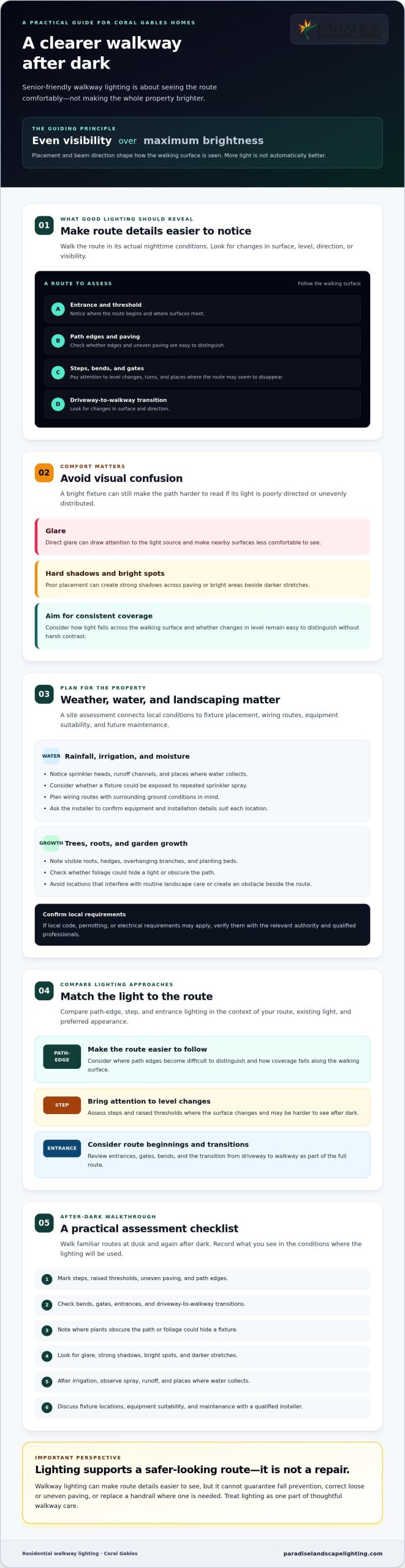
A Coral Gables Checklist for Assessing and Planning a Safer-Looking Walkway
An after-dark assessment can turn a general concern into a clear lighting plan. Focus on the routes people actually use, then distinguish visibility issues from physical hazards that need a different solution. For safe walkway lighting for seniors Coral Gables, careful observation helps a qualified professional understand where illumination may be useful without treating lights as a substitute for repairs or other safety measures.
A simple after-dark route assessment
- Identify the routes. Note the usual paths between the home, driveway, gate, and other frequently used entrances.
- Mark changes and obstacles. Record steps, turns, thresholds, uneven surfaces, edges, and transitions between driveway and walkway.
- Observe the path after dark. If appropriate and safe, walk the route slowly with the older adult. Otherwise, assess it from a safe position. Note where edges are hard to see and where fixtures, windows, vehicles, or neighboring properties create glare.
- Map the existing light. Record porch lights and other sources, along with dark gaps, strong shadows, and sections hidden by plants or branches.
- Set priorities. Identify where visibility needs attention, then list separate concerns such as loose paving, blocked pathways, or a missing handrail.
Take notes or photos from safe locations, and write down questions about fixture direction, placement, and maintenance. This gives a lighting professional useful context for assessing the property. For broader installation context, see the Broward County outdoor lighting installation guide.
When to involve a lighting professional
Consider a professional assessment if the property has several routes, multiple changes in level, mature landscaping, or lighting that needs to work as a coordinated system. A designer can consider how fixtures relate to the path, existing ambient light, and the home’s appearance. Electrical work and installation details should be handled by appropriately qualified professionals. A lighting plan alone won’t resolve surface defects or other hazards.
Paradise Landscape Lighting provides residential walkway lighting design and installation. If you’re ready to discuss a site-specific plan, explore walkway lighting options and confirm project details directly.
Professional Walkway Lighting in Coral Gables: Design, Installation, and Next Steps
A well-planned walkway lighting project brings design decisions and technical details together. The route, fixture positions, light direction, and surrounding landscape all influence how the finished system feels at night. Coordinating design, engineering, installation, and maintenance can keep those considerations connected from the initial plan through ongoing care.
Paradise Landscape Lighting designs, engineers, installs, and maintains custom low-voltage LED systems for residential outdoor spaces, including walkway lighting. Its team includes a lighting designer and a lighting engineer. This supports a considered approach to visibility, comfortable light, and the character of the home, without treating lighting as a guarantee against falls.
What to discuss during a walkway lighting consultation
Bring your route notes and describe which paths are used most often, where navigation feels difficult, and what you observed after dark. Discuss the appearance you prefer, whether fixtures should be discreet or more visible, and how existing porch lights or other outdoor illumination affect the scene. Point out planting that may grow across a beam or make fixture access difficult.
Ask how the proposed layout addresses glare, maintenance access, and future landscape changes. Clarify what ongoing maintenance the system may need, and verify applicable electrical or local requirements with the relevant authority and qualified professionals. These conversations help turn general preferences into specific design priorities.
A coordinated design for comfort and curb appeal
Walkway lights can serve a practical purpose while fitting naturally into the home’s broader landscape. Placement can help define a route without overwhelming garden features or competing with architectural details. For homeowners considering safe walkway lighting for seniors Coral Gables, keep the design conversation focused on actual walking routes and the desired balance between visibility and visual comfort.
The company’s Broward County landscape lighting installation overview offers broader regional installation context. Its Fort Lauderdale outdoor lighting design guide may also be useful for a wider look at design considerations. Neither guide should be taken as proof of a specific Coral Gables project.
If you’re considering a residential walkway lighting project, discuss your lighting plans with Paradise Landscape Lighting and confirm project details directly.
Make Your Walkway Easier to Navigate After Dark
Thoughtful walkway lighting starts with the route itself. Identify where steps, edges, and surface changes need to be more visible, then consider how fixture placement, glare, landscaping, and existing light affect the view. The aim of safe walkway lighting for seniors Coral Gables is comfortable, consistent visibility, not simply a brighter yard. Lighting can support clearer wayfinding, but it doesn’t replace repairs, handrails, or attention to other hazards.
Paradise Landscape Lighting provides residential low-voltage LED landscape lighting design, engineering, and installation, along with maintenance services. Its team includes a lighting designer and a lighting engineer, and its offerings include walkway and fence lighting. The company serves South Florida communities including Fort Lauderdale, Weston, Southwest Ranches, Wilton Manors, Palm Beach, Miami, Miami Beach, Coral Gables, Plantation, West Palm Beach, and Coconut Grove.
Discuss a thoughtfully designed walkway lighting plan for your Coral Gables home. Share your priority routes, preferred appearance, and maintenance considerations, and confirm project details directly.
Frequently Asked Questions
Can walkway lighting help seniors see steps and uneven paths at night?
Yes, thoughtfully placed walkway lighting can make steps, uneven paving, thresholds, and path edges easier to distinguish after dark. For safe walkway lighting for seniors Coral Gables homeowners should look for consistent illumination along the route, not just a bright fixture near the door. Lighting can improve visibility, but it won’t repair damaged surfaces or guarantee fall prevention. Address physical hazards separately, and consider handrails where appropriate.
What type of outdoor lighting is best for an older adult’s walkway?
The best approach depends on the route. Path-edge lights can help show where a walkway runs, while targeted lighting near steps, gates, entrances, and driveway transitions can highlight changes in level or direction. A coordinated design considers existing porch or street lighting, landscaping, and the appearance you prefer. Avoid choosing fixtures based on brightness alone. Placement and beam direction affect whether the path feels clear and comfortable.
How can walkway lights be positioned to reduce glare?
Aim light toward the walking surface rather than directly toward someone approaching. Shielded fixtures or carefully directed beams can help keep the light source out of the line of sight. Check for bright spots and deep shadows, too. View the route from its usual approach and, where practical, from both standing and seated positions. Nearby windows, vehicle lights, and existing outdoor fixtures can also affect comfort.
Are low-voltage LED walkway lights suitable for Coral Gables homes?
Low-voltage LED systems are used in residential landscape lighting, including walkway applications, but suitability depends on the site and design. Consider moisture exposure, irrigation, planting, route layout, and how the lights will be aimed. A system category alone doesn’t guarantee comfortable visibility or appropriate performance. Ask the designer or installer to confirm equipment and installation details for each location, and verify applicable Coral Gables requirements with relevant authorities and qualified professionals.
Does walkway lighting prevent falls for seniors?
No lighting system can guarantee that falls will be prevented. Walkway lighting may help make surface changes and obstacles more visible, but it doesn’t correct loose paving, remove obstructions, or replace a needed handrail. Pair lighting improvements with attention to the walking surface and other site hazards. If a route remains difficult to navigate, consider seeking appropriate professional advice rather than relying on brighter lights alone.
How do I assess a walkway for lighting needs after dark?
Identify the routes used most often, then observe them at dusk and after dark from a safe position. Note steps, turns, thresholds, uneven areas, and driveway transitions that are hard to distinguish. Record existing lights, glare, shadows, and plants that block the route or fixtures. If it’s appropriate and safe, include the older adult who uses the path. Keep lighting needs separate from surface repairs or other hazards.
Can a landscape lighting professional design and install walkway lighting in Coral Gables?
Yes. Paradise Landscape Lighting provides residential landscape lighting design and LED installation, including walkway and fence lighting, with engineering and maintenance services also available. Its team includes a lighting designer and a lighting engineer. The company serves South Florida communities including Coral Gables, Miami, and Fort Lauderdale. Discuss your routes and glare concerns, then confirm project details directly.
How should outdoor walkway lights be maintained in South Florida?
Review the route and fixtures periodically, especially after landscaping changes or adjustments to irrigation. Check whether foliage now blocks a beam, shadows have shifted, or a fixture appears misaligned or damaged. Keep the walking surface clear and note moisture exposure or drainage changes for the installer to assess. Ask what maintenance the selected equipment needs and how to arrange service if the system’s performance changes over time.
Return to News