
Seasonal Landscape Lighting Adjustments: When to Re-Aim Fixtures and Update Controls

Calendar changes alone don’t tell you when landscape lights need attention. Plan for quarterly checks and fuller tune-ups in spring and fall. Between them, seasonal landscape lighting adjustments may be needed when fixtures tilt, shadows become uneven, glare appears, or light falls on the wrong surfaces. These signs often matter more than the season itself.
A lighting scheme should keep working as the landscape changes, but growing plants, fallen leaves, shifting daylight, and seasonal displays can alter how beams look at night. A path that once seemed evenly lit may develop dark patches, while an accent fixture may shine toward a window instead of the feature it was meant to highlight.
A professional assessment can determine whether fixtures need re-aiming and whether beam spread or brightness should change for the setting. Mechanical timers, photocells, astronomical timers, and smart controls respond differently to seasonal daylight. Visible signs, such as glare or uneven shadows, can also indicate that a lighting system needs attention.
Key Takeaways
- Use glare, uneven shadows, dark patches, and beams landing on the wrong surfaces as cues that fixtures may need professional re-aiming.
- Seasonal displays and changing plant growth can alter where light is needed, so fixture direction should suit the landscape as it looks now.
- Choose lighting controls based on how schedules should respond to changing daylight, from simple timing to more adaptive options.
- Tune brightness and beam spread to highlight key features without creating harsh glare or deep shadows.
1. Adjustable fixtures for changing seasonal displays
Useful outdoor lighting changes follow the landscape: spring fixtures can highlight fresh colors with soft-white LEDs, while summer scenes may call for warmer, brighter light around outdoor living areas. In fall, uplighting can reveal colorful leaves, and spotlights can pick out pumpkins or gourds. Winter displays can use soft, festive light, with path and accent lighting shifted to a warm 2700K.
Fixture direction matters as the sun angle and foliage change. In autumn, lower sunlight can create longer shadows, so assess whether beams still reach their intended surfaces. Adjustable fixtures can be redirected for seasonal displays, such as shifting an accent from a summer flower bed to a tree’s changing leaves. Aim to highlight the feature without sending light into windows or neighboring properties.
Plant growth also affects fixture placement. A shrub that was small when the system was designed may eventually block a beam, leaving a dark patch behind its foliage. Account for likely growth when positioning fixtures, then reassess the beam as plants mature. This can preserve useful illumination without repeatedly moving lights to compensate for predictable obstructions.
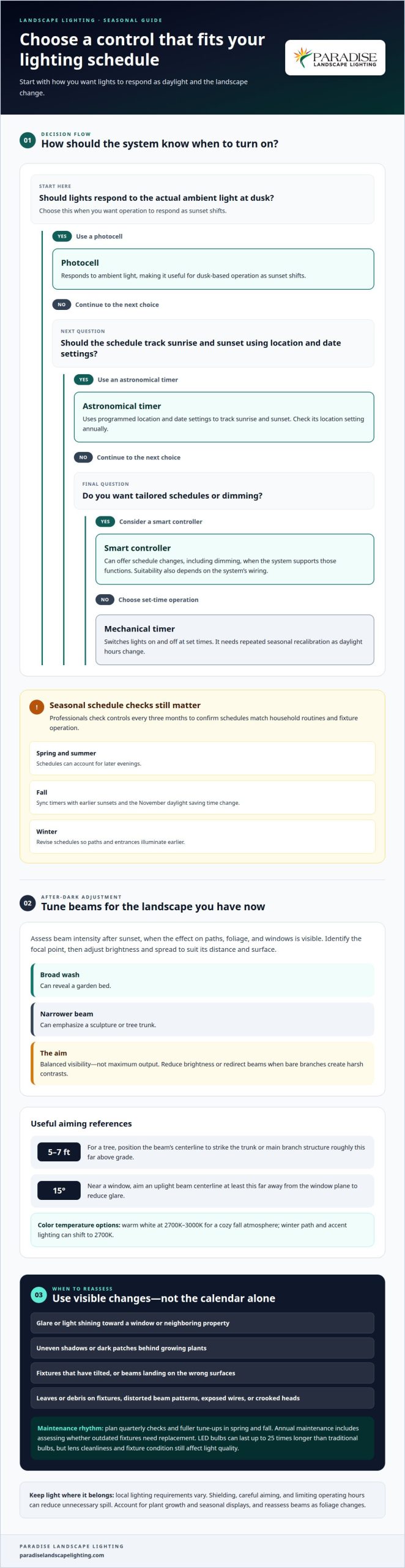
During seasonal maintenance, professionals clean exterior lenses because dust, pollen, and debris can distort beam patterns. They also clear leaves from fixtures and inspect for exposed wires or crooked heads. Quarterly alignment checks can catch changes early, while annual maintenance includes assessing whether outdated fixtures need replacement. LED bulbs can last up to 25 times longer than traditional bulbs, but lenses and fixture condition still affect the quality of light. For outdoor exposure, IP-rated fixtures are recommended to withstand rain, snow, and extreme temperatures. These checks help fixtures perform reliably as weather and displays change.
Comparing mechanical timers, photocells, astronomical timers, and smart controllers
Choose outdoor lighting controls to suit the property’s schedule and desired level of automation. Mechanical timers switch lights on and off at set times but need recalibration as daylight hours change. Photocells respond to ambient light, making them useful for dusk-based operation as sunset shifts. Astronomical timers use programmed location and date settings to track sunrise and sunset. Smart controllers can offer schedule changes, including dimming, when their system supports those functions.
For shorter winter days, professionals revise schedules so walkways and entrances illuminate earlier, rather than leaving people to arrive home in darkness. In fall, they sync timers with earlier sunsets and the November daylight saving time change. Mechanical timers need repeated seasonal adjustments; an astronomical timer’s location setting should be checked annually. A professional also checks controls every three months, confirming that schedules still match household routines and fixture operation.
Local lighting requirements vary, so account for the rules that apply to the property rather than assuming one nationwide standard. Shielding and careful aiming can keep beams on intended surfaces, while limiting operating hours can reduce unnecessary spill. These choices support dark-sky-conscious lighting without relying on one setting for every property.
Seasonal programming should reflect the landscape as well as daylight. In spring and summer, schedules can account for later evenings; in fall and winter, earlier activation can illuminate paths before residents return. Professionals consider how branches and other obstructions affect the intended coverage, then tune operating times to the areas that need light.
Timers and sensors can help save energy and add security. Scheduling lights to turn off or dim when they’re no longer needed can reduce unnecessary illumination and light pollution. The right control depends on the desired schedule, the system’s wiring, and whether automatic dusk response or more tailored programming matters most. For a coordinated plan, professional landscape lighting design can bring fixture placement and control choices together.
3. Adjusting beam intensity and spread
Professionals assess beam intensity after sunset, when the effect on paths, foliage, and windows is visible. They identify the intended focal point, then adjust brightness and spread to suit its distance and surface. A broad wash can reveal a garden bed, while a narrower beam can emphasize a sculpture or tree trunk. The goal is balanced visibility, not maximum output.
There isn’t one color temperature or brightness level that suits every season or landscape. For a cozy fall atmosphere, warm white light at 2700K-3000K is one option; winter path and accent lighting can shift to 2700K. Professionals consider the surrounding materials, nearby windows, and how the space is used during the evening before settling on the effect.
Leaf loss changes how light travels. After foliage drops, an uplight that once softened across a leafy canopy may strike bare branches more sharply. Reduce brightness or redirect the beam to soften harsh contrasts. Balance coverage across walkways and living areas, where one overly bright fixture can create glare and deep shadows. Several carefully placed fixtures can produce more even light across the ground.
For a tree, the beam’s centerline can be positioned to strike the trunk or main branch structure roughly 5 to 7 feet above grade. Near a window, professionals aim an uplight beam centerline at least 15 degrees away from the window plane to reduce glare. They then assess the illuminated surface from relevant viewpoints, including the path and outdoor seating area. Smart outdoor lighting systems can also provide control over brightness and color, allowing a scene to be tuned without relying on one fixed intensity. In this way, seasonal changes refine both visibility and atmosphere while keeping light directed where it serves a purpose.
4. Signs landscape lighting needs adjustment
A lighting design that worked in summer may look different by October. At 6:30 p.m., a yard can appear darker than it did in July because sunset arrives earlier. If walkways, steps, or entrances now have dark patches, the system may need a schedule or fixture adjustment. These changes are practical cues for seasonal landscape lighting adjustments, especially where people use outdoor spaces after dusk.
Look for beams highlighting the wrong surface, harsh glare, uneven shadows, or tilted fixtures. Even a path light shifted slightly can create more glare. A beam that once reached a garden feature may now strike a window or miss its target. Reassess the view from paths and living spaces, then correct the direction and coverage.
Shorter winter days can also reveal weak coverage. Solar lights in shaded areas may provide less brightness or operate for less time, leaving a walkway dim when people need it. If a route that felt clear in summer becomes difficult to see at night, a professional can assess whether placement, aiming, or the lighting schedule needs attention. That assessment helps identify which seasonal landscape lighting adjustments will best address the problem.
Physical damage deserves prompt attention. Crooked fixtures, flickering lights, exposed wiring, or suspected damage to buried lines call for professional investigation, not just an aiming change. Seasonal checks can also identify loose connections and shallow wires before they lead to larger repairs. If several fixtures fail together, the problem may involve the system rather than a single light.
A useful assessment connects each symptom to its location and timing. Professionals note which nights or areas show the problem, whether glare affects a window, and whether steps or walkways remain visible. Those details help distinguish a control issue from a misaligned fixture or damaged component. For a tailored review of lighting placement and performance, request a professional lighting assessment.
Paradise Landscape Lighting
Paradise Landscape Lighting helps homeowners address changing coverage, glare, and control needs through tailored outdoor lighting design and installation. Its lighting designer and engineer develop solutions for residential spaces, considering how fixtures illuminate gardens, pools, fountains, and architectural features as the landscape changes.
Turn to Paradise Landscape Lighting when seasonal displays change, growing foliage blocks a beam, or nighttime use reveals dark areas on paths or pool decks. A project can include landscape lighting design, LED lighting installation, or focused illumination for sculpture and artwork, depending on which areas need attention.
Tell Paradise Landscape Lighting which fixtures or spaces look different after dark, and discuss your seasonal lighting needs with the team.
Shape the Next Lighting Plan Around How You Live
Let the way you use your outdoor spaces guide the next lighting decision. A quiet seating area, a frequently used entrance, and a garden viewed from indoors each call for a different balance of visibility and atmosphere. Prioritizing these areas turns seasonal landscape lighting adjustments into a considered plan rather than a series of isolated changes.
Before a professional review, note which areas feel less comfortable after dark and what you’d like to emphasize. Clear priorities give the design process a practical starting point and help align the lighting with your home’s character.
For a tailored next step, contact Paradise Landscape Lighting today. Thoughtful planning can help your outdoor spaces feel welcoming as the landscape and your needs evolve.
Frequently Asked Questions
How often should a professional adjust your landscape lighting?
Schedule professional checks quarterly, with fuller tune-ups in spring and fall. Visible changes can also signal the need for a review: a newly planted bed may start blocking a beam, or a path may become harder to see after dark. In Fort Lauderdale and Miami, Paradise Landscape Lighting can assess how the landscape and household routines affect your lighting plan.
How do professionals safely adjust outdoor spotlights?
Inspect each spotlight’s condition and wiring before changing its aim. Direct the beam toward its intended feature, then assess the result from nearby paths, windows, and seating areas. If a fixture needs to move, a lens is cracked enough to expose wiring, or wiring appears damaged, the work calls for a qualified professional, not a simple aiming correction.
When should you call a professional?
Call a qualified professional about exposed wiring, flickering lights, or suspected damage to buried lines. Professional help is also appropriate when a fixture must move elsewhere in the yard, a transformer needs upgrading, or the system needs additional fixtures on a circuit. These conditions go beyond seasonal aiming and can involve wiring or system components.
Why does my yard look darker in the fall?
Earlier sunsets can make the yard feel darker at the same evening hour than it did in summer. The autumn sun angle can also create longer shadows, while fallen leaves change how light reaches branches and ground surfaces. If a familiar route feels dim, compare its visibility after dark and note whether the change affects a walkway, entrance, or seating area.
How do changing daylight hours affect landscape lighting schedules, and how do professionals adjust them?
As daylight hours shorten, outdoor lights may need to switch on earlier to illuminate entrances and paths before residents arrive. Adjust timer schedules to suit the season and household routine. Mechanical timers need recalibration as sunset shifts; astronomical timers track sunrise and sunset through their location setting. Photocells respond to ambient light, while smart controllers can support schedule and brightness changes.
How should lighting placement change as trees and plants grow or lose leaves?
As trees and shrubs grow, assess whether foliage blocks beams or creates dark areas behind plants. After leaves fall, check whether previously softened light now strikes bare branches sharply. For a home in Weston or Palm Beach, Paradise Landscape Lighting can consider mature plant shapes and the surfaces you want illuminated, then refine fixture direction or placement to suit the changed landscape.
Return to News