
Is Professional Landscape Lighting Worth It in Florida? A 2026 Guide
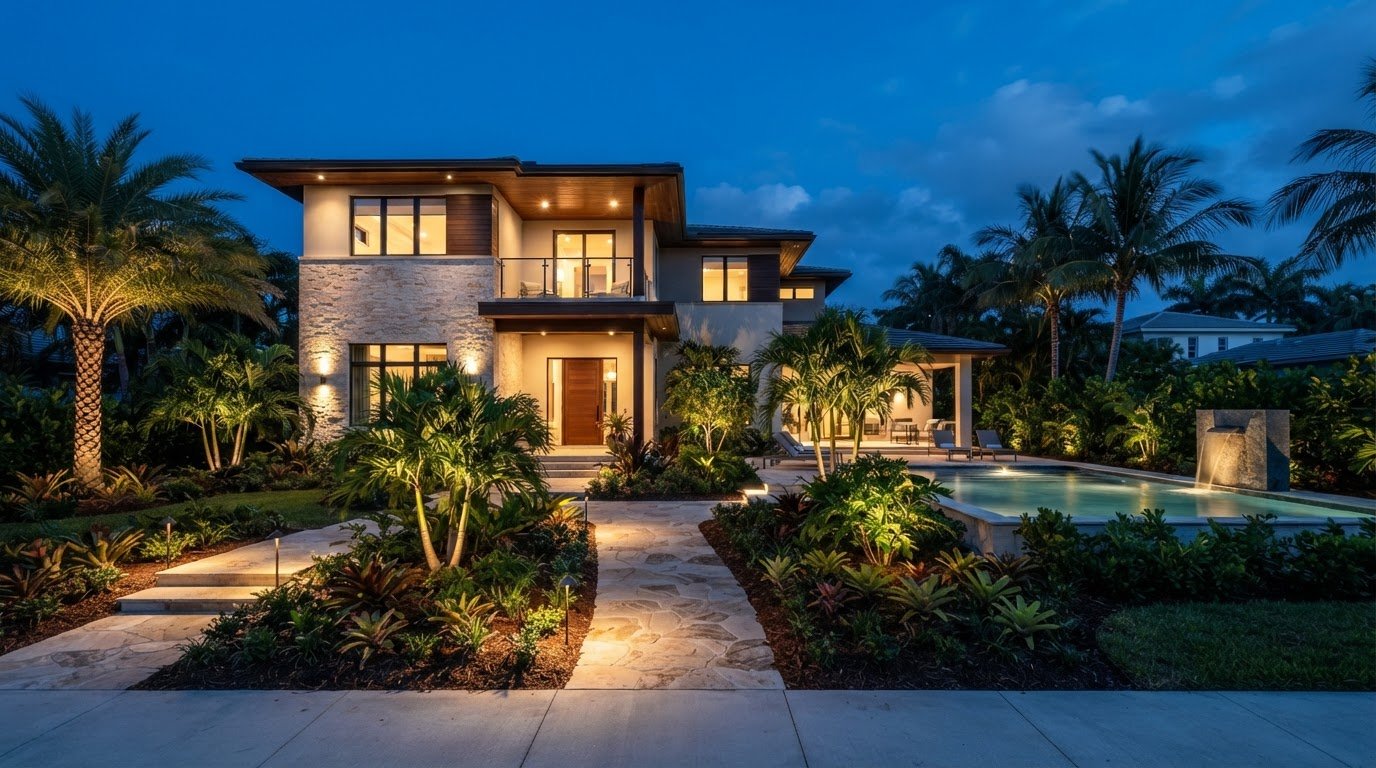
What if the best return on landscape lighting isn’t a higher sale price, but the pleasure and confidence you gain every evening? If you’re asking, “is professional landscape lighting worth it in Florida,” the answer depends on how you use your outdoor spaces and what you expect the investment to deliver. A polished lighting plan may enhance curb appeal, but it can’t promise a specific resale return.
It’s reasonable to weigh that uncertainty against the simplicity of a DIY setup, especially when Florida’s heat, humidity, and coastal salt air raise questions about upkeep and durability. Professional lighting involves more than placing fixtures. Design and engineering coordinate light across your home’s architecture, garden, paths, pool, or artwork to create a cohesive effect.
This guide will help you assess practical and aesthetic benefits, distinguish measurable advantages from subjective appeal, and consider maintenance before deciding. You’ll learn what to compare between a tailored professional plan and DIY, and what to ask about design, materials, controls, and ongoing care before requesting a proposal. The goal is to make a clear decision based on your property, priorities, and expectations, not a promise of resale gains.
Key Takeaways
- Decide whether professional landscape lighting is worth it in Florida by ranking the benefits you want, from clearer pathways to a more composed nighttime view.
- Look beyond fixture count: placement, beam direction, brightness, and viewing angles affect how well lighting suits your home and outdoor spaces.
- Compare a professional plan with a focused DIY project by considering design control, installation complexity, coordination, and future service needs.
- Separate essential lighting needs from decorative options to identify where professional design could make the greatest difference.
- Understand the typical project progression, from defining goals and assessing the property to design, engineering, installation, and maintenance.
Is Professional Landscape Lighting Worth It in Florida? Start With the Benefits You Value
Professional landscape lighting can be worthwhile when its practical and aesthetic benefits match your priorities. If you spend time outside after dark, want a clearer view along a walkway, or value a thoughtfully illuminated home, those benefits may matter more to you than a possible resale gain. Start by asking what you want the light to help you see and do, rather than counting fixtures.
Landscape lighting combines illumination, placement, and visual effect. A general overview of landscape lighting can help clarify common uses, but a professional plan also considers how your property looks and functions at night. Carefully aimed light can draw attention to architectural lines, garden textures, a fountain, or a sculpture without illuminating every part of the yard equally.
Which benefits matter beyond resale value?
Start with how you use your outdoor spaces. Lighting near a patio or pool deck can make the area feel more welcoming after sunset, while well-planned illumination along a path can help people see their route. These are practical and experiential benefits, not promises of crime prevention. Lighting can also reveal landscape and architectural details that disappear in the dark, creating a more considered view from outdoors and from inside the home.
Resale is less predictable. Buyer preferences, the property, and local market conditions all influence whether outdoor lighting affects a sale or valuation. For insight into how buyers evaluate coastal properties and presentation, regional real estate resources such as krissyinthekeys.com highlight that overall outdoor lifestyle appeal often matters more than specific fixture counts. Professional landscape lighting may enhance perceived curb appeal and the experience of a property, but that perception is not a guaranteed financial return or a promise of a specific increase in resale value. Treat resale as a possible secondary benefit, not the only reason to invest.
What does the Florida setting change?
Florida’s humid, rainy conditions make it sensible to ask how a proposed system is suited to its location and what maintenance it may require. In coastal areas, salt exposure is another site-specific consideration. Ask the lighting professional to explain how the selected materials suit your property rather than assuming every fixture performs equally well near the coast.
That local assessment can be especially relevant in South Florida communities such as Fort Lauderdale and Miami, as well as Weston, Southwest Ranches, Wilton Manors, Palm Beach, Miami Beach, Coral Gables, Plantation, West Palm Beach, and Coconut Grove. Before deciding whether professional lighting is right for your home, compare the value of tailored design, installation, and ongoing care with your priorities. If everyday use, visibility, and a cohesive nighttime appearance matter to you, the investment may make sense even without a guaranteed resale premium.
What Professional Landscape Lighting Adds: Design, Engineering, and a Cohesive Result
A professional lighting plan starts with the property, the atmosphere you want after dark, and how you use each outdoor area. It doesn’t begin with a target fixture count. A lighting designer considers what should draw the eye, what needs practical illumination, and how different parts of the home relate when viewed from the patio, pathway, or street. That broader perspective can make the result feel composed rather than like a collection of unrelated lights.
How does a tailored lighting plan shape the result?
Design choices guide attention. A focused beam can reveal the texture of a mature tree or the lines of a facade, while softer light along a garden path can support orientation without competing with the home’s focal features. Layering combines these effects, balancing light and shadow instead of making the whole yard uniformly bright. For more criteria to consider, explore a guide to bespoke outdoor LED lighting design.
Fixture placement shapes what you see: the right angle can reveal a feature while limiting glare, harsh shadows, and visual imbalance. Brightness, beam direction, and viewing angles all matter. A light that looks subtle from the garden might shine directly into a window from the street, so the design should account for how people experience the space from different viewpoints.
A coordinated plan can connect architectural lighting with gardens, walkways, pool decks, fountains, and sculptures. As property enhancement specialists like Palisades Outdoor Solutions often emphasize with outdoor spaces, lighting works best when balanced with the surrounding landscape and lawn care. For example, a softly lit facade can provide a visual anchor while nearby planting and a path receive more restrained illumination. The aim is not to light every surface equally, but to create a clear hierarchy suited to the property and its use.
Why do engineering and installation matter?
Design establishes the visual intent; engineering and installation translate it into a system suited to the site. A project may need to account for fixture locations, wiring routes, system layout, and the relationship between separate illuminated areas. The details depend on the property and project scope. For water-feature projects, a dedicated pool and fountain lighting guide can help homeowners identify questions to discuss before planning begins.
Paradise Landscape Lighting designs, engineers, and installs custom low-voltage LED systems for residential properties in South Florida. If you’re comparing approaches, reviewing the company’s landscape lighting design services can help you understand how a tailored plan may fit your home.
Professional vs. DIY Landscape Lighting in Florida: Compare the Value, Not Just the Fixtures
DIY and professional lighting solve different problems. A small, clearly defined project may be manageable for a homeowner who’s comfortable planning fixture locations, handling installation, and troubleshooting later. A professional plan may offer more value when the goal involves several areas, complex sightlines, or a unified look across the property. Professional service isn’t automatically worthwhile for every home or project.
| Consideration | DIY approach | Professional approach |
|---|---|---|
| Design control | Direct control over a limited layout; results depend on your planning and adjustments. | A designer develops a coordinated plan around the property, priorities, and desired effect. |
| Installation complexity | Can suit a straightforward project if you’re comfortable with its requirements. | Useful when the site or system layout involves more features and coordination. |
| Coordination | You decide how each fixture relates to the others and to the home. | One plan can connect architectural, garden, walkway, and pool-area lighting. |
| Future service | You take responsibility for adjustments and troubleshooting, or arrange help separately. | Ask what maintenance or future service is available and included in the proposal. |
When can a DIY approach be enough?
DIY may fit a modest project with one clear purpose, such as adding a small number of lights along a simple garden path. Before choosing it, consider whether you can plan the layout, complete the installation, and identify the cause of a problem later. A kit isn’t automatically inadequate; its suitability depends on your goals, the property, and the scope you’re prepared to manage.
When does professional planning offer a clearer advantage?
Professional planning becomes more useful when several zones need to work together. A facade, mature planting, walkway, and pool area each create different design and installation considerations. A coordinated system can account for how those features appear from multiple viewpoints, rather than treating each as a separate lighting task. Ask how the proposed design covers the full scope and what ongoing service may be available.
For a homeowner asking, is professional landscape lighting worth it in Florida, the comparison comes down to personal value as much as technical complexity. DIY may be sensible if the project is contained and you’re comfortable managing it. Professional design and installation may be a better fit if you want a cohesive result across several features or prefer to have the system planned and installed as one project. Compare proposals by scope, design approach, installation details, and future support, not just fixture count.
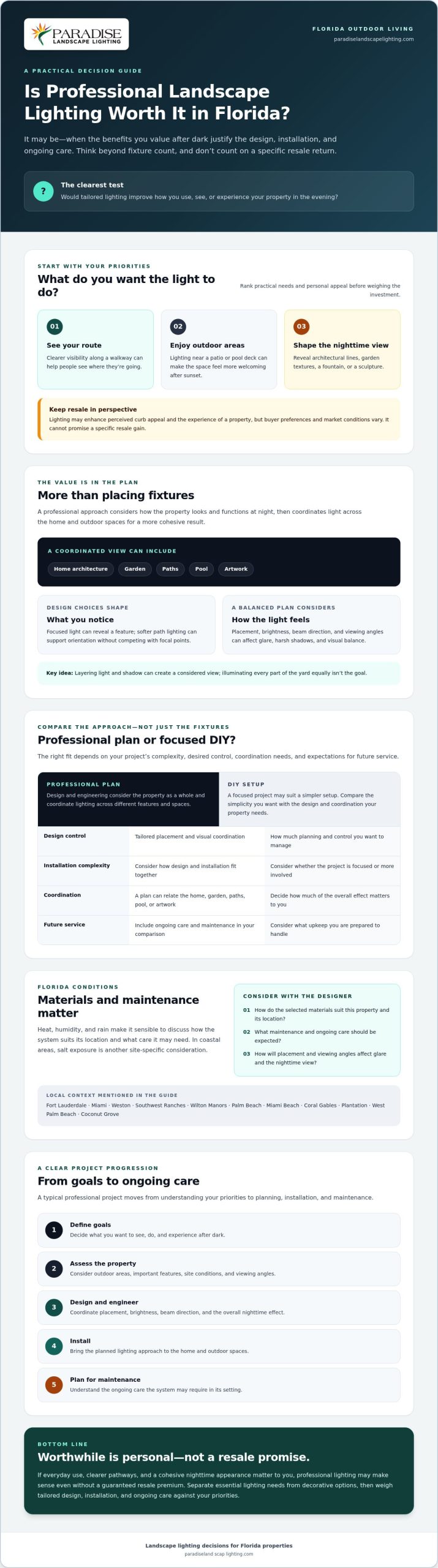
How to Decide If Professional Landscape Lighting Is Worthwhile for Your Property
A good decision starts with what you want the lighting to do, not with a fixture count. Use this checklist to identify your priorities, define the project, and compare proposals on more than appearance alone.
- 1. Name your priorities. Decide what matters most: seeing a garden path clearly, enjoying an outdoor seating area after dark, highlighting the home’s architecture, or creating a more decorative effect. Separate must-haves, such as pathway visibility, from optional features.
- 2. List the areas to address. Note the spaces you use or view at night, such as a walkway, garden, pool deck, fountain, or facade. Identify where you want light and where you’d prefer to preserve darkness.
- 3. Describe the experience you want. Think about the mood and viewpoints that matter, including how the property looks from the patio, windows, and street. This helps a designer understand your priorities beyond the locations of individual fixtures.
- 4. Define your preferred scope. Decide which elements are essential and which could be added later. Ask whether the plan can prioritize your must-haves while leaving room to adjust decorative choices.
What should you clarify before requesting a proposal?
Share your list of spaces and intended use, then ask how the proposed scope handles design, engineering, installation, and maintenance. Request an explanation of fixture placement and glare control, and ask how the design will look from the viewpoints you care about. Clarify which elements are included and which could be adjusted if you need to refine the project’s priorities.
How should you think about ownership over time?
Before comparing proposals, find out what maintenance may involve, how future service is handled, and what support is available if the system needs attention. For an existing system, a full replacement may not be the only option. Paradise Landscape Lighting offers LED retrofitting; ask whether a retrofit is relevant to your setup. A 2026 LED retrofit guide may also help you prepare questions, but confirm any recommendations against your specific system.
Finally, weigh the proposed scope against the benefits you actually expect to use. If the design, installation approach, and future care fit your priorities, professional lighting may be a sensible investment. If your needs are limited and straightforward, a smaller DIY project may be a better fit. For a tailored assessment of your South Florida property, you can discuss your landscape lighting project with Paradise Landscape Lighting.
What a Professional Landscape Lighting Project Looks Like in South Florida
A custom project moves from your goals to a plan suited to the property, then into engineering, installation, and ongoing care. The sequence matters: the features you want to illuminate, how you use outdoor spaces, and the views you want to create all help shape the recommendations. For South Florida homes, the assessment may consider gardens, architecture, walkways, pools, fountains, sculptures, and other outdoor features as parts of one setting.
How does Paradise Landscape Lighting approach a custom project?
Paradise Landscape Lighting serves residential properties in Fort Lauderdale, Miami, and surrounding South Florida communities, including Weston, Southwest Ranches, Wilton Manors, Palm Beach, Miami Beach, Coral Gables, Plantation, West Palm Beach, and Coconut Grove. A lighting designer and lighting engineer contribute to bespoke projects, bringing design and technical planning together. Their work may include landscape lighting design and low-voltage LED system engineering, followed by installation tailored to the agreed project scope.
The company also offers maintenance and LED retrofitting. Those services may be relevant both to homeowners planning a new system and to those considering changes to existing outdoor lighting. Ask how each stage applies to your property: which areas the design addresses, what the installation includes, and what maintenance or future service may be available. Recommendations depend on the home’s layout and your goals, so a plan for a garden and walkway may differ from one that also includes a pool deck, fountain, or sculpture.
What is a useful next step for a Florida homeowner?
Before discussing a project, gather a short list of priorities and the areas you want to light. Property photos can help illustrate architectural details, planting, paths, and outdoor living areas. Note what you want to see after dark, what needs practical illumination, and what is optional. Bring questions about design scope, installation, maintenance, and how the plan may be adjusted to fit your priorities.
If you’re still weighing is professional landscape lighting worth it in Florida, a conversation grounded in your property can help clarify what a tailored project might involve. You can Discuss a landscape lighting project with Paradise Landscape Lighting and share your goals, photos, and questions about scope and ongoing care.
Make Your Next Lighting Decision With Confidence
So, is professional landscape lighting worth it in Florida? It can be when the design addresses priorities you’ll appreciate, from a more usable outdoor space to a cohesive view of your home after dark. A tailored plan offers value through thoughtful placement and coordination, while a focused DIY project may suit simpler needs. Treat resale appeal as a possibility, not a promised financial return.
For homeowners ready to explore a custom approach, Paradise Landscape Lighting provides residential design, engineering, installation, maintenance, and LED retrofits. A lighting designer and lighting engineer contribute to custom projects serving Fort Lauderdale, Miami, and surrounding South Florida communities. Your property’s layout and goals will shape the recommendations.
Bring your priorities and questions about project scope and future care to the conversation. Discuss a custom landscape lighting project and take the next step toward outdoor lighting that feels considered, practical, and distinctly yours.
Frequently Asked Questions
Is professional landscape lighting worth it in Florida?
Yes, professional landscape lighting can be worthwhile in Florida when the design and service match your priorities. If you’re asking, “is professional landscape lighting worth it in Florida,” consider whether you’ll value clearer pathway visibility, a more welcoming outdoor space, or a cohesive view of your home after dark. A professional plan can help coordinate different areas, but it can’t guarantee a resale premium. A modest, clearly defined project may be suitable for DIY.
Does landscape lighting increase home value in Florida?
Landscape lighting may improve perceived curb appeal and how buyers experience a property, but a specific increase in Florida home value isn’t guaranteed. Resale impact depends on the home, buyer preferences, and local market conditions. Consider lighting first for benefits you can enjoy, such as highlighting architectural details or making a path easier to see. Treat any potential effect on resale as a possible secondary benefit, not a predictable financial return.
Is professional landscape lighting better than a DIY kit?
Neither option is automatically better; it depends on the project and how involved you want to be. A DIY kit may suit a small, straightforward area if you’re comfortable planning the layout, installing it, and handling future troubleshooting. Professional design and installation may be a clearer fit when several zones, water features, or architectural elements need to work together. Compare the design scope, installation needs, and future service, not just the fixtures.
Can landscape lighting withstand Florida rain and humidity?
Outdoor lighting can be designed for Florida conditions, but rain and humidity make it wise to ask about the system’s suitability and maintenance needs. Have the company explain how the proposed fixtures and installation fit your property and its exposure. Coastal locations may have additional salt exposure, so ask how material choices account for the specific site rather than assuming every fixture is equally suited to every setting.
How much does professional landscape lighting cost in Florida?
There isn’t one price that fits every Florida property, and a project estimate should reflect its actual scope. The number and type of areas to illuminate, design and engineering needs, installation complexity, and selected fixtures can all affect a proposal. Ask for a clear breakdown of what’s included, such as design, installation, and any maintenance or future service. Comparing proposals by scope makes more sense than comparing fixture counts alone.
Does landscape lighting use a lot of electricity?
Electricity use depends on the fixtures’ power requirements and how long the system runs. LED lighting is designed for energy efficiency, but actual consumption varies with the project’s layout, selected fixtures, and operating schedule. Ask the provider to explain the proposed system’s expected electrical load and control options. That gives you a property-specific basis for considering operating costs instead of relying on a general estimate that may not match your setup.
What should I ask a landscape lighting company before hiring them?
Ask what the design covers, how fixture placement and glare are addressed, what installation includes, and what maintenance or future service is available. Clarify how the proposal can prioritize must-haves and which features are optional. For local context, Paradise Landscape Lighting serves Fort Lauderdale, Weston, Southwest Ranches, Wilton Manors, Palm Beach, Miami, Miami Beach, Coral Gables, Plantation, West Palm Beach, Coconut Grove, and surrounding South Florida communities.
Return to News