
Hurricane-Proof Landscape Lighting in South Florida 2026
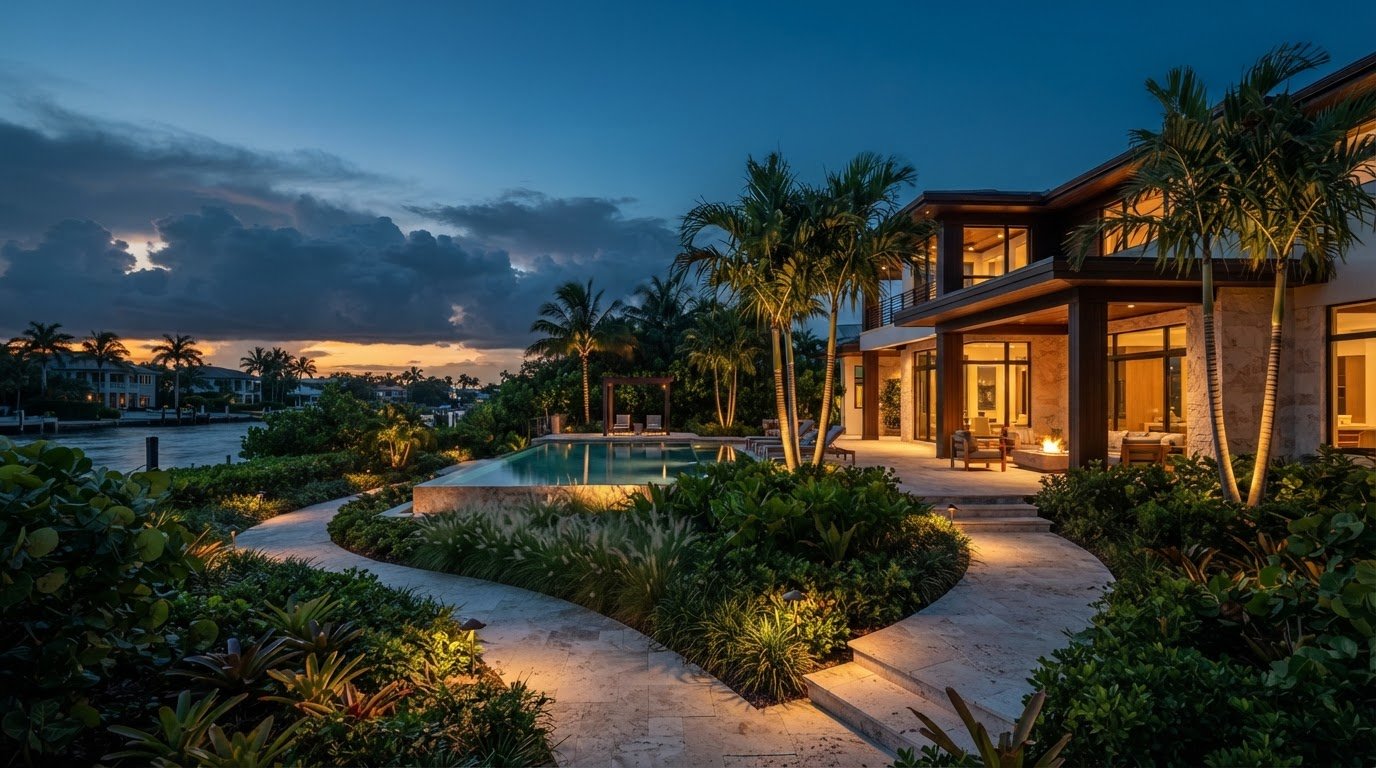
“Hurricane-proof” isn’t a promise any landscape lighting system should make. The smarter goal for hurricane proof landscape lighting South Florida homeowners can rely on is thoughtful design that reduces exposure and vulnerability. Strong winds can move fixtures or branches, while heavy rain, humidity, and salty coastal air challenge the components and connections that keep a system working.
If you’re concerned about storm damage or repeated repairs, that concern is understandable. Resilience depends on more than choosing a sturdy-looking fixture. It starts with understanding how your property is exposed, then making considered decisions about placement, mounting, wiring, and ongoing care.
This article explains how South Florida’s weather and coastal conditions affect outdoor lighting, and which design and installation choices can help reduce avoidable risks without guaranteeing storm survival. You’ll also see how Paradise Landscape Lighting brings design and engineering together to create custom low-voltage LED lighting for gardens, walkways, pools, architecture, and artwork, with the goal of preserving your property’s nighttime character while accounting for its environment.
Key Takeaways
- Think of storm resilience as reducing risk through informed design, not guaranteeing that lighting will survive every hurricane.
- Compare a lighting system by its exposure, fixture placement, material suitability, and ease of maintenance, not by broad claims like “stormproof.”
- Learn what to observe before and after a storm, and when to leave equipment alone and seek a professional assessment.
- Explore how hurricane proof landscape lighting South Florida design can account for coastal conditions while complementing your home and landscape.
- See how site assessment and collaboration between a lighting designer and engineer can align your visual goals with practical planning.
What Hurricane-Resistant Landscape Lighting Means in South Florida
For a South Florida home, hurricane resistance is best understood as risk reduction, not a guarantee. Thoughtful planning can limit exposure and make a lighting system less vulnerable, but no fixture or installation can promise to emerge undamaged from every storm. A useful definition is: Storm-resilient landscape lighting is designed around a property’s specific exposure to reduce avoidable risks to fixtures, wiring, and connections.
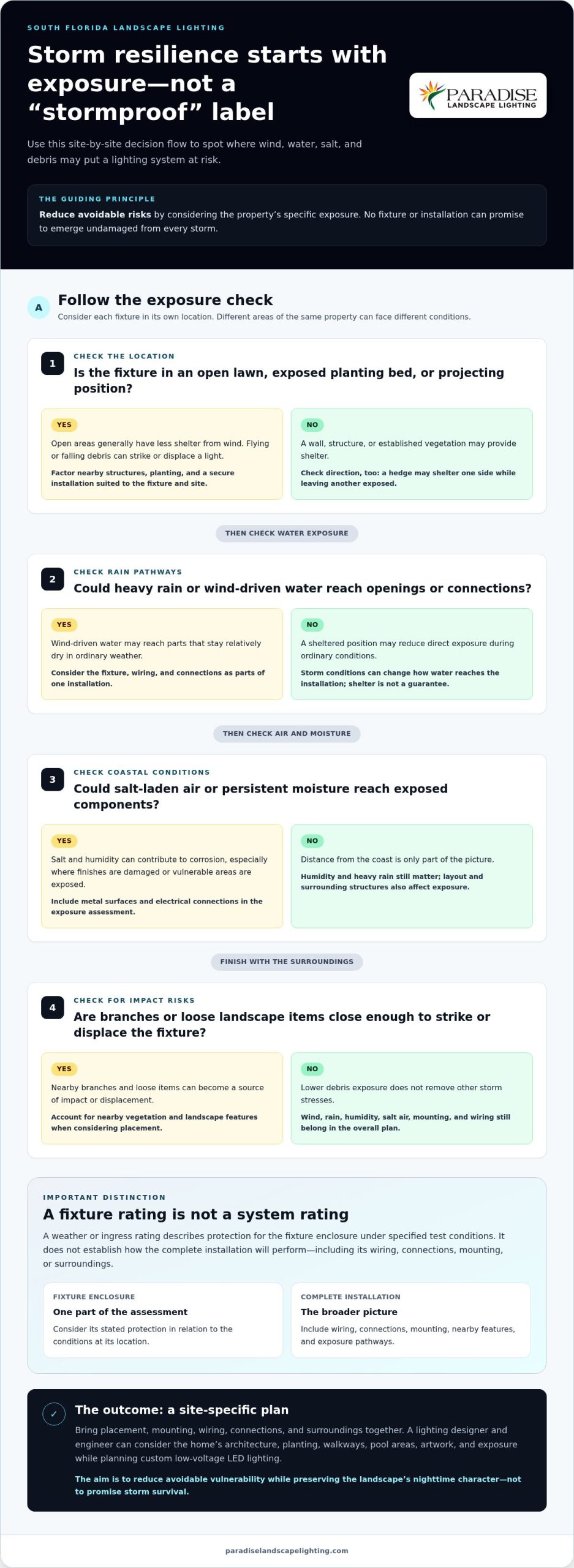
That distinction matters because landscape lighting is a system, not a collection of isolated fixtures. Wind, debris, driving rain, humidity, and coastal salt can affect different parts in different ways. A fixture’s weather or ingress rating describes protection for the fixture enclosure under specified test conditions. It doesn’t establish how the complete installation will perform, including its wiring, connections, mounting, or surroundings.
Why South Florida conditions are unusually demanding
Coastal air carries salt, while South Florida’s humidity keeps outdoor components exposed to moisture. Together, these conditions can accelerate corrosion, particularly when a fixture’s protective finish is damaged or vulnerable areas are exposed. Heavy rain and wind-driven water may reach openings or connections that are less exposed during ordinary weather. Wind can also move nearby branches or debris into fixtures, while projecting or poorly sheltered placements may face greater exposure.
There’s no single exposure profile for the region. A property’s distance from the coast is only part of the picture. Open lawn, dense planting, roof overhangs, walls, fences, and the direction a fixture faces can all change how wind, rain, and salt reach it. A sheltered garden bed and an exposed path may need different placement decisions, even on the same property.
What “hurricane-proof” can, and cannot, promise
The phrase “hurricane-proof” suggests certainty that outdoor systems can’t responsibly promise. Design choices can reduce vulnerability, but they can’t eliminate the possibility of storm damage. A rating attached to a fixture isn’t a rating for every connection and wire in the installation, nor does it account for debris striking the fixture or the conditions around it.
For homeowners evaluating hurricane proof landscape lighting South Florida options, the more useful question is how each part of the plan responds to the property’s exposure. Consider a light near an open driveway compared with one tucked into a protected planting area. The location, mounting approach, nearby vegetation, and route of the wiring all contribute to the system’s overall vulnerability. The fixture specification is one consideration, not the whole answer.
A site-specific design brings those details together without sacrificing the nighttime character of the landscape. Paradise Landscape Lighting’s designer and engineer can consider a home’s architecture, planting, walkways, pool areas, and exposure as part of custom low-voltage LED lighting design. That joined-up view helps shape practical decisions across the system, rather than treating storm resilience as a label on a single fixture.
How Wind, Rain, Salt Air, and Debris Affect Landscape Lighting
Storm exposure changes across a property. A fixture in an open lawn faces different conditions from one beside a wall or beneath established planting. Wind, wind-driven rain, salt-laden moisture, and flying or falling debris can all place stress on outdoor lighting, but the way those stresses reach each fixture depends on its position and surroundings.
Wind, driving rain, salt air, humidity, and debris are the environmental stresses a South Florida landscape lighting plan needs to consider. Their effects can range from physical impact to moisture reaching components or corrosion developing on exposed metal parts and electrical connections. The goal is to understand those pathways, not assume every fixture on the property faces the same risk.
Wind, uplift, and flying debris around the landscape
Open lawns and exposed planting beds offer less shelter from wind than areas protected by a wall, structure, or established vegetation. A fixture that projects into an open space may also be more exposed than one placed discreetly within a planting area. Placement and secure installation matter, though the right approach depends on the fixture and site. Fallen branches and loose landscape items can also strike or displace lights, even where wind exposure is partly screened.
Look beyond the fixture itself. A narrow side yard can channel wind, while a hedge may provide shelter in one direction but leave a light exposed from another. A property-specific plan considers those differences rather than treating every bed, path, or architectural feature as equally exposed.
Salt, moisture, and corrosion near the coast
Coastal exposure varies with a property’s location, layout, and surrounding structures. Salt carried through the air can settle on exposed components, and humidity keeps outdoor installations in a persistently moist environment. Over time, corrosion may affect metal surfaces or electrical connections. Heavy rain and wind-driven water can also reach parts of an installation that stay relatively dry in ordinary conditions.
Appearance alone doesn’t tell the whole story. A fixture’s finish and shape are visible, but the installation environment includes less obvious details such as where connections sit, how water moves through the landscape, and which areas are repeatedly exposed to spray or rain. Those factors belong in the design conversation alongside the desired nighttime effect.
Why the complete system matters
A lighting system works as a connected whole. Fixtures, cabling, connections, controls, placement, and installation all contribute to how it performs outdoors. A substantial-looking fixture can’t establish the resilience of the wiring or connections attached to it, and a product’s stated rating applies only within the scope of its verified specifications. Avoid treating general labels like “weatherproof” as proof of whole-system performance. Check any rating or code claim against its authoritative documentation.
For hurricane proof landscape lighting South Florida homeowners are planning, this system-wide view helps turn broad concerns into practical design decisions. A lighting designer and engineer can consider how exposure varies from the front approach to a garden, pool area, or walkway, then coordinate visual goals with the installation plan. Property-specific landscape lighting design can help bring those considerations together without suggesting that any system is immune to storm damage.
How to Compare Landscape Lighting for Storm Resilience
Compare each lighting location in context, not by searching for one “stormproof” fixture. A light near a sheltered wall has different exposure, visibility, and maintenance needs from one placed in an open bed. The right choice balances those conditions with the purpose of the light, whether it guides a walkway, highlights a tree, or brings out architectural detail.
| What to compare | Questions to consider |
|---|---|
| Exposure | Is the location open to wind and rain, or partly sheltered by a structure or established planting? |
| Fixture position | Will the fixture project into a busy or exposed area, or can it sit discreetly while still directing light where it’s needed? |
| Material suitability | Does the manufacturer describe the materials and their intended outdoor conditions in a way that suits this property’s coastal exposure? |
| Maintenance access | Can the fixture and its connections be inspected and serviced without disturbing important planting or hardscape? |
Evaluate placement, profile, and exposure
An open planting bed may leave a fixture more exposed than a light beside a wall or beneath an eave. But shelter isn’t the only measure: the fixture still needs to illuminate its intended feature, and its placement should work with the landscape. A low-profile or recessed option may suit a particular surface and lighting goal, but it isn’t automatically the better choice for every location.
Read fixture and component specifications carefully
Manufacturer ratings describe performance under defined conditions. Read the product documentation to understand what a rating covers, and don’t treat it as evidence that the entire installation will resist storm damage. Broad marketing words such as “weatherproof” or “stormproof” aren’t a substitute for documented specifications. For coastal properties, assess the manufacturer’s corrosion information alongside the actual exposure. Don’t assume a material or rating is universally suitable.
Balance resilience with visual quality
A discreet fixture can keep attention on foliage, artwork, or architecture, while a concealed position may make inspection or service less convenient. Those trade-offs should be considered together. Paradise Landscape Lighting’s bespoke low-voltage landscape lighting design guide explores how design and engineering can work together to shape a considered plan.
Use the comparison as a site-planning tool, not a pass-or-fail product score. For hurricane proof landscape lighting South Florida homeowners should weigh documented specifications, location-specific exposure, lighting purpose, and future access as parts of one decision. A single fixture type, material, or rating can’t establish that a complete system is hurricane-proof.
How to Prepare Landscape Lighting Before and After a Storm
A simple plan can make it easier to compare conditions before and after severe weather, but preparation doesn’t guarantee that a lighting system will avoid damage. Safety comes first: follow official storm guidance and don’t go outdoors or approach electrical equipment while conditions are unsafe. Keep damaged, submerged, or exposed components untouched until they can be assessed safely.
Before severe weather: document and secure what is appropriate
Use calm conditions to create a record of visible fixtures and nearby landscape features. The goal is to document, not dismantle or modify electrical equipment. Follow the manufacturer’s instructions and local emergency guidance for any system shutdown, and leave electrical work to a qualified professional.
- Photograph visible lights, walkways, planting beds, and other relevant areas. Keep the images together so you can compare the same locations later.
- From a safe position, note loose objects or removable decorative elements that could become debris. Secure or move them only if it’s safe and consistent with official instructions.
- If shutdown is recommended, follow the manufacturer’s guidance and applicable emergency instructions. Don’t handle outdoor electrical equipment in wet, windy, or otherwise unsafe conditions.
After a storm: assess before restoring use
Wait until authorities say conditions are safe before surveying the property. Avoid standing water and keep away from exposed wiring or damaged equipment. A visual check can help identify concerns, but it isn’t a substitute for professional assessment or electrical testing.
- From a safe location, look for shifted fixtures, fallen branches, debris, standing water, and visible damage to the landscape lighting.
- Photograph concerns without touching, moving, or opening damaged equipment. Compare the images with your pre-storm record to help identify changes.
- Don’t energize a visibly damaged system or attempt repairs or electrical testing yourself. Arrange a professional assessment before returning affected lighting to use.
Plan ongoing care for South Florida conditions
Between storms, periodic inspections can help identify corrosion, loose fixtures, damaged wiring, or planting that has grown around lights or changed their exposure. How often attention is needed depends on the property’s coastal exposure, system design, and observed condition. A maintenance review can consider the system as a whole, including how fixtures and connections are holding up. Paradise Landscape Lighting provides landscape lighting maintenance and retrofitting to support ongoing system care.
For hurricane proof landscape lighting South Florida homeowners should think in terms of careful preparation, safe observation, and informed follow-up, not a guarantee against storm damage. Paradise Landscape Lighting can assess and maintain outdoor lighting with your property’s conditions in mind.
Design a More Storm-Resilient Landscape Lighting System in South Florida
A considered lighting plan begins with the property, not a checklist of supposedly storm-proof fixtures. South Florida homes differ in coastal exposure, shelter, architecture, planting, and how outdoor spaces are used. Mapping those details helps identify where lighting can create atmosphere and improve visibility, while also bringing practical site conditions into the design from the start.
Resilience isn’t a package or a promise that a system will survive a hurricane. It’s a project-specific approach to reducing avoidable exposure while preserving the landscape’s nighttime character.
Start with the property, not a fixture checklist
An initial assessment can consider the home’s coastal setting, sheltered and exposed areas, existing lighting, and the way structures and planting shape the site. The plan can then map where light serves a purpose: guiding a walkway, revealing garden texture, highlighting architecture or artwork, or bringing definition to a pool or fountain area. These goals help determine where fixtures belong and how they can complement the property without ignoring environmental conditions.
For example, lighting a garden path involves different placement and visibility considerations from illuminating a feature beside a sheltered wall. Looking at the whole property makes those distinctions part of one coherent design.
Bring design and engineering into the same plan
Paradise Landscape Lighting brings a lighting designer and lighting engineer into its custom process. Design shapes the visual experience, while engineering contributes practical system planning. Together, these perspectives can align the intended effect with the property’s layout and exposure, then guide low-voltage LED installation. Ongoing maintenance also supports a considered system by giving the installation attention as the landscape and outdoor conditions change.
This progression connects artistry with technical planning rather than treating them as separate steps. The Fort Lauderdale bespoke outdoor lighting design guide provides another perspective on creating a tailored outdoor lighting plan.
Make the next step feel clear and practical
For homeowners in Fort Lauderdale, Weston, Southwest Ranches, Wilton Manors, Palm Beach, Miami, Miami Beach, Coral Gables, Plantation, West Palm Beach, and Coconut Grove, a useful starting point is to consider what you want your outdoor spaces to reveal after dark and which areas have distinct exposure or access needs. A project-specific discussion can bring those priorities together, whether the focus is a garden, walkway, architecture, pool, fountain, or artwork. The result is a plan shaped around your property, not a one-size-fits-all storm-proof package.
If you’re planning hurricane proof landscape lighting South Florida, Paradise Landscape Lighting can help you explore a custom design, engineering, installation, and maintenance approach without promising immunity from storm damage. Discuss your South Florida landscape lighting project and the goals you have for your property.
Plan Outdoor Lighting With the Next Season in Mind
Your landscape will keep changing: trees grow, planting shifts, and the way you use outdoor spaces can evolve. Treat lighting resilience as an ongoing design consideration, not a one-time promise. A system planned around your home’s character can adapt as your priorities and surroundings change, while thoughtful maintenance helps keep its performance and appearance in view.
For hurricane proof landscape lighting South Florida, the meaningful next step is a plan tailored to your property, with storm exposure considered alongside the nighttime experience you want to create. Paradise Landscape Lighting provides custom residential design, engineering, installation, and maintenance across Fort Lauderdale, Miami, Boca Raton, and surrounding South Florida communities.
Discuss a custom South Florida landscape lighting design and explore an approach shaped for your home. With a considered plan, you can bring greater intention to your outdoor spaces and enjoy their beauty after dark.
Frequently Asked Questions
Is any landscape lighting truly hurricane-proof?
No landscape lighting system can be guaranteed to withstand every hurricane or property condition. “Hurricane-proof” is an absolute claim, while hurricane proof landscape lighting South Florida is more realistically approached through project-specific risk reduction. A courtyard in Miami Beach and an open yard in Weston may have different exposure, even if both use similar fixtures. Consider wind, rain, debris, coastal air, installation, and the system’s condition rather than relying on a promise of certainty.
Can landscape lighting withstand hurricane-force winds?
There’s no universal answer because performance depends on the particular fixture, its installation and position, surrounding shelter, potential debris, and the storm itself. A product document may describe tested conditions for an individual fixture, but that doesn’t predict how an entire landscape system will fare in a hurricane. Review relevant product documentation and applicable local requirements for the project. Even a carefully planned system may need inspection or repair after severe weather.
What materials are best for landscape lighting near the South Florida coast?
No single material is best for every coastal property. Salt exposure varies by location and by features such as walls, planting, and open areas, so compare manufacturer information about a product’s materials and intended outdoor conditions. Also consider the construction of connections and other components, where fixtures will be placed, and how the installation can be maintained. Material choice matters, but it can’t establish whole-system resilience on its own.
Should landscape lights be turned off before a hurricane?
Follow official local emergency guidance and the manufacturer’s instructions for your lighting system. Don’t go outside or touch electrical equipment as conditions deteriorate. If a control is safely accessible indoors, operating it may be an option only when conditions allow and instructions support it. Turning lights off doesn’t protect fixtures or wiring from wind, flooding, or debris, so don’t take extra risks to reach a switch or control.
What should I check on landscape lighting after a hurricane?
Wait until the property is safe, then look from a safe position for shifted fixtures, visible damage, standing water, exposed wiring, or fallen branches and debris. Don’t step into water to inspect a light, touch damaged components, or try to restore equipment that appears affected. A visual survey can identify concerns, but it can’t confirm electrical safety. Have a qualified professional assess the system before using damaged or questionable components again.
Does low-voltage landscape lighting automatically make a system hurricane-resistant?
No. Low voltage describes an electrical characteristic, not protection from storm damage. Fixtures and wiring can still be affected by wind, debris, water, corrosion, installation conditions, or a lack of maintenance. A custom low-voltage LED plan may suit a residential landscape, but its resilience depends on the complete design and the property’s exposure. In places such as Miami, Coral Gables, or Palm Beach, site conditions still need individual consideration.
Return to News