
How Long Do LED Landscape Lights Last? What Affects Their Lifespan
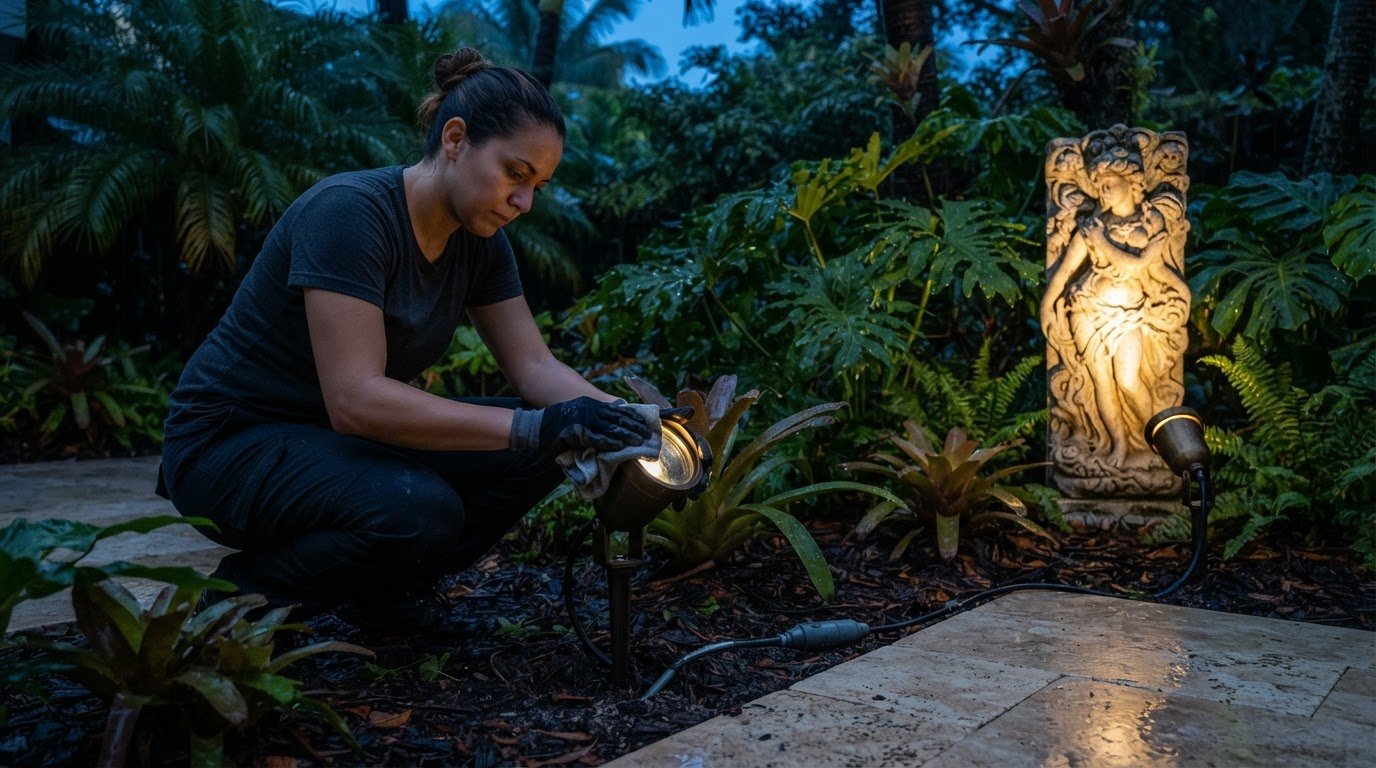
An LED’s rated lifespan isn’t necessarily the moment it goes dark. The practical answer to how long LED landscape lights last is 25,000 to 50,000 hours of operation under ideal conditions. That rating often describes when light output has fallen to a threshold, not when the fixture suddenly stops working.
It’s reasonable to expect outdoor lights to provide years of service, but an LED’s rated lifespan is only part of the picture. Heat, moisture, voltage, fixture and driver quality, and physical damage all affect how long a landscape lighting system performs well.
This guide explains what an LED lifespan rating means and how nightly use translates into years of illumination. You’ll learn which installation and environmental factors can shorten fixture life, what routine care can help reduce replacements, and when a coordinated lighting design and installation can support a dependable result.
Key Takeaways
- Read an LED lifespan rating as a guide to how brightness changes over time, not a guaranteed date when a light will fail.
- Heat, moisture, voltage fluctuations, driver quality, and physical damage can all affect how well outdoor fixtures hold up.
- Routine cleaning and attention to wiring, connections, and surrounding plants can help reduce avoidable maintenance.
- Choose lighting and installation details with the site’s conditions and nightly use in mind to support longer-lasting performance.
How Long Does LED Landscape Lighting Last?
Quality LED landscape fixtures are commonly rated for 25,000 to 50,000 operating hours. That figure estimates performance, not a fixed replacement date. A typical planning question is, “How long do LED landscape lights last?” The answer depends on nightly runtime and the durability of the complete fixture.
Lifespan Estimates in Hours and Years
An LED landscape light’s rated lifespan estimates its operating time, and converting hours into years helps set practical expectations. At six hours of nightly use, a 50,000-hour rating works out to about 22.8 years; a 15,000-hour rating works out to about 6.8 years. If you’re asking, “How long do LED landscape lights last with my timer schedule?” start by estimating how many hours they run each night.
Lumen Maintenance and Depreciation
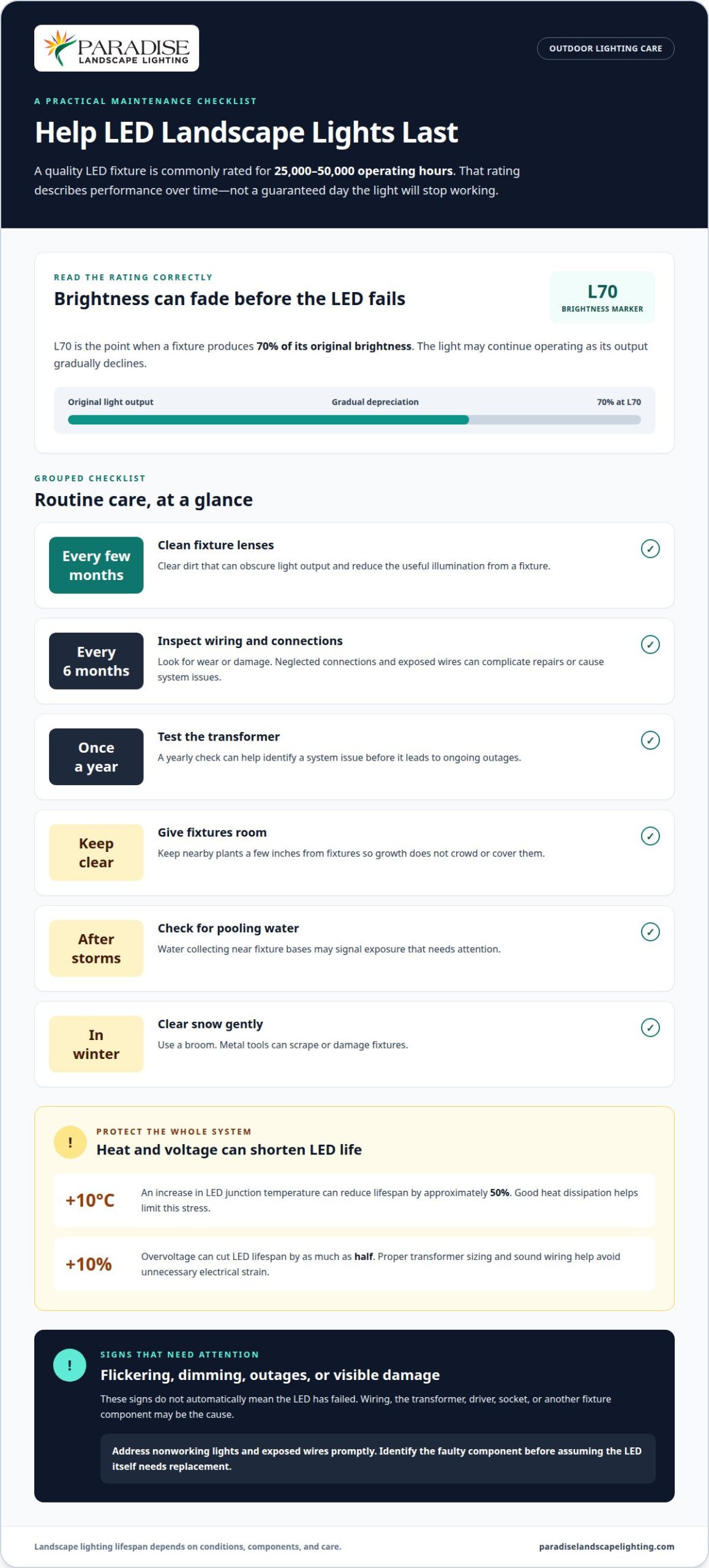
Lumen maintenance describes how much light output an LED retains over time, making it useful for understanding gradual dimming. According to the Illuminating Engineering Society, L70 is the point when an LED fixture outputs 70% of its original brightness. For example, an L70 rating at 30,000 hours means the fixture is rated to produce 70% of its original output then. The LED may continue operating as its brightness declines.
Low-Quality System Lifespan
A low-quality landscape lighting system may last around 1-3 years, much less than the operating-hour ratings for quality LED fixtures. The distinction matters because an LED’s rating doesn’t describe the lifespan of every component in an outdoor fixture. Construction and installation affect the complete system. A lens, housing, connection, or other component may need attention even when the LED itself still works.
LEDs Compared With Incandescent Bulbs
LEDs generally offer a longer rated lifespan than incandescent bulbs, which average 1,000-2,000 hours. LED lights are described as lasting 25 times as long as incandescent bulbs, though actual operating years depend on nightly use. For landscape lighting, this difference can mean fewer bulb changes over time. It’s still useful to distinguish the bulb’s lifespan from the fixture’s: a durable LED won’t prevent replacement if another part fails.
Heat, moisture, voltage, driver quality, and physical damage
Outdoor conditions and electrical setup influence whether a fixture maintains its brightness or develops faults. Heat and unstable voltage can shorten LED life, while water and impact can damage other system components.
Environmental and Physical Stressors
Environmental stressors are conditions such as heat, moisture, and impact that can wear down outdoor lighting components. They matter because the LED is only one part of each fixture. For every 10°C increase in LED junction temperature, lifespan can fall by approximately 50%. Good heat dissipation helps limit that stress. Moisture can enter poorly sealed housings or connections; IP67 fixtures are protected against immersion up to 1 meter and suit in-ground or wet-zone placement. After storms, pooling water near fixture bases may signal exposure that needs attention. Lawn equipment, shifting soil, and foot traffic can also crack lenses or disturb wiring. Similarly, for in-ground fixtures installed along vehicle access routes, coordinating with professional driveway contractors wolverhampton ensures robust sub-bases that protect recessed lighting from heavy vehicle loads and ground movement.
Voltage and Driver Quality
Voltage and driver quality determine how steadily electrical power reaches the LED, which affects consistent output and component wear. A driver regulates power; a weak driver may fail before the LED does. Surges and voltage fluctuations can stress both components, and a 10% overvoltage can cut LED lifespan by as much as half. Proper transformer sizing and sound wiring help avoid unnecessary electrical strain.
Low-cost systems may use less durable housings, connections, or drivers, so the LED’s advertised hours alone don’t reveal how long the complete installation will last. A higher-quality system is designed around the fixture, driver, transformer, and wiring as a working whole. That distinction matters in exposed areas, where moisture and physical contact can quickly reveal weak points.
Warranty length can offer a useful quality signal, though it isn’t a lifespan guarantee. Industry benchmarks cite 5 years or longer for pathway lights and transformers, and lifetime-limited coverage for in-ground fixtures. Frequent outages or changing brightness can point to wiring, transformer, or driver problems rather than a worn-out LED. A carefully planned landscape lighting design can account for site exposure and system requirements.
Reducing bulb replacement and maintenance
Thoughtful installation and regular care help outdoor lighting stay functional and limit avoidable replacements. A few checks throughout the year can catch wear before it affects multiple components.
Installation and Routine Care
Routine maintenance includes keeping lenses, wiring, connections, and nearby plants clear and in good condition. Dirt, overgrowth, and neglected connections can reduce useful light or complicate repairs.
- Clean LED fixture lenses every few months to clear dirt that can obscure light output.
- Inspect wiring and connections every six months for wear or damage.
- Keep nearby plants a few inches from fixtures, so growth doesn’t crowd or cover them.
- Test the transformer once a year to identify a system issue before it causes ongoing outages.
In winter, clear snow gently with a broom; metal tools can scrape or damage fixtures. Address nonworking lights and exposed wires promptly instead of leaving damaged components in place.
Replacement Costs and Failure Signs
Replacement costs in the United States depend on what needs attention: a bulb, an integrated fixture, a driver, or wiring. The quote reflects the components and labor involved, so replacing one bulb differs from repairing several parts of a system.
Signs of a failing LED landscape light include flickering, dimming, repeated outages, or visible damage. Frequent outages can point to aging fixtures, worn sockets, or deteriorating wiring, not just a failed LED. Identifying the faulty component helps avoid replacing parts that still work.
Extending Light Lifespan
Extending outdoor LED lifespan means reducing preventable wear and addressing faults early. Regular lens cleaning, six-month wiring inspections, and yearly transformer tests help reveal maintenance needs before lighting becomes unreliable.
Keep plants a few inches from fixtures, and clear winter snow with a broom instead of metal tools. If a light stops working, swapping its bulb with one from a working fixture can help distinguish a bulb problem from a fixture problem. Frequent bulb replacements can signal that the system needs an upgrade.
LED landscape lighting longevity
Long-term performance depends on more than the LED itself. Housings, connections, drivers, and other components each face their own exposure and wear. A fixture’s rating describes the LED’s expected operation, while the garden environment and nightly schedule shape how long the installed lighting remains dependable.
Landscape lighting typically runs 6 to 10 hours per night, depending on season and timer settings. At 8 hours nightly, a 50,000-hour rating corresponds to about 17 years of operation. That calculation is a useful planning estimate, not a promise that every fixture or component will last equally long. A system’s weakest part may need attention first.
Housing material can make a substantial difference outdoors. Solid brass housings are estimated to last more than 20 years, while cast-aluminum housings are estimated at 3 to 7 years. Plastic or composite housings are estimated at 1 to 3 years. These estimates show why LED longevity and fixture longevity aren’t interchangeable: the light source may continue working after its housing or another component has deteriorated.
Traditional incandescent lights generally need more frequent replacement, while an LED’s longer operating-hour rating can mean fewer bulb changes. Still, the rating alone doesn’t show how well a fixture will withstand moisture, heat, impact, or changing site conditions. Consider the whole installation, including the housing and electrical components, rather than focusing only on the LED specification.
Dimming outdoor LED spotlights can reduce energy consumption and may prolong their lifespan. It also lets you shape garden illumination to the desired effect instead of running every light at full brightness. The clearest takeaway: longevity comes from matching the LED, fixture, and operating schedule to the setting. For a system planned around your landscape, plan a tailored landscape lighting design.
Paradise Landscape Lighting
Paradise Landscape Lighting helps homeowners plan outdoor LED systems with longevity, site conditions, and the desired look in mind. The team provides Landscape Lighting Design and LED Lighting Installation, creating a coordinated approach for gardens, pools, and architectural features.
If existing lights dim unevenly, fail repeatedly, or no longer suit the space, a new design can address the system as a whole rather than treating each fixture in isolation. Planning considers where illumination is needed and how fixtures work together; installation brings the design into the landscape. This can suit a new project or a broader rethink prompted by replacements.
For a tailored landscape lighting design and installation, contact Paradise Landscape Lighting.
Plan Outdoor Lighting for the Years Ahead
The question of how long do LED landscape lights last is a starting point, not the whole design decision. Consider how you want your outdoor spaces to feel after dark, which features deserve attention, and how the lighting should work as one composition. A thoughtful plan connects practical illumination with the character of your home and garden.
Paradise Landscape Lighting can help shape that plan through Landscape Lighting Design and LED Lighting Installation, including focused lighting for sculpture and artwork. Discuss the spaces you want to illuminate and the effect you hope to create. This turns lifespan considerations into a lighting approach tailored to your property, rather than a collection of separate fixture decisions.
Contact Paradise Landscape Lighting to discuss your outdoor lighting plans and move toward a more considered, enduring design.
Frequently Asked Questions
How Is LED Lifespan Measured?
LED lifespan is measured by tracking how well a light maintains its output over time. According to the Illuminating Engineering Society, L70 is the point when an LED fixture outputs 70% of its original brightness. Testing methods add context: IES LM-80 measures how LEDs maintain brightness, while IES TM-21 projects longer-term performance beyond the test period. This helps distinguish gradual dimming from sudden failure.
How many hours do LED landscape lights typically last?
Quality LED landscape fixtures are commonly rated for 25,000 to 50,000 operating hours. These are cumulative hours when the lights are on, not calendar hours spent outdoors. For example, timer settings that switch off lights during part of the night reduce the rate at which operating hours accumulate. Treat the rating as a performance estimate, not a guaranteed replacement date for every fixture component.
How many years do LED landscape lights last with nightly use?
Calendar lifespan depends on nightly runtime. Low-voltage LED garden lights used for about five hours a night could last over 25 years before replacement, based on the operating-hour estimates. That’s a projection, not a promise that every fixture will remain unchanged for that span. A timer schedule, seasonal use, and the condition of the fixture components all affect the real-world result.
What factors affect the lifespan of outdoor LED landscape lights?
Heat, moisture, voltage quality, driver performance, and physical damage all influence outdoor LED life. In South Florida communities such as Fort Lauderdale, the lighting plan should suit the actual garden, pool, or walkway setting. For example, a fixture near a frequently watered planting bed faces different moisture exposure than one beneath a covered architectural feature. The surrounding components and installation also affect system reliability.
Do LED landscape light bulbs or fixtures last longer?
The LED source and the complete fixture don’t necessarily share the same lifespan. A fixture with a non-integrated bulb may need bulb replacement every 3-5 years, while its housing can remain in place. With an integrated LED, the light source is part of the fixture, so a fault may involve a larger component. Check which design you have before assuming a dim light needs a whole-fixture replacement.
How does the lifespan of LED landscape lighting compare with halogen and incandescent lights?
LEDs generally have longer rated operating lives than halogen and incandescent bulbs. Halogen bulbs average 2,000-4,000 hours, while incandescent bulbs average 1,000-2,000 hours; quality LED landscape fixtures are commonly rated for 25,000 to 50,000 hours. For a homeowner planning garden or walkway lighting, the comparison can help estimate how often bulbs may need attention, though the fixture’s other parts matter too.
Return to News