
Front Yard Lighting Design in Fort Lauderdale: A Homeowner’s Buying Guide
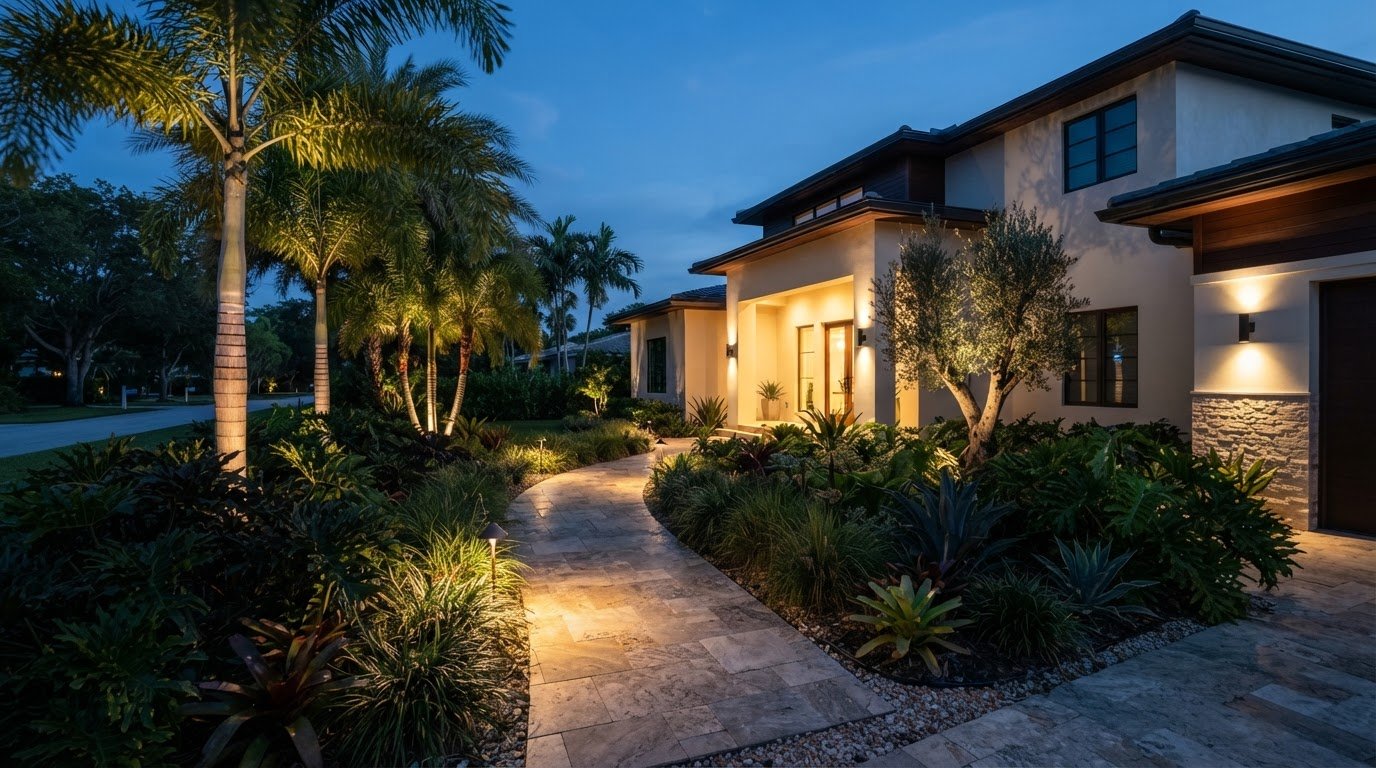
What makes a front yard welcoming after dark? It isn’t necessarily more brightness, but well-placed light that helps guide you home and brings the right details into view. Thoughtful front yard lighting design Fort Lauderdale homeowners can enjoy balances curb appeal, a clear arrival route, and a comfortable nighttime atmosphere.
A cohesive plan doesn’t need to illuminate every corner. Carefully placed light can connect the home’s façade, plantings, and walkway, drawing attention to defining details while limiting glare. In South Florida, the design should also account for outdoor exposure, including salt-laden air in coastal locations.
This guide explains what to prioritize, how to compare different lighting approaches, and what to prepare before installation. You’ll also learn how a professional design and engineering process can shape a custom low-voltage LED landscape lighting system around your home, so the front yard feels inviting and considered after dark.
Key Takeaways
- A successful front yard plan connects the home’s entry, architecture, planting, and walkways into one welcoming nighttime view.
- Choose a leading focal point, such as the entry, a defining architectural detail, or a mature tree, based on your home and site.
- Build visual depth in stages: establish the entry, add architectural emphasis, then use selective landscape lighting to guide attention.
- Prepare by noting your goals and site conditions, and taking photos of the front elevation, entry, walkways, and landscape in daylight and after dark.
- A lighting designer and lighting engineer can shape a custom plan around your home, arrival route, and South Florida conditions.
What should Fort Lauderdale front yard lighting design accomplish?
Effective front yard lighting design Fort Lauderdale homeowners can live with is a coordinated plan, not a collection of fixtures chosen one at a time. It connects the arrival route, front entry, architecture, and planting so each element contributes to a clear nighttime composition. The aim is to make the home feel welcoming and its approach easy to read, while preserving the character that makes the property appealing by day.
Start by setting a visual hierarchy. A front door, a distinctive façade detail, or a mature planting can take priority, while less important areas stay quieter. This selective approach reflects the principles of landscape lighting: light can serve practical and aesthetic purposes, but more illumination isn’t automatically better. The result should complement the home, not compete with it or create glare for residents and passersby.
A successful front yard lighting plan balances visual hierarchy, useful visibility, and restraint. Useful visibility means helping people recognize the walkway, steps, and entry as they arrive. It can make movement more comfortable, but it isn’t a promise of crime prevention or guaranteed security. Lighting is one part of a home’s nighttime environment, not a substitute for broader safety measures.
How does front-yard lighting shape the arrival experience?
Picture a Fort Lauderdale home where the front door sits back from the street behind a garden and a curving walk. If every fixture calls attention to itself, the eye jumps from one bright spot to another. Instead, choose a focal point, often the entry, then let the approach and façade support it. The walkway should read as a clear route, while a considered accent reveals an architectural detail or planting near the door. This connects the house and its approach rather than making them feel separately lit.
Choosing that focal point early also clarifies what can stay unlit. A lighting designer can consider the view from the street, walkway, and entry, then shape a composition that suits the home’s proportions. This keeps individual fixture choices in service of the overall effect.
Which South Florida site conditions belong in the design brief?
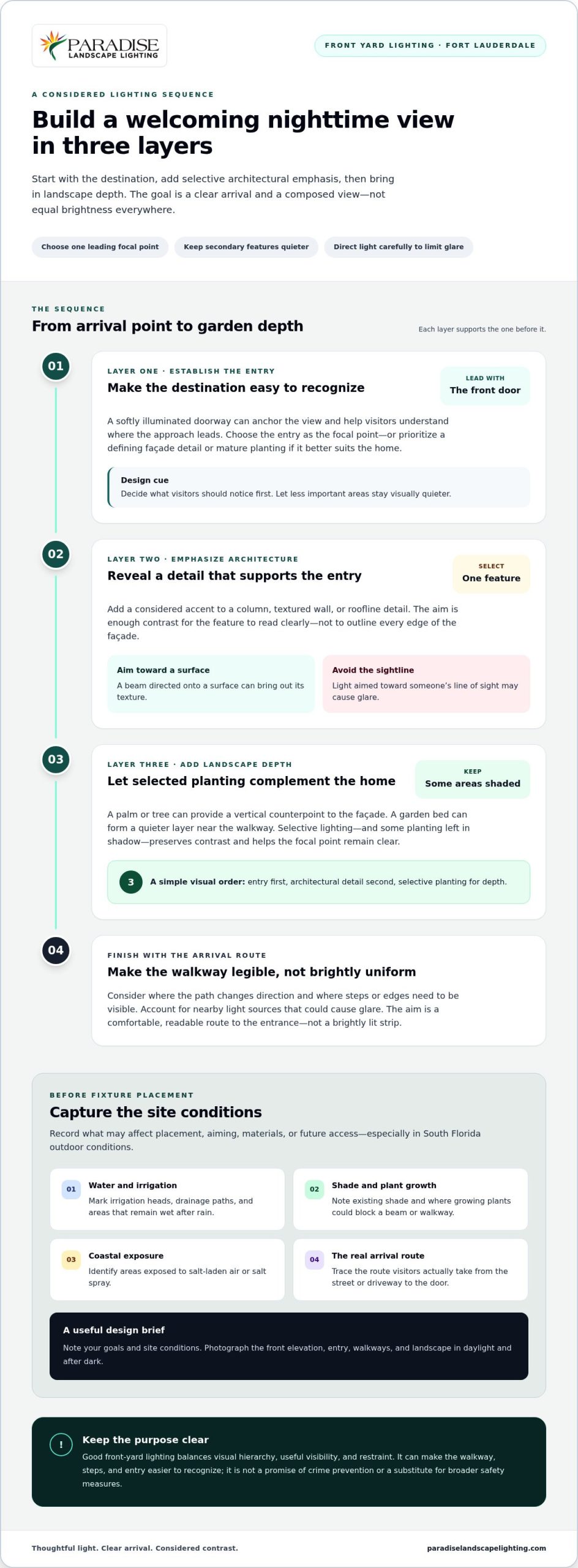
Outdoor conditions matter as much as appearance. Before planning fixture locations, note where rainwater collects, where irrigation spray reaches, how much shade the planting creates, and where growth may eventually block a beam or walkway. In coastal locations, record areas exposed to salt-laden air. These observations help guide placement and material decisions, while keeping weather exposure and maintenance in view.
- Mark irrigation heads, drainage paths, and areas that remain wet after rain.
- Note existing plants and where their growth could affect light or access.
- Identify coastal exposure and surfaces that may receive salt spray.
- Trace the route visitors actually use from the street or driveway to the door.
Include any known site constraints in the project brief so they can be considered during planning and before installation begins.
How do lighting layers bring a Fort Lauderdale front yard together?
Think of a front yard as a sequence the eye can follow, not a scene that needs equal brightness everywhere. A practical layering order is to establish the entry, add selected architectural emphasis, then introduce landscape depth. Each layer has a distinct role, so the front door remains easy to find while the home and garden gain dimension without competing for attention.
Layered lighting feels intentional because it guides the eye from one considered focal point to the next, rather than giving every surface the same emphasis. That restraint matters in front yard lighting design Fort Lauderdale homes can use comfortably. Beam direction, fixture placement, and light intensity all shape whether a feature feels softly revealed or distractingly bright.
How can the entry and façade become the front-yard focal points?
Begin with what a visitor should notice on approach. A softly illuminated doorway can establish the destination; selected architectural lighting can then reveal a column, textured wall, or roofline detail that supports the entry. The aim isn’t to outline every edge of the façade. It’s to create enough contrast for the entrance to read clearly, while keeping secondary features visually quieter.
Placement and aiming matter. A beam directed toward a surface can bring out its texture, while a light aimed toward someone’s line of sight may cause glare. The right balance depends on the home’s materials, setbacks, and viewing angles, so a standard layout or fixture count won’t determine the best result for every property.
How should planting and the approach complement the architecture?
Once the architecture has a clear emphasis, selective landscape lighting can add depth around it. A palm or tree might provide a vertical counterpoint to the façade, while a garden bed can form a quieter layer closer to the walkway. Leaving some planting in shadow helps preserve contrast. As DarkSky International’s lighting guidelines emphasize, outdoor light should be useful and carefully directed, rather than excessive or scattered.
The approach should read as a comfortable, legible route to the entrance. Consider where the walkway changes direction, where steps or edges need to be visible, and whether nearby light sources could cause glare. The goal is orientation, not turning the entire path into a brightly lit strip. A coordinated plan lets the route support the entry without taking focus from it.
To shape these layers around your own façade, approach, and planting, custom landscape lighting design can bring the creative plan and technical considerations together.
Which front yard lighting approaches suit your Fort Lauderdale home?
Choose an approach by deciding what should lead the nighttime view: the welcome at the door, the character of the façade, or the texture of the landscape. The right priority depends on the home’s architecture, planting, and the route people use to reach the entrance. For front yard lighting design Fort Lauderdale homeowners are planning, compare options by purpose and site conditions, not by fixture count or maximum brightness.
| Approach | Purpose | Likely visual effect | Suitable site conditions |
|---|---|---|---|
| Entry-led | Make the door and arrival point easy to recognize. | A welcoming focal point, with the rest of the façade kept secondary. | Homes with a recessed, less visible, or especially prominent entrance. |
| Architecture-led | Bring attention to defining lines, materials, or details. | A stronger sense of structure and depth across the façade. | Homes with distinctive columns, textured surfaces, or architectural features. |
| Landscape-led | Reveal selected trees, palms, or garden areas. | A layered garden view that frames rather than overwhelms the house. | Properties where mature planting or a front garden shapes the street-facing view. |
These approaches are starting points, not fixed formulas. An entry-led scheme suits a home where visitors need a clear visual destination, while an architecture-led plan can bring definition to a façade with strong forms. A landscape-led approach may be compelling where planting gives the property its character. Many homes benefit from a measured combination, with one emphasis leading and the others supporting it.
Should the design emphasize the façade, landscape, or front walk?
Let the daily arrival route and the home’s strongest visual feature guide the decision. A front walk that’s difficult to distinguish may deserve more attention than a decorative planting bed; a distinctive façade may call for subtle accents rather than a bright, competing garden display. A balanced combination works when each element has a clear role and no single feature overwhelms the others.
More brightness doesn’t automatically create a more polished or welcoming result. Glare can come from a beam aimed toward the viewer, a fixture placed too close to the line of sight, or competing bright spots that flatten the scene. Careful aiming and placement direct light onto its intended surface. Selective emphasis preserves contrast, so the entry, architecture, and landscape remain visually distinct.
How can homeowners compare LED and low-voltage design choices?
LED describes the lighting technology; low voltage describes how power is delivered through the residential lighting system. Paradise Landscape Lighting designs custom low-voltage LED systems, with planning and engineering shaped around the property rather than a one-size-fits-all layout. For more context on design decisions, explore this Fort Lauderdale outdoor lighting buying guide.
What should you prepare before commissioning front yard lighting design?
A little preparation helps turn a general wish for a brighter exterior into a clear design brief. For front yard lighting design Fort Lauderdale homeowners can tailor to their property, begin with how you use the entry and what you want the home to express after dark. Then document the site so the lighting plan responds to actual routes, planting, and outdoor conditions rather than assumptions.
Which details help clarify your lighting priorities?
Rank your priorities before focusing on fixtures. Is curb appeal most important, or do you want the entrance to be easier to recognize? Are there architectural details or landscape features you’d like to bring forward? Note the route you and your guests use most often, and identify spots that feel visually unclear after dark. This short list helps separate essentials from features that would simply add more light.
Gather observations and photos in sequence:
- Write down your main goals, such as entry visibility, architectural emphasis, or a more defined nighttime view of the garden.
- Walk the everyday route from the street or driveway to the door and note turns, steps, or areas where the path feels hard to read.
- Photograph the front elevation, entry, walkways, and landscape in daylight and after dark. Include more than one viewpoint when it helps show how the façade and approach relate.
- Record existing exterior lights, irrigation spray, drainage after rain, planting that may grow into a beam, and any coastal exposure to salt-laden air.
- List features you want the design to complement, such as established trees, garden beds, or a distinctive architectural detail.
These notes give a designer useful context. A path light placement, for example, may need to account for an irrigation head, while a planting accent needs room for future growth. Daylight photos show materials and landscaping clearly; nighttime photos reveal existing glare, dark patches, and how the current lighting reads from the approach.
Once your priorities and site notes are together, explore professional lighting design in Broward County to take the next step toward a plan shaped around your home.
How does a professional design move from concept to installation?
At Paradise Landscape Lighting, a lighting designer and lighting engineer bring creative and technical perspectives to a custom residential plan. They consider the home, arrival route, planting, and site conditions together, then develop a design and engineering approach tailored to the property. This coordination helps the intended visual effect guide installation, rather than treating the project as a generic list of fixtures.
Installation puts the plan into place. Maintenance is also available to support the lighting system over time as the landscape and outdoor conditions change. Together, design, engineering, installation, and maintenance make the project a connected process, grounded in how the front yard should look and function after dark.
How does Paradise Landscape Lighting create front yard lighting in Fort Lauderdale?
A front yard lighting plan needs both a clear visual idea and a sound technical foundation. At Paradise Landscape Lighting, a lighting designer and lighting engineer bring complementary perspectives to residential projects in Fort Lauderdale and across South Florida. Their work connects the homeowner’s goals with the property itself, shaping a custom low-voltage LED system around the home’s architecture, landscape, arrival route, and site conditions.
This coordinated approach moves beyond choosing fixtures individually. The design considers how the front yard should feel after dark, while engineering informs how the system can support that intention. The result is a plan tailored to the home rather than a standard layout applied to every property.
What makes a custom front-yard lighting plan site-specific?
Architecture, planting, focal points, and circulation all influence the design together. A home with a prominent entry may call for a different emphasis than one framed by mature trees or a distinctive façade. The team considers these relationships alongside the route people take to the door, making visual interest and practical movement part of one composition.
Homeowners can describe the nighttime impression they want, whether that means a more welcoming entry, greater emphasis on architectural features, or added depth in the garden. The plan can then respond to those priorities and the property’s conditions, rather than relying on a universal fixture arrangement.
What can homeowners expect from design through ongoing care?
The process brings several connected capabilities into one project:
- Design: The lighting designer develops a custom concept around the homeowner’s priorities and the property’s architecture, planting, and approach.
- Engineering: The lighting engineer helps translate that concept into a considered low-voltage LED system for the residential site.
- Installation: The team installs the system according to the plan, with lighting placed to serve its intended role rather than following a generic fixture list.
- Maintenance: Ongoing maintenance supports the system over time as outdoor conditions and the landscape evolve.
Each project is shaped by its own features and goals, so design and installation details are tailored to the property. For homeowners considering how the façade fits into the wider composition, the residential architectural lighting guide offers related perspective on illuminating exterior features.
With design, engineering, installation, and maintenance connected from the outset, front yard lighting design Fort Lauderdale homeowners choose can feel cohesive from the entry to the landscape. Plan your Fort Lauderdale landscape lighting project with Paradise Landscape Lighting.
Give Your Front Yard a Thoughtful Next Chapter
The right nighttime atmosphere begins with a clear sense of how you want to experience arriving home. As you consider front yard lighting design Fort Lauderdale, look beyond individual fixtures and imagine how the entry, architecture, and landscape could feel connected after dark. That vision gives the design process a useful starting point.
Paradise Landscape Lighting brings a lighting designer and lighting engineer together to shape custom residential low-voltage LED lighting, from design and engineering through installation and maintenance. The team serves Fort Lauderdale and surrounding South Florida communities, including Weston, Southwest Ranches, Wilton Manors, Palm Beach, Miami, Miami Beach, Coral Gables, Plantation, West Palm Beach, and Coconut Grove.
Your next step is to share what you’d like your front yard to express and which features matter most. A considered plan can turn that inspiration into a welcoming arrival and a more compelling view of home after sunset.
Start planning your front yard lighting with Paradise Landscape Lighting.
Frequently Asked Questions
Is low-voltage LED lighting a good choice for a Fort Lauderdale front yard?
Yes, low-voltage LED lighting is a suitable option for residential landscape lighting, and Paradise Landscape Lighting designs custom systems using this approach. The right plan depends on the property’s features and how you want the front yard to look after dark. Homeowners in Fort Lauderdale, Weston, Southwest Ranches, Wilton Manors, Palm Beach, Miami, Miami Beach, Coral Gables, Plantation, West Palm Beach, and Coconut Grove can have the design tailored to their residence.
Can front yard lighting improve visibility without making the house look overly bright?
Yes. A design can focus light where it helps people recognize the entry or follow the approach, while keeping less important areas subdued. A softly defined doorway and visible walkway, for example, can provide orientation without washing the entire façade in light. If a fixture shines directly toward a window, the street, or a visitor’s eyes, its position or aim may need adjustment for a more comfortable view.
How many lights does a front yard lighting design need?
There isn’t one appropriate fixture count for every front yard. The number depends on what the plan needs to accomplish, the size and shape of the property, and how its entry, pathways, architecture, and planting relate. A compact frontage with a clear route may need a different arrangement from a deep setback or winding approach. Establish the intended effect first, then determine which fixtures can support it.
Do front yard landscape lights need maintenance?
Yes, outdoor lighting can benefit from maintenance as the property changes. Plant growth may obscure a beam, or a fixture may shift and no longer highlight the intended feature. A maintenance review can assess whether lights remain aligned with the design and whether the nighttime effect still suits the landscape. Paradise Landscape Lighting provides maintenance for residential lighting systems, with care tailored to the system and its condition.
Can existing front yard lighting be incorporated into a new design?
Existing lights can be considered as part of a redesign, but each one should be assessed for its role and condition. A fixture may still serve the plan, while another could create glare, duplicate a focal point, or no longer suit the landscape. Reviewing the existing layout helps determine what to retain, reposition, or replace. Paradise Landscape Lighting also retrofits outdated systems, including upgrades from halogen to LED, so the new design can feel coordinated rather than simply adding more lights.
Will front yard lighting work with palms and tropical landscaping?
Yes. Lighting can complement tropical planting by revealing a palm’s form or bringing gentle definition to selected leaves and garden areas. Consider how moving fronds change the shadows and whether the effect remains comfortable from the home and walkway. It also helps to think ahead about how mature plants may alter the view or block light. The goal is to highlight the landscape without turning every plant into a focal point.
Can landscape lighting make a home more secure?
Landscape lighting can make an entry or walkway easier to see, which may help residents feel more oriented as they come and go. It can’t guarantee security or prevent crime, so it’s best considered one element of a home’s nighttime environment rather than a security solution. For practical visibility, focus on areas where people need to identify a route, steps, or the entrance, and avoid aiming light into eyes or neighboring properties.
Return to News