
Dark Sky Compliant Lighting in Palm Beach: Energy and Cost
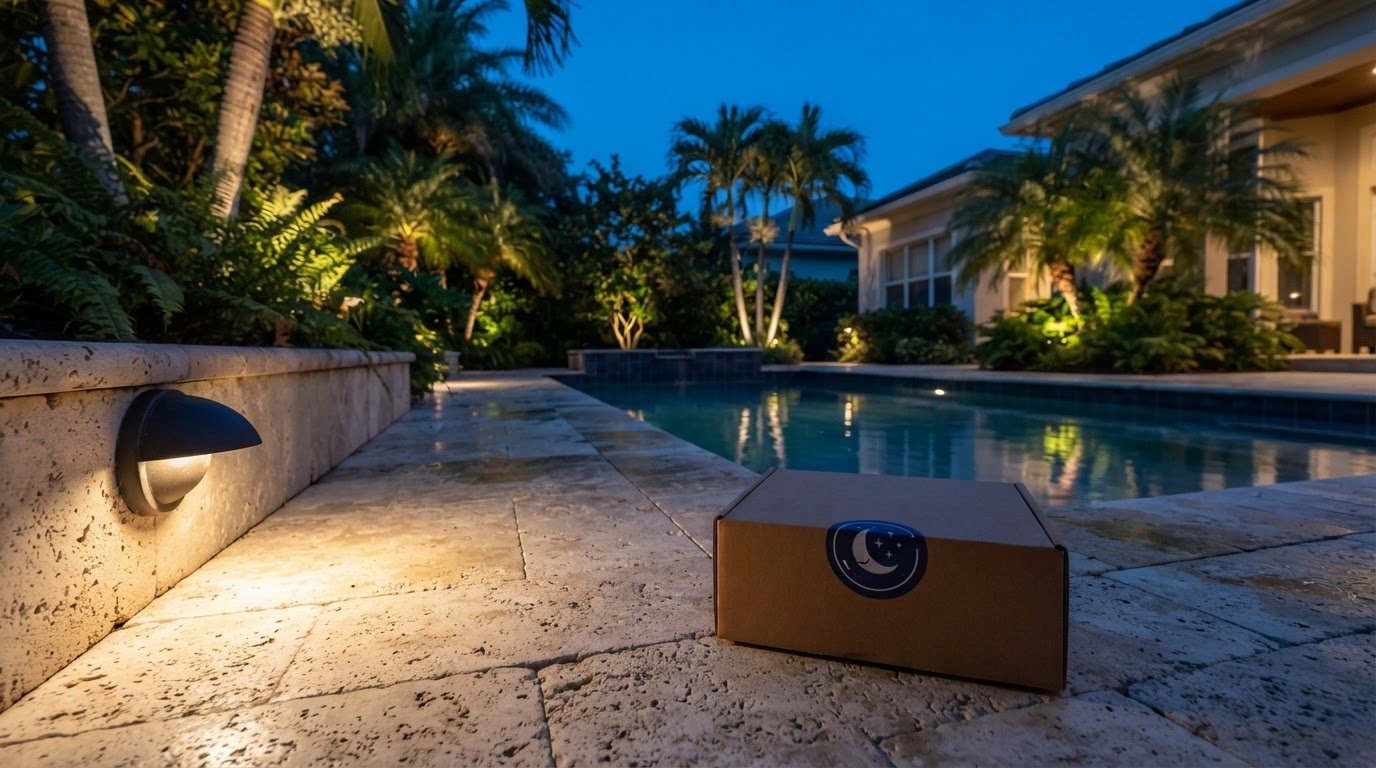
More light can make an outdoor space less comfortable, not more functional. Dark sky compliant lighting in Palm Beach keeps illumination targeted, limits glare and upward light, and favors warmer color. DarkSky Approved certification sets a maximum color temperature of 3000K. The aim is to illuminate useful areas without sending unnecessary light into the sky or neighboring spaces.
It makes sense to want outdoor lighting that feels welcoming, supports safe movement, and highlights what makes your property distinctive. The key is balancing those goals with thoughtful control: brightness, direction, color temperature, and operating times all matter. This guide explains dark sky lighting, how its principles inform fixture choices, and how to choose color temperatures for different settings. It also shows how poor aiming or inefficient lighting can waste energy and money, and how a considered plan can bring clarity to gardens, walkways, pools, and architectural features without excess illumination.
Key Takeaways
- Distinguish an official DarkSky Approved seal from general “dark sky friendly” wording, and learn what fixture documentation can reveal.
- Find out how shielding and directing light toward its intended target can reduce wasted illumination and energy use.
- See how warmer color choices can suit outdoor spaces, with extra care around wildlife-sensitive areas.
- Understand how landscape lighting design can balance visibility, visual appeal, and responsible light placement.
DarkSky Approved seal and photometric reports
An official DarkSky Approved seal identifies an outdoor fixture evaluated and certified by DarkSky International. The phrase “dark sky friendly” is broader marketing language; it doesn’t by itself indicate certification. DarkSky International rebranded from the International Dark-Sky Association in 2022, so older references to IDA standards may appear alongside the current program. For a Palm Beach property, distinguish an approved product from a general claim before comparing fixture specifications.
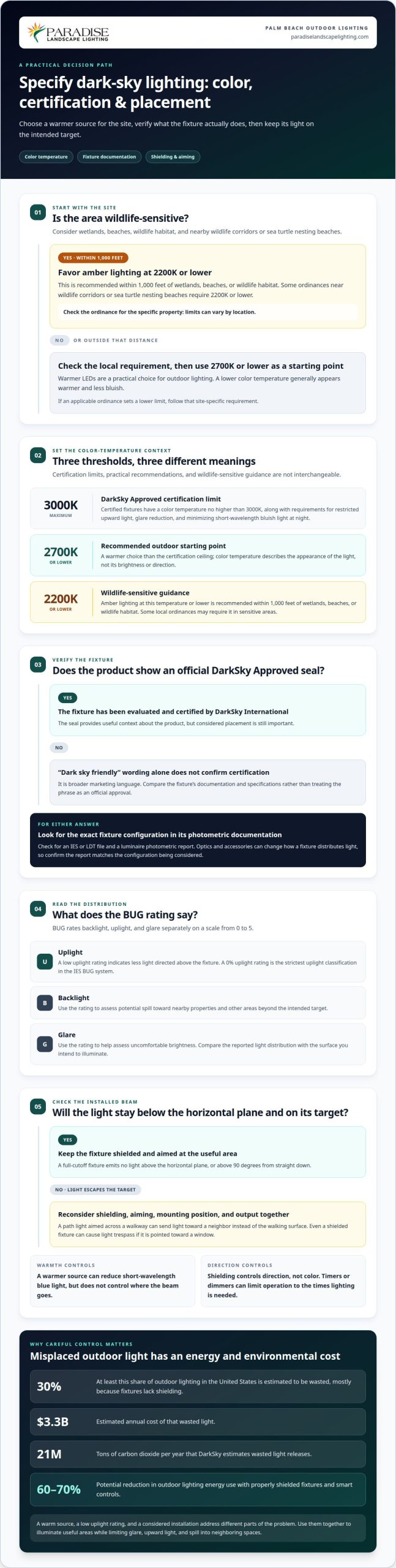
DarkSky Approved certification requires a color temperature no higher than 3000K, restricted upward-directed light, and glare reduction. It also calls for minimizing short-wavelength, bluish light at nighttime. These criteria address both the fixture’s output and its potential effects beyond the intended area, including wildlife habitat. A fixture that looks discreet in a product photo may still create glare or spill light when installed at the wrong angle, so certification is useful context, not a substitute for considered placement.
Photometric documentation helps reveal how a specific fixture distributes light. For each outdoor model, look for an IES or LDT file and a luminaire photometric report. The report should identify the exact configuration being considered, since optics and accessories can change the distribution. Check its BUG rating: the system rates backlight, uplight, and glare separately on a scale from 0 to 5. A low uplight rating indicates less light directed above the fixture, while the backlight and glare ratings help assess spill toward nearby properties and uncomfortable brightness.
In practice, compare the reported distribution with the surface to be illuminated. A path fixture aimed across a walkway, for example, may send light toward a neighbor instead of the walking surface. Use the report to understand that risk, then consider shielding, mounting position, and output together. The IDA name is relevant to the standards’ history, but the current product certification is DarkSky Approved. Local ordinances may set separate requirements, so certification alone doesn’t establish compliance with every Palm Beach rule.
How Much Energy and Money Does Poor Outdoor Lighting Waste?
Outdoor lighting wastes energy when it sends illumination above the horizontal plane or beyond its intended target. At least 30% of outdoor lighting in the United States is estimated to be wasted, mostly because fixtures lack shielding. That wasted light has an estimated cost of $3.3 billion per year. DarkSky estimates it also releases 21 million tons of carbon dioxide per year. Light pollution is not only a matter of brightness; misplaced artificial light can create skyglow and light trespass.
Which outdoor light fixtures are dark-sky compliant and shielded? Choose shielded, downward-directed fixtures that keep light below the horizontal plane. A full-cutoff fixture emits no light above that plane, or above 90 degrees from straight down. In the IES BUG system, a 0% uplight rating is the strictest uplight classification. These features reduce upward spill, but placement and aiming still matter: a shielded fixture pointed toward a window can cause light trespass.
Warm color temperature and shielding address different problems. A warm source may reduce short-wavelength blue light, but it can still shine upward if the housing leaves the lamp exposed. Shielding controls direction, not color. In turtle-sensitive areas, both factors matter: use a suitable warm source and direct the beam downward. Timers or dimmers can also limit operation to the times outdoor lighting is needed.
Properly shielded fixtures and smart controls could reduce outdoor lighting energy use by 60 to 70%. To assess a property, identify light escaping past the target, then consider shielding, aiming, output, and operating time together. Where can I buy dark-sky-compliant outdoor lighting in Palm Beach, Florida? A landscape lighting design and LED installation service can help select and install fixtures for the property, rather than implying retail stock. For a tailored outdoor plan, explore landscape lighting design that accounts for the areas to illuminate and the light that should remain contained.
What color temperature is dark sky compliant?
For dark sky compliant lighting in Palm Beach, warmer LEDs are a practical starting point. DarkSky Approved certification allows color temperatures no higher than 3000K, while choosing 2700K or lower is recommended for outdoor lighting. A lower temperature generally appears warmer, with less bluish quality than cool white light. Color temperature describes the appearance of the light, not its brightness, direction, or ability to prevent trespass.
Wildlife-sensitive areas call for added care. Some ordinances near wildlife corridors or sea turtle nesting beaches require 2200K or lower. Amber lighting at 2200K or lower is recommended within 1,000 feet of wetlands, beaches, or wildlife habitat. These are practical thresholds to understand, not a universal rule for every coastal property. The ordinance applying to a particular site determines whether a specific limit applies.
For Florida coastal properties, follow the ordinance that applies to the specific site. Some ordinances near wildlife corridors or sea turtle nesting beaches require 2200K or lower; requirements can vary by location. Sea turtle hatchlings emerge at night and orient toward the ocean horizon, so artificial light visible from the beach can disrupt that cue. Shielding and careful placement matter alongside a warmer source.
The American Medical Association has raised concerns that blue-rich light at night suppresses melatonin and disrupts circadian rhythms. Outdoors, warmer light can help minimize short-wavelength blue emissions, while shielding addresses glare and light trespass. Neither choice replaces the other. A low-temperature LED aimed toward a neighbor’s window can still spill light; a shielded cool-white source can still add blue-rich light to the nighttime environment.
To apply these principles, match color temperature to the setting: use warmer light in general residential areas, and consider amber output near beaches, wetlands, or wildlife habitat. Check whether local ordinances set a specific limit, and direct each beam onto its intended surface. DarkSky International’s principles favor warm-colored light, but the right choice also depends on spectrum, direction, and purpose.
Dark Sky compliance principles
DarkSky International frames responsible outdoor lighting around five principles: Useful, Targeted, Low Level, Controlled, and Warm-Colored. Each guides a different design decision. A garden sculpture may need focused illumination, while a side path may need modest light for orientation. The goal is to serve a clear purpose without adding excessive brightness to the night sky. These principles make compliance a design approach, not simply a fixture choice.
Start with usefulness: illuminate an area only when it serves a purpose. Direct the beam toward that area, then use no more brightness than needed. DarkSky International recommends fully shielded sources as a best practice, helping direct light downward and away from windows and the sky. A narrow beam aimed at a tree, for example, can highlight its form without washing the whole garden in light.
Control involves timing as well as output. Timers, dimmers, and motion sensors can limit operation to when lighting is needed. Warm-colored sources help minimize blue light at night. Together, these choices can reduce glare, skyglow, light trespass, and visual clutter. A thoughtful design accounts for the property’s purpose and surroundings instead of giving every outdoor area the same brightness or schedule.
For technical evaluation, the BUG system rates backlight, uplight, and glare separately from 0 to 5. The IDA/IES Model Lighting Ordinance uses BUG classifications to tier lighting allowances by lighting zone. Its listed maximum uplight allowances include 1.5% for LZ2 and 3% for LZ3. Those zone values illustrate why context matters: the same fixture can behave differently across spaces and applications. A design should pair its documented distribution with placement, shielding, and controls.
The practical takeaway is to design around purpose first, then assess direction, brightness, color, and operating time as connected choices. To apply these principles to your property, plan a responsible outdoor lighting design around the areas that need illumination.
Paradise Landscape Lighting: Landscape Lighting Design
Paradise Landscape Lighting can help translate dark sky principles into a cohesive outdoor plan when you want to improve visibility while preserving your property’s character. Its Landscape Lighting Design Service considers which features to illuminate and how placement serves that purpose. For example, a plan can balance a softly lit pool deck with focused Sculpture and Artwork Lighting instead of treating every outdoor area alike.
When the design is ready for installation, Paradise Landscape Lighting provides Custom Installation of low-voltage outdoor LED lighting. This connects the intended look with practical fixture placement across the landscape. A tailored design is especially useful when you’re updating several outdoor areas or refining existing lighting.
Contact Paradise Landscape Lighting to discuss a landscape lighting design for your property.
Shape an Outdoor Lighting Plan That Fits Your Property
A dark sky compliant lighting plan for Palm Beach starts with a simple question: what should your evening landscape make easier to see, use, or appreciate? Set those priorities before choosing fixtures to keep the design intentional, rather than adding light without a clear purpose. This gives the project a personal focus, whether you’re refining the atmosphere around a garden feature or bringing definition to outdoor artwork.
Paradise Landscape Lighting offers Landscape Lighting Design and LED Lighting Installation, with Sculpture and Artwork Lighting available to emphasize distinctive features. These services can connect the visual direction of a space with practical installation choices, so the finished plan reflects how you want to experience your property after dark.
If you’re ready to explore a tailored approach, contact Paradise Landscape Lighting to discuss your outdoor lighting goals. A considered plan can make the night landscape feel both more useful and more distinctly yours.
Frequently Asked Questions
What Is Dark Sky Lighting?
Dark sky lighting is outdoor illumination designed to serve a clear purpose while reducing unnecessary brightness beyond the area being lit. For homeowners, that means considering where a beam lands, how much light it produces, and when it operates. A path, for example, can be lit for nighttime movement without brightly illuminating nearby windows or leaving fixtures on when the area is unused.
How do I verify a supplier’s dark-sky claim?
Check any certification claim against the exact fixture model, not just a general product description. Look for a DarkSky Approved certification record and compare the model and configuration with its photometric report. A shield or optic listed for one version may change how another version distributes light. An IES or LDT file can also help you understand a fixture’s output before selecting it.
What Are the Easiest Dark-Sky Upgrades for an Existing Home?
Address existing light directly: aim adjustable fixtures at their intended surfaces, add suitable shielding where light escapes, and use timers, dimmers, or motion sensors to limit operation. Replace exposed or overly bright sources if aiming alone does not resolve glare. A light spilling across a driveway, for instance, may be redirected toward the walking area instead of made brighter.
What Does “Dark-Sky Friendly” Actually Mean for a Homeowner?
“Dark-sky friendly” generally describes lighting intended to reduce unwanted nighttime illumination, but the phrase alone is not an official certification. It does not show that a specific fixture has been independently evaluated or meets a particular ordinance. Treat it as a design description, then assess the fixture’s distribution, color, placement, and controls against your project’s needs.
What Makes A Fixture DarkSky Approved?
A fixture earns DarkSky Approved certification through evaluation by DarkSky International. The certification requires a color temperature no higher than 3000K, restricted upward-directed light, reduced glare, and minimized short-wavelength blue light. Approval applies to the evaluated outdoor product, so use the precise model and configuration when reviewing its status. The seal is distinct from a seller’s general “dark-sky friendly” wording.
What are Palm Beach County’s dark-sky-compliant outdoor lighting requirements?
Requirements depend on the jurisdiction and property context; local ordinances may address light spill, controls, operating times, or wildlife-sensitive locations. For homeowners seeking dark sky compliant lighting in Palm Beach, rules may differ between Palm Beach, West Palm Beach, Fort Lauderdale, Weston, Southwest Ranches, Wilton Manors, Miami, Miami Beach, Coral Gables, Plantation, and Coconut Grove. Apply the ordinance for your property’s location rather than assuming a single countywide standard.
Return to News