
Convince Your HOA to Approve Landscape Lighting in Weston
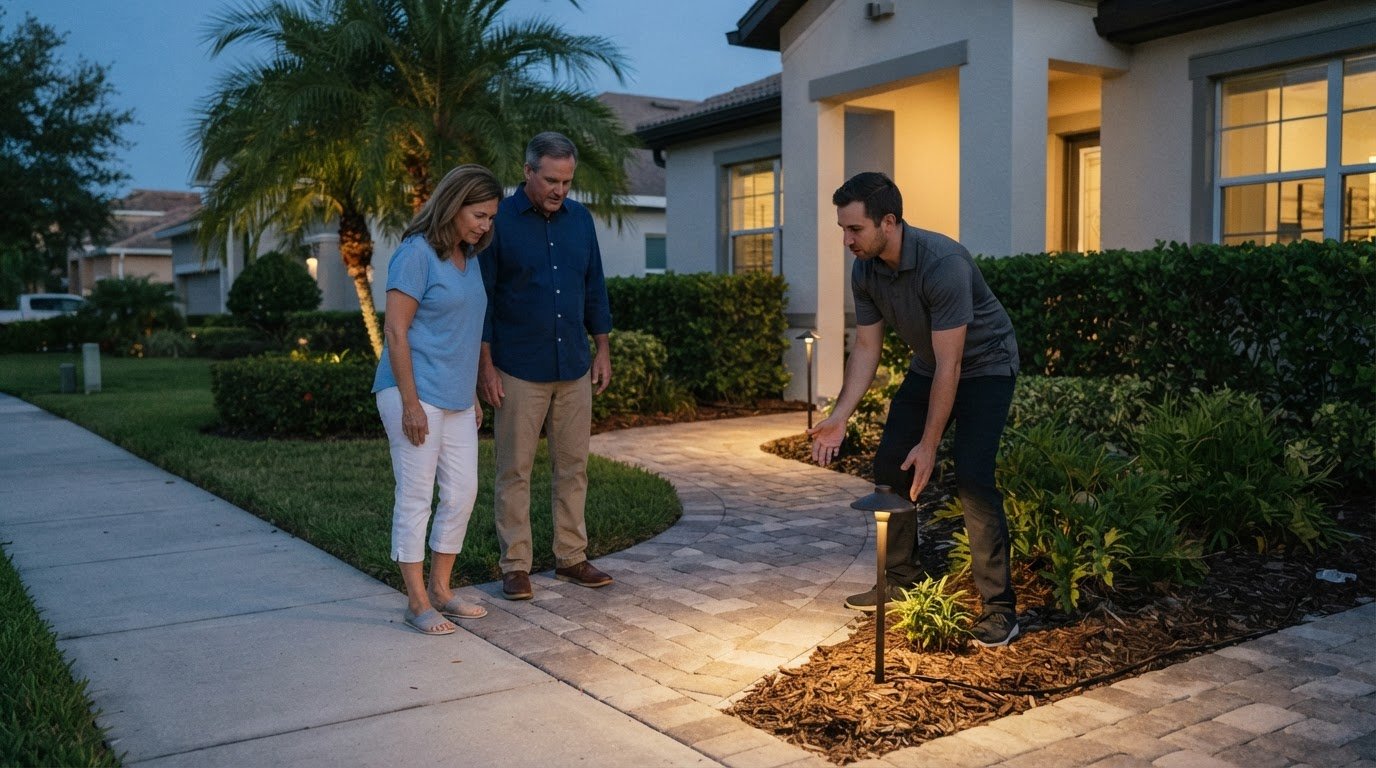
A written architectural-review request, submitted before installation, is the clearest first step toward HOA approval for landscape lighting in Weston. To convince your HOA about landscape lighting in Weston, show how the plan respects community rules for fixture appearance, placement, brightness, and light spill; reviews often take 2-4 weeks in many communities.
It’s reasonable to want lighting that makes paths easier to navigate and brings out your home’s character while respecting the neighborhood’s appearance. A thoughtful proposal can address both priorities with a clear design, not just a verbal explanation or general idea. This article explains how to review your HOA documents, prepare an architectural-review application, and present details about safety and light control. You’ll also learn how a tailored landscape lighting design can support your effort to convince your HOA in Weston without overpowering your property or its surroundings.
Key Takeaways
- Shape your application around the community’s architectural standards, and present a clear lighting plan rather than a broad request.
- Frame pathway lighting around visibility and safer movement, while considering how placement and brightness affect nearby homes.
- Use your governing documents to understand the HOA’s authority over exterior changes and landscaping on private community property.
- Choose restrained fixtures and light direction to reduce glare and spillover while supporting the look you want outdoors.
Architectural review applications
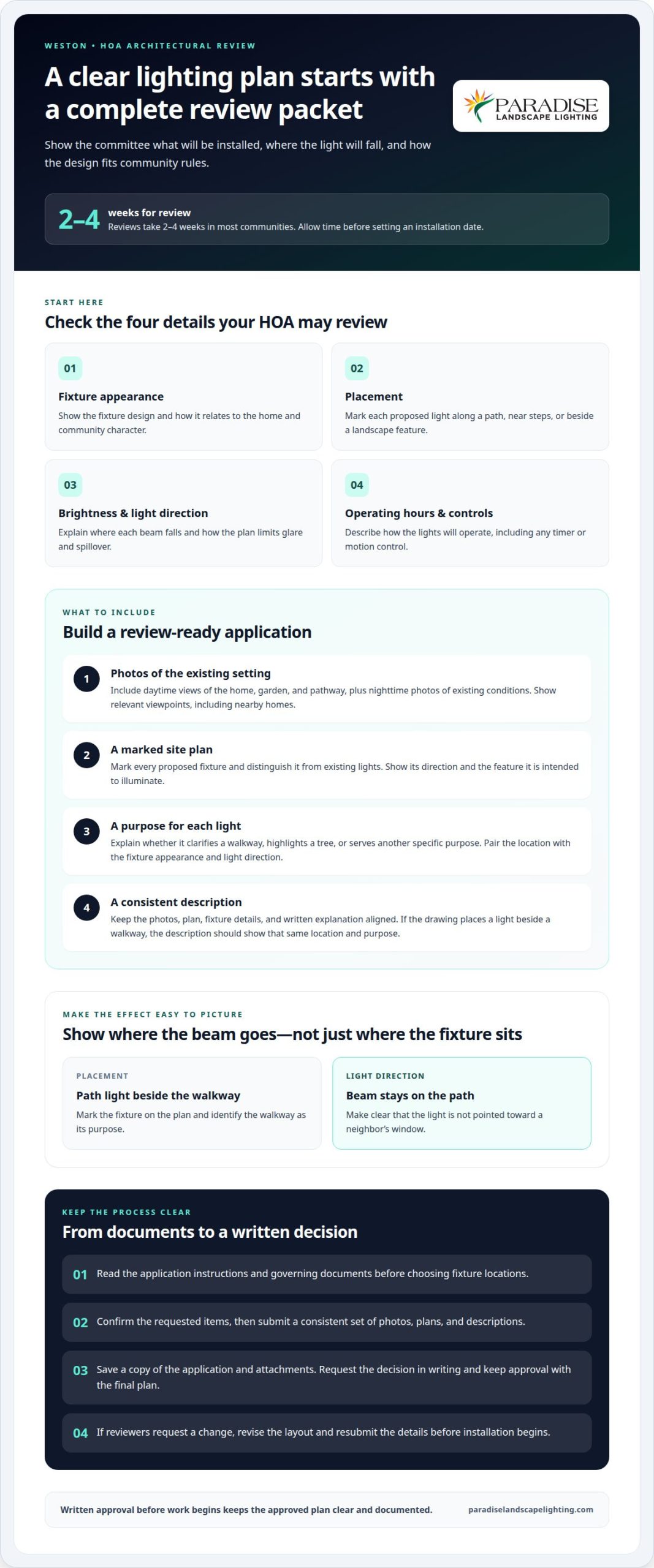
To convince your HOA about landscape lighting in Weston, begin with the community’s architectural-review process before scheduling installation. Read the application instructions and governing documents, then note rules about fixture appearance, placement, brightness, and operating hours. Reviews take 2-4 weeks in most communities, so allow time for a decision before setting an installation date. Get written approval before work begins; verbal confirmation leaves residents without a clear record of the approved plan.
Photos and a marked site plan help reviewers assess your proposal. Include daytime views of the home, garden, and pathway, along with nighttime photos of existing conditions. On the plan, mark each proposed fixture, its direction, and the feature it would illuminate. For example, label a path light beside the walkway and show that its beam stays on the path rather than pointing toward a neighbor’s window. These specifics can help you convince your HOA to approve landscape lighting in Weston.
- Show the existing setting. Photograph the front elevation, planting beds, entry, and nearby homes from relevant viewpoints. These images help the committee assess how the design relates to the community’s character.
- Map proposed locations. Mark fixtures along paths, near steps, or beside landscape features. Distinguish proposed lights from existing ones so reviewers can follow the changes.
- Explain the effect. Pair each fixture location with its purpose, such as clarifying a walkway or highlighting a tree. Include fixture appearance and light direction to address visual concerns.
- Describe controls. State how the lights will operate, including any timer or motion control in the proposal. This helps reviewers consider brightness and hours of use.
Keep the application consistent across photos, plans, and descriptions. If the drawing places a light beside the walkway, the written description and fixture image should show that same location and purpose. A precise submission gives the architectural committee a practical basis for reviewing the design against community requirements.
Before submitting, confirm that you have included every requested item, then save a copy of the application and attachments. Request the decision in writing and keep the approval with the final plan. If reviewers ask for a change, update the layout and resubmit the revised details before installation begins.
HOA common-area safety and security
In Weston, an association can assess shared paths, entries, and gathering spaces as distinct safety needs. Well-lit common areas can deter crime and support residents’ sense of security. Illuminated walkways can also make changes in surface or direction easier to see, reducing the risk of slips, trips, and falls. A proposal is stronger when it identifies a specific location and explains what visibility problem the lighting addresses.
Landscape lighting can make paths and entrances easier to navigate, while careful placement can highlight landscaping and enhance curb appeal. A cohesive, well-maintained appearance may support property value, though lighting alone cannot guarantee a particular outcome. For example, a plan might illuminate a dim turn in a shared walkway while keeping the beam away from nearby windows.
Help the association weigh practical benefits alongside visual impact:
- Map the route. Mark dark turns, steps, or uneven transitions on a common-area plan, then show how proposed lights improve visibility.
- Show light direction. Identify where each beam falls and how fixture placement limits glare toward homes, roads, and neighboring properties.
- Address existing fixtures. If a builder-installed 150-watt bulb creates harsh brightness, propose a concealed 4-watt LED lamp as a more restrained alternative.
- Consider shared use. Note whether residents use the space to walk, enter a building, or gather, and tailor the lighting plan to those activities.
Improving visibility doesn’t require flooding an area with light. A focused layout can make a path easier to see while preserving the community’s appearance. Identify a specific concern, such as a poorly lit path beside a shared entrance, so the association has a clear basis for reviewing placement and coverage.
For a common-area proposal, separate safety goals from decorative ones. Show which fixtures support walking routes and which highlight landscape features. This helps the association assess coverage, brightness, and consistency with the neighborhood without treating every light as if it serves the same purpose. A considered balance can strengthen both the proposal’s practical case and its visual appeal.
HOA governing documents and landscaping authority
Start with your community’s declaration, covenants, conditions, and restrictions, commonly called the CC&Rs. These documents outline what homeowners may change on exterior property and help distinguish private yards from shared landscaping. In Weston’s gated or private communities, the homeowners’ association maintains infrastructure, roadways, and landscaping on private community property. That distinction matters: a fixture beside your own walkway may involve different approval considerations than one installed in a shared planting bed.
Read the sections on exterior alterations, landscape changes, and lighting before choosing fixture locations. Then compare those rules with the association’s application requirements. HOA outdoor-lighting standards may address appearance, placement, brightness, safety, and operating hours, and may go beyond city code. Compliance with city code does not replace the association’s review; installing lights without HOA approval can still result in a violation.
Use the documents to answer practical questions before preparing your proposal:
- Identify ownership. Mark whether each proposed location falls on your lot or shared property. A light in a common planting area may involve association-maintained landscaping.
- Find the applicable rule. Search the CC&Rs and architectural guidelines for exterior fixtures, landscape changes, and review procedures. Note the exact language that applies.
- Compare fixture details. Match the proposed appearance and placement to the community’s stated standards. If a rule addresses brightness or hours, explain how the design responds.
- Clarify changes. If you plan to replace an existing outdoor fixture, describe what changes and what remains. A clear comparison helps reviewers assess the scope.
For example, if you’re proposing lights beside a private path, identify the lot boundary and show the beam directed toward the walking surface. A proposal near a shared roadway should make the property distinction clear. The association’s rules and the installation location determine which review provisions apply, so make those details easy to see in your application.
Keep a copy of the governing documents and mark the relevant passages for easy reference. This helps you connect each design choice to the community’s written standards, rather than relying on assumptions about what the HOA can approve.
Landscape and pathway lighting restrictions
Weston HOA rules may govern fixture appearance, placement, brightness, and operating hours. Whether a permit is required depends on the installation work and applicable City of Weston requirements; HOA approval alone does not determine permit requirements.
Fixture and Color Temperature Choices
For Florida homes, choose fixtures that suit the landscape and direct light toward a clear purpose, such as a garden feature or path. Warm-white LEDs with a color temperature of 2700 to 3000 K offer a restrained option for a residential proposal. Landscape LED lighting uses 15 to 20 percent of the electricity used by halogen or incandescent bulbs, which can help address homeowners’ energy-use concerns.
Describe the fixture style and color temperature in your application instead of leaving the association to guess how the installation will look. Include placement and intended use so reviewers can compare the proposal with community standards.
Glare and Light Pollution Controls
For a dark-sky-conscious plan, direct light onto the intended surface rather than upward or across property lines. Downward-directed or hooded fixtures can help limit glare and spillover. For example, a shielded path light can illuminate the walking surface without sending its beam toward a neighbor’s windows.
Dusk-to-dawn timers or motion sensors can keep outdoor lighting from staying on all night. Show the control method alongside fixture locations and explain which area each light serves. These details help distinguish useful illumination from unnecessary brightness.
Addressing Common HOA Objections
Associations may object to glare, inconsistent fixture styles, excessive brightness, or lights operating too long. Address each concern directly: show a consistent fixture appearance, indicate beam direction, and specify timers or motion controls where appropriate. If the concern is neighborhood character, explain how the design complements the home and nearby landscape.
If energy use is a concern, explain the potential advantages of LED technology without promising a specific bill reduction. If reviewers raise light spill, revise the fixture direction or add shielding. A focused response gives them a practical alternative to rejecting the proposal outright and keeps the design aligned with community requirements.
Paradise Landscape Lighting: Landscape Lighting Design
Paradise Landscape Lighting can help turn your HOA-approved concept into a considered outdoor lighting plan. Its Landscape Lighting Design Service pairs visual intent with practical placement, helping you present pathway illumination and focal accents as a coherent proposal. The team also provides LED Lighting Installation to carry the approved design through to installation.
Consider the service when you have a clear goal, such as illuminating a walkway, highlighting a sculpture, or refining poolside lighting, but need a unified design and installation plan. Share the HOA’s requirements and the features you want to illuminate so the design can respond to your property and the review criteria.
Contact Paradise Landscape Lighting to shape your landscape lighting proposal.
Take the Next Step Toward a Thoughtful Lighting Plan
Your next step is to turn your outdoor vision into a proposal the association can assess clearly. Decide what matters most: a more visible entry, a softly defined path, or a focal point that brings an outdoor feature into view. Keep the design focused on those goals. A considered plan makes it easier to explain how each light serves the property without adding unnecessary brightness.
If you’re working to convince your HOA about landscape lighting in Weston, align the design with your home’s character and the community’s standards. Paradise Landscape Lighting can create a tailored concept, including Sculpture and Artwork Lighting when a focal piece is part of your vision. A clear design gives you a practical foundation for continuing the HOA conversation and planning the next steps.
Contact Paradise Landscape Lighting to discuss a landscape lighting design for your property. With a considered plan in hand, you can approach the review process with clarity and confidence.
Frequently Asked Questions
What are Weston HOA rules for outdoor landscape lighting?
Weston HOA lighting rules depend on the community’s governing documents and architectural guidelines. They may cover fixture style, placement, brightness, operating hours, and effects on neighboring properties. Before choosing equipment, look for provisions on exterior changes and shared landscaping. For example, a fixture near a private entry may be reviewed differently from one proposed beside an association-maintained roadway.
How do I submit an architectural review request to a Weston HOA?
Use your association’s architectural-review form and include the information requested in its instructions. Organize the submission so reviewers can match each fixture to its location: label the site plan, describe the fixtures, and note whether the work changes existing lighting. Add photos showing the property from the street and the proposed installation area. Keep the submitted documents together in case reviewers follow up.
Which local landscape lighting contractors serve Weston, Florida?
Paradise Landscape Lighting serves Weston and nearby South Florida communities, including Fort Lauderdale, Southwest Ranches, Wilton Manors, Palm Beach, Miami, Miami Beach, Coral Gables, Plantation, West Palm Beach, and Coconut Grove. Its residential outdoor services include Landscape Lighting Design and LED Lighting Installation. Sculpture and Artwork Lighting can also support a proposal focused on a garden focal point or outdoor artwork.
Return to News