
Best Time of Year to Install Outdoor Lighting in Florida (2026 Guide)
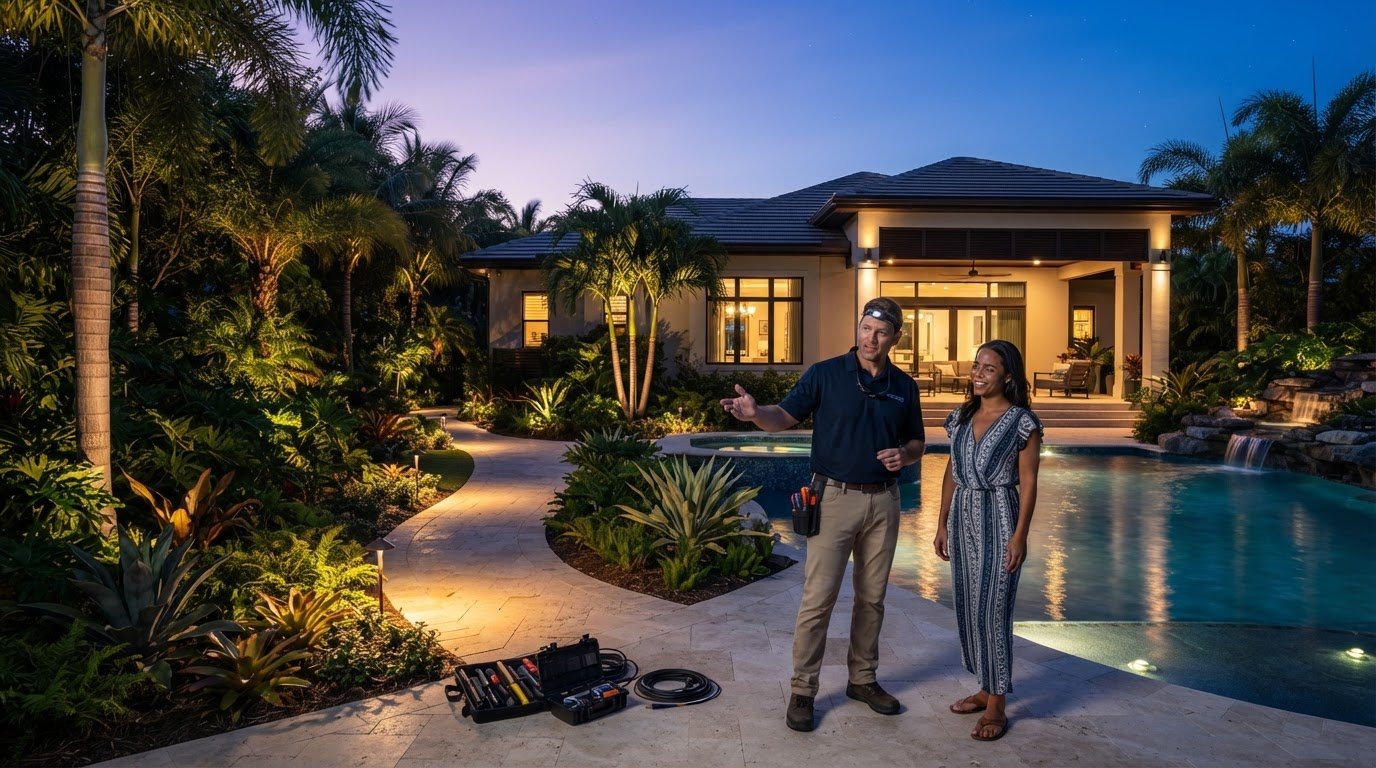
There isn’t one perfect month for Florida homeowners to install outdoor lighting. The best time of year to install outdoor lighting Florida homeowners should choose depends on more than the calendar: rain and humidity can affect site access, while storm-season forecasts can complicate scheduling. Planning around the property’s condition and other outdoor work can help prevent installation from clashing with wet ground, new planting, or unfinished projects.
Weather is worth considering, but you don’t need to rule out an entire season. The right window depends on your property, the scope of the lighting plan, and what else is happening outdoors. This guide explains how seasonal conditions can shape installation, when drier periods may be convenient, and how to coordinate lighting with landscaping and other improvements. It also covers practical questions to discuss with a local lighting professional before choosing a schedule.
Key Takeaways
- The best time of year to install outdoor lighting Florida homeowners choose depends on weather, site access, and whether the property is ready for work.
- Compare seasonal advantages and constraints, then use the forecast and your project schedule to guide timing instead of relying on a fixed month.
- Coordinate the installation sequence with the lighting plan, whether you’re illuminating a garden, walkway, architecture, pool deck, or fountain.
- Before scheduling, identify focal areas, circulation routes, existing features, and any landscaping or outdoor work that could affect access.
- A local design and engineering team can assess property conditions and help plan an installation sequence tailored to the site.
Best time of year to install outdoor lighting in Florida: what homeowners should know
There isn’t one ideal month for every Florida property. The best time of year to install outdoor lighting Florida homeowners can choose is the period when weather, site access, and project readiness align. Installation may be possible year-round, but heavy rain, saturated ground, active landscaping work, or other construction can affect when it makes sense to proceed.
Plan outdoor lighting when the site is ready, the work areas are accessible, and the timing fits the rest of your outdoor projects. A useful lighting plan considers more than fixtures and wiring. It accounts for how people move through the property and how light can bring gardens, architecture, and outdoor features into view. For a broad introduction to the discipline, Landscape lighting offers background on its components and design principles.
Is Florida’s dry season the most practical installation window?
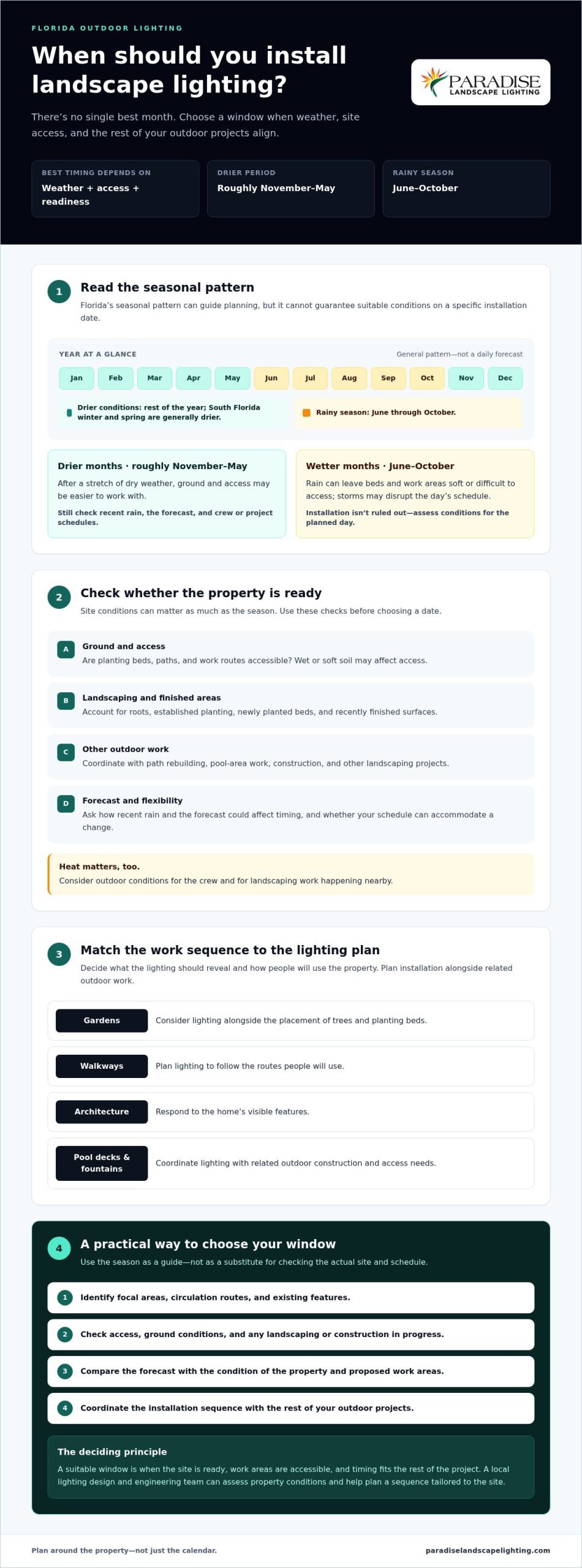
Homeowners may find it easier to plan during comparatively drier periods because rain can make outdoor work less convenient. In South Florida, winter and spring are generally drier than the wetter summer months. That pattern can help with planning, but it doesn’t guarantee suitable conditions on a particular installation date.
Think of drier weather as a possible scheduling advantage, not a technical requirement or a promise of uninterrupted work. The installer still needs to assess the conditions at your property. Ask how recent rain, the forecast, and access to the work areas could affect your proposed timing. If your schedule can accommodate a change, it may be easier to avoid proceeding when the site isn’t ready.
Why does the right timing depend on the property?
Site conditions can matter as much as the season. Wet or soft soil may affect access to planting beds and walkways, while established landscaping may call for careful planning around roots and finished areas. If you’re adding plants, rebuilding a path, or completing pool-area work, coordinate the lighting sequence with those projects. This helps avoid working over newly finished surfaces or disturbing recently completed planting.
The lighting plan also affects the order of work. Garden lighting should be considered alongside the placement of trees and beds. Walkway lighting needs to follow the route people will use, while architectural lighting should respond to the home’s visible features. Pool deck and fountain lighting also need to be considered with any related outdoor construction.
South Florida properties have different access and coordination needs. A compact urban lot, a coastal landscape, and a larger property with extensive planting may each present different site conditions. A lighting designer and engineer can assess the property and help determine a practical sequence. Before choosing a date, consider what work is happening outdoors, which areas need access, and whether the landscape is ready.
Florida seasons and outdoor lighting installation: rain, heat, and storm planning
Florida’s seasons can help guide your plans, but they can’t guarantee a clear workday. The University of Florida describes a rainy season from June through October, with drier conditions during the rest of the year. Its overview of Florida’s rainy and dry seasons provides general background. For a specific date, your local forecast and the condition of your property matter more.
Rain can leave planting beds and other work areas soft or difficult to access, and storms may disrupt the day’s schedule. That doesn’t make installation during wetter months impossible. Ask how the installer handles changing forecasts and whether the work areas are suitable on the planned day. Heat can also make outdoor work less comfortable, so consider conditions for the crew and any landscaping work happening nearby.
| Season | Potential advantage | Possible constraint | Homeowner planning action |
|---|---|---|---|
| Drier months, roughly November through May | Ground and access may be easier to work with after a stretch of dry weather. | Rain can still occur, and project or crew schedules may affect the start date. | Check the forecast and the condition of planting beds, paths, and access routes. |
| Wetter months, June through October | A suitable window may still be available between rain events. | Heavy rain can affect access, ground conditions, and the day’s work plan. | Keep scheduling flexible and coordinate with the installer if the forecast changes. |
| Atlantic hurricane season, June through November | Installation can be considered if site conditions and the schedule allow. | Storm forecasts may disrupt plans, especially as a system approaches. | Follow official forecasts and agree in advance how weather-related rescheduling will be handled. |
Plan around rain and storm forecasts
The National Hurricane Center identifies the Atlantic hurricane season as June 1 through November 30. Those dates describe the season, not a prediction that a storm will affect your project. If a tropical system or heavy rain is forecast, contact the installer to review the timing rather than assuming work can or can’t proceed. Flexible scheduling is particularly helpful when the plan covers several areas of the property.
Use drier periods as an opportunity, not a promise
Drier months may make access and coordination more convenient, but you still need to check current conditions. A walkway project and a design that includes gardens, architectural features, and a pool area can have different planning needs. Discuss the project scope, site readiness, and schedule with a local professional. For South Florida properties, custom landscape lighting design can be planned around the site’s conditions.
Choosing the best Florida installation season for your landscape lighting project
The best time of year to install outdoor lighting Florida homeowners should consider depends in part on what the design needs to illuminate. A walkway project may need access to a narrow route, while a plan covering gardens, architecture, and water features may require coordination across several outdoor projects. Choose a window that suits the work area and the property’s readiness, rather than choosing by season alone.
Project type affects preparation and sequencing:
- Garden lighting: Share planting plans and identify established trees or beds so fixture placement can be considered alongside the landscape.
- Walkway lighting: Coordinate with path construction or repairs, and confirm the route will be accessible for installation.
- Architectural lighting: Discuss which exterior features should stand out and whether other facade work is planned.
- Pool and fountain lighting: Include water features in the overall plan and coordinate with any related construction. For more detail, see the pool-and-fountain lighting guide.
Coordinate lighting with landscaping or renovation work
Discuss lighting before major planting or hardscape work is finalized. Early planning gives the design team a chance to consider fixture locations, sightlines, and how the property should look after dark. It also helps everyone coordinate the sequence of work. This doesn’t mean planted areas will never need attention later, but it can help you make informed decisions before the landscape is complete.
Drainage and access matter, too. Tell the installer about areas that collect water, surfaces being rebuilt, and routes that may be blocked during construction. If several contractors are involved, or you are coordinating with a custom home builder like Maverick Design and Construction, clarify who is working where and when. That information helps the lighting professional assess the site and plan around its conditions.
Let project scope guide the schedule
A short walkway installation may be simpler to coordinate than a plan covering several areas, but neither has a universal season. A broader design involving gardens, a facade, a pool deck, and a fountain may require access to more parts of the property and coordination with landscaping or renovation schedules. Share the full scope, current site conditions, and the effects you want so the schedule reflects the work involved.
For hurricane-season planning, UF/IFAS provides general advice on preparing your home’s electrical system for hurricane season. Discuss questions about your home’s electrical readiness with an appropriate professional. A lighting designer and lighting engineer can also consider the property’s conditions when developing a custom low-voltage plan and installation sequence.
How to prepare a Florida property before outdoor lighting installation
A little preparation helps a lighting professional understand your goals and assess whether the property is ready for work. Before requesting an installation date, gather details about what you want illuminated, what else is happening outdoors, and any conditions that could affect access. This makes it easier to discuss the best time of year to install outdoor lighting Florida homes can accommodate based on their individual site and project needs.
Use this checklist before scheduling
- Identify focal areas. Note the trees, garden beds, architectural details, artwork, pool deck, or fountain you’d like to highlight. Photos taken at different times of day can show how the property is used and where light may have the greatest visual impact.
- Mark circulation routes. Identify walkways, steps, gates, and other routes people use after dark. Include areas where you’d like lighting to guide movement through the property.
- Record existing features. Make a note of outdoor fixtures and features that should remain visible or be incorporated into the design. Share access limitations, such as narrow side yards or areas temporarily blocked by equipment.
- Flag site conditions. Tell the professional about wet or soft ground, drainage concerns, and areas where rain could make access difficult. These details help with site assessment, but they don’t replace the installer’s evaluation.
- List active outdoor work. Share plans for planting, walkway or deck construction, pool-area work, and other projects. Confirm which contractor will be working in each area and when, so the lighting sequence can be discussed before schedules are set.
- Clarify priorities and questions. Decide which areas matter most if the work needs to be phased. Ask how design and engineering will account for the property, what installation sequence is proposed, and what maintenance the system may need over time.
For South Florida homeowners, scheduling is easier when you share both your preferred timing and how flexible you can be. Ask the lighting professional how weather-related changes would be handled, especially if installation depends on dry ground or another contractor finishing first. A clear conversation helps align expectations without assuming that every project will follow the same schedule.
Once you’ve organized your priorities and site notes, discuss them with a local team that designs and installs custom low-voltage LED lighting for residential outdoor spaces. Discuss your outdoor lighting project with Paradise Landscape Lighting to explore how design, engineering, installation, and maintenance can be considered together.
Plan outdoor lighting installation in Florida with a local design and engineering team
Seasonal guidance can narrow your options, but a property-specific plan turns a possible installation window into a practical schedule. A local professional can consider site access, the existing landscape, and outdoor project plans before recommending an installation sequence. This is especially useful when the design needs to cover several areas rather than a single path or feature.
What can a professional lighting assessment help clarify?
A lighting designer and lighting engineer can help translate your priorities into a custom plan for the property. You might want a garden to feel more dimensional, a walkway to be easier to follow after dark, or architectural details to stand out. If the plan includes a pool deck or fountain, those features can be considered alongside the rest of the landscape.
Discuss what’s already in place and what may change. New planting, drainage concerns, renovations, or limited access can all inform the design and order of work. Paradise Landscape Lighting designs, engineers, and installs custom low-voltage LED lighting for residential outdoor spaces in South Florida, and also provides maintenance. The team serves Fort Lauderdale, Weston, Southwest Ranches, Wilton Manors, Palm Beach, Miami, Miami Beach, Coral Gables, Plantation, West Palm Beach, Coconut Grove, and surrounding areas. Homeowners planning a project in the area can also explore the bespoke Fort Lauderdale outdoor lighting design guide.
What should you ask before confirming your project schedule?
Before settling on dates, make sure the schedule reflects the scope and condition of the property. Ask how weather or restricted access could affect the proposed sequence, and explain any landscaping, pool, walkway, or construction work planned nearby. Confirm which areas are included, how installation is expected to progress, and what maintenance support is available after installation.
There’s no need to choose a date simply because a particular season is often considered convenient. The best time of year to install outdoor lighting Florida properties can accommodate depends on the design, current site conditions, and coordination with other work. Share your priorities and questions with a local lighting professional, then discuss a schedule that fits your property rather than assuming every project follows the same timeline.
If you’re ready to explore a property-specific plan, contact Paradise Landscape Lighting to discuss landscape lighting design and LED installation for your outdoor space. A conversation about your goals, site conditions, and preferred timing can help clarify the next steps before you settle on a date.
Choose a season that fits your property and plans
The best time of year to install outdoor lighting Florida homeowners can choose isn’t simply the driest month. It’s a practical window that matches current weather, site access, project scope, and the timing of landscaping or other outdoor work. A focused walkway project may have different needs from a custom plan for gardens, architecture, a pool deck, or a fountain.
Before settling on a date, identify the areas you want to illuminate and share any drainage concerns, active construction, or planting plans with your lighting professional. A property-specific assessment can help clarify the design and installation sequence. Paradise Landscape Lighting provides custom residential low-voltage LED design and installation, with a lighting designer and lighting engineer supporting projects across South Florida communities.
If you’re ready to explore your options, discuss a custom outdoor lighting plan for your property. A conversation about your goals and site conditions is a practical first step toward a schedule that suits your home.
Frequently Asked Questions
What is the best time of year to install outdoor lighting in Florida?
Comparatively drier months may be easier for scheduling, but there’s no single ideal month for every property. The best time of year to install outdoor lighting Florida homeowners can choose depends on recent weather, site access, landscaping plans, and project scope. Check local conditions and discuss timing with your installer. Seasonal patterns can guide planning, but they don’t guarantee suitable weather or ground conditions on a specific date.
Can outdoor lighting be installed during Florida’s rainy season?
Yes, installation may be possible during the rainy season, depending on the property and work planned. Heavy rain or saturated ground can affect access, working conditions, and the day’s schedule, but that doesn’t mean every project must be postponed. Ask the installer how forecast changes are handled and whether the work areas are suitable. A soft planting bed, for example, may present different access concerns from a paved walkway.
Does hurricane season affect outdoor lighting installation in Florida?
It can affect scheduling if storm forecasts or site conditions make outdoor work impractical, but hurricane season doesn’t automatically rule out installation. The Atlantic hurricane season officially runs from June 1 through November 30, according to the National Hurricane Center. Build flexibility into the schedule, confirm weather-related plans with your installer, and follow official local guidance when a storm threatens. The season’s dates are not a prediction for your specific project.
Is winter a good time to install landscape lighting in South Florida?
Winter can be a convenient planning window for some South Florida homeowners, particularly when access is clear and other outdoor work is coordinated. It doesn’t guarantee ideal weather or an available installation date. Conditions can vary between Fort Lauderdale, Miami, and nearby communities, and project scope and crew schedules also matter. Discuss your property’s current condition and preferred timing with a local professional before confirming a start date.
Should outdoor lighting be installed before or after landscaping?
Discuss lighting before landscaping or hardscape work is complete whenever possible. Sharing planting plans, walkway layouts, and focal features early can help the lighting professional consider fixture placement and project sequence. The right order depends on the site and the work involved, so coordinate schedules with your landscaper and other contractors. Clarify where crews need access and how later planting or construction could affect the completed lighting system.
How far in advance should I schedule outdoor lighting installation in Florida?
There’s no universal lead time. Timing depends on project scope, site readiness, and the installer’s schedule. Contact a local professional once you know which areas you want to illuminate and what other outdoor work is planned. Paradise Landscape Lighting serves communities including Fort Lauderdale, Weston, Southwest Ranches, Wilton Manors, Palm Beach, Miami, Miami Beach, Coral Gables, Plantation, West Palm Beach, and Coconut Grove. Ask about assessment, scheduling flexibility, and weather adjustments.
Return to News